

A structured shipping strategy for ecommerce operations helps you control delivery costs, improve fulfillment performance, and adapt as your network changes.
Key highlights:
- An ecommerce shipping strategy is a documented plan that links your fulfillment model, carrier mix, pricing approach, and delivery promises to your cost and customer-experience goals.
- Free shipping thresholds, flat rates, and real-time carrier rates shape margins and conversion.
- Multi-carrier shipping, zone skipping, and negotiated rates reduce dependency on any single provider and protect you during peak periods.
- Shipium gives operators a single platform to run rate shopping, delivery promises, and post-purchase tracking using real network data rather than static rules.
In this article, we’ll break down seven steps for designing an ecommerce shipping strategy that controls cost, sharpens delivery performance, and earns the next order from your customer.
1. Define your ecommerce shipping goals
Clear goals help you measure performance, identify inefficiencies, and determine whether your strategy is improving over time. Most ecommerce shipping teams balance these three main priorities:
- Reduced cost per order: Lower blended shipping spend across zones, package types, and modes.
- Faster delivery times: One- or two-day transit windows in your top metros without burning margin.
- Better customer experience: Accurate promises, real-time tracking, and recoverable returns.
Create goals you can measure. For example, you might want to reduce the average shipping cost per parcel by 12% next quarter or improve on-time delivery rates from 91% to 96%.
2. Analyze your product type and shipping requirements
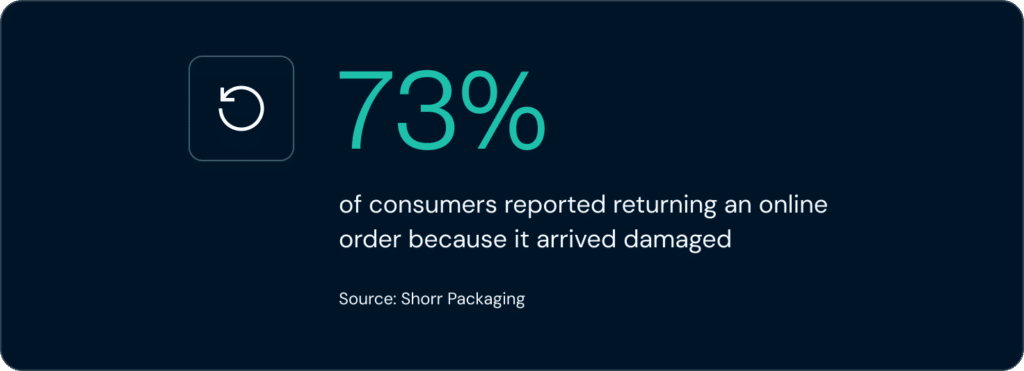
The fragility, dimensions, weight, and returnability of your products dictate your choice of carrier and packaging. In a Shorr survey, 73% of consumers reported returning an online order because it arrived damaged. High volumes of returns not only affect your profits but also tie up warehouse resources.
When developing your approach to cartonization, consider these dimensions:
- Product size and dimensional weight: Packaging optimization flags box sizes that pull orders into a higher rate band and surfaces consolidation opportunities.
- Fragile or high-value products: Protective packaging, signature requirements, and shipping insurance reduce damage and loss for breakable or perishable items.
- Packaging requirements: Standard shipping box sizes simplify warehouse operations and create more consistent costs.
- Return and exchange flow: Plan labels, restocking processes, and reusable packaging in advance to manage return expenses.
3. Choose the right ecommerce fulfillment model
Fulfillment decisions affect nearly every part of the shipping process, including delivery speed, operational costs, inventory placement, and customer experience. The right model depends on how much control, flexibility, and operational support your business needs.
In-house fulfillment
An in-house fulfillment solution gives your ecommerce business greater control over inventory management, packaging quality, and the overall customer experience. The trade-off is higher operational overhead, including warehouse space, labor, and warehouse management software.
In-house operations make sense if your brand has consistent volume, custom packaging, or specialized fulfillment needs.
Third-party logistics (3PL)
Third-party logistics providers manage all aspects of warehousing, picking, packing, and carrier coordination on your behalf. This approach lets you expand your fulfillment capacity without opening additional space or building a larger internal logistics team.
Before selecting a provider, you need to compare transit coverage, technology capabilities, pricing structures, and service reliability across different regions.
Distributed fulfillment networks
Distributed fulfillment networks place inventory in multiple warehouse locations across different regions. Inventory placed closer to your customers reduces transit times and lowers shipping costs. Managing inventory across several facilities tightens demands on forecasting, replenishment, and order management.
Dropshipping
The dropship model shifts inventory risk to the supplier and allows you to list SKUs you would not stock yourself. The model fragments the customer experience across vendors with different ship cutoffs, package quality, and tracking standards. Vendor visibility is the hard part that most dropship brands fail to crack at scale.
Learn how to take control of your dropshipping operations with Shipium.
4. Build a carrier strategy around speed, cost, and coverage
Shipping carriers vary in cost, coverage areas, transit speeds, and service reliability. As a result, many ecommerce businesses work with a mix of national and regional carriers without relying too heavily on a single provider.
A diversified carrier strategy should include:
- National and regional carriers: Use a mix of FedEx, UPS, USPS, and regional carriers to compare rates, expand delivery coverage, and avoid overreliance on a single provider.
- Multi-carrier shipping: Compare carrier rates in real time and avoid assigning every order to the same shipping provider. Fixed carrier rules become outdated as rates, surcharges, and delivery performance change over time.
- Shipping zones and transit times: Consolidate your shipments closer to their final destination before handing them off to regional carriers for delivery. Zone skipping reduces shipping costs on long-distance orders without increasing transit times.
- Peak-season capacity planning: Secure carrier capacity before your peak shipping season begins. Waiting too long to negotiate rates or availability limits your shipping options.
- Negotiated carrier rates: Review your shipping volume, surcharge data, and carrier performance before renewing your shipping agreements. Comparing rates across multiple providers helps strengthen pricing and identify unnecessary shipping costs.
With Shipium, you get a pre-integrated carrier network that lets you access national and regional carriers without custom integrations. This setup runs rate shopping, transit-time optimization across zones, and peak-season capacity management in one place.
5. Decide how you’ll price shipping for customers
Shipping costs are the last thing customers see before placing an order, making pricing decisions important. Some ecommerce businesses absorb part of the cost to stay competitive, while others pass more of it on to customers through flat-rate or real-time pricing models.
Free shipping thresholds
A Ryder study found that 76% of consumers say free shipping influences their purchase decisions year-round. Free shipping thresholds are one of the most common ways ecommerce businesses encourage larger orders.
Many brands set minimum order thresholds slightly above their average order value to push customers to add more items before checking out.
Flat-rate shipping
Flat-rate shipping gives customers a predictable cost at checkout, regardless of where the order is going. This approach often works well for ecommerce businesses with similar product sizes, weights, and shipping distances. Costs become harder to manage, though, when heavier packages or long-distance shipments start to exceed the flat fee charged.
Real-time carrier rates
Calculate real-time carrier rates based on your customer’s address, package dimensions, and shipping speed. This pricing approach is common among operators who ship larger, heavier, or oversized products, such as furniture, equipment, or electronics.
The downside is that shipping costs climb quickly on larger or long-distance orders, which pushes some customers to abandon their carts at checkout.
Hybrid shipping pricing models
Some ecommerce businesses combine multiple shipping approaches at checkout. For example, offering free shipping above a minimum order value, flat-rate shipping for standard orders, and faster delivery options for customers willing to pay for expedited service.
6. Optimize delivery promises and the post-purchase experience
Customers pay attention to how clearly you communicate order details and assess whether delivery expectations match reality. Strong post-purchase operations should include:
Accurate delivery estimates
Generic delivery estimates create uncertainty at checkout, leading to more abandoned carts. Clear expectations build trust before customers place an order.
With a solution like Shipium, you offer delivery promises modeled with machine learning that reflect inventory levels, carrier performance, pickup times, and network-specific rules. Customers who set specific pre-purchase delivery estimates with Shipium see an average conversion lift of up to 4% over those using vague timeframes.

Learn how to calculate and optimize your estimated delivery dates.
Real-time order tracking
Real-time tracking has shifted from a nice-to-have to a buying factor. A UPS whitepaper found that 65% of shoppers cited the ability to track packages as a perk that makes them more likely to purchase. Surface tracking links in confirmation emails, account pages, and text alerts so the customer doesn’t have to ask.
Proactive customer notifications
Your customers don’t want to search for shipping updates after placing an order. Notifications about delivery delays, weather disruptions, and out-for-delivery updates reduce support requests and help maintain trust after checkout.
Delivery transparency at checkout
Show estimated delivery dates and shipping costs before customers reach checkout. Unexpected fees are one of the most common reasons shoppers abandon their carts, especially when delivery costs appear late in the buying process.
Returns and delivery exception management
Returns and lost packages frustrate customers, especially when the process is slow or difficult to navigate. Make returned products easy to track and manage by providing clear instructions, shipping labels, and consistent communication throughout the process.
Explore the best practices for ecommerce returns management.
7. Measure shipping performance and continuously optimize
Ecommerce shipping strategies aren’t a set-it-and-forget-it exercise, especially as carrier rates, fulfillment conditions, and customer expectations continue to change. Set up shipping analytics that pull carrier invoices, WMS data, and order data into a single view so your team works with real numbers when making operational decisions.
Here are key metrics to track:
| Shipping metrics | What to measure |
|---|---|
| Shipping cost per order | Track shipping costs across SKUs, zones, and carriers to identify dimensional-weight charges, accessorial fees, and other unnecessary surcharges |
| Carrier performance metrics | Review carriers based on on-time delivery rates, damage claims, invoice accuracy, and claim resolution performance. |
| Delivery performance and on-time rates | Compare promised delivery windows with actual transit times to identify service gaps affecting customer satisfaction. |
| Cart abandonment and conversion impact | Monitor how shipping costs and delivery estimates affect checkout behavior and overall conversion rates. |
| Return and refund trends | Analyze returns by SKU, carrier, and return reason to identify issues tied to packaging, fulfillment, or product expectations. |
Explore how Shipium powers data-driven savings at scale.
Power shipping strategies for ecommerce with Shipium
An effective ecommerce shipping strategy requires ongoing adjustments as carrier rates, delivery performance, and fulfillment conditions change throughout the year. Shipium Console gives operators a centralized place to manage operations and respond to those changes without rebuilding workflows every quarter.
With Shipium, you can:
- Shop carrier shipping rates in real time across your fulfillment network
- Configure delivery promises and shipping rules from one interface
- Track shipments and monitor carrier performance
- Analyze shipping costs, transit times, and fulfillment trends
- Adjust routing and carrier selection without extensive IT support

Book a demo today and explore how Shipium powers better shipping strategies for ecommerce brands.
Enhance your shipping strategy with Shipium
-
 Read more
Everything You Need to Know About Third Party Logistics Companies
Whether you’re a high-volume shipper looking to better manage fulfillment in specific geographic locations…
-
 Read more
How Last Mile Delivery Impacts Your Shipping Cost
When studying ecommerce leaders like Amazon, it becomes clear that focusing on the customer…
-
Read more
How to Future-Proof Your 3PL Ecommerce Fulfillment Strategy
The role of third-party logistics (3PL) ecommerce fulfillment has changed. What was once a…