
Every week you approve a carrier invoice that no one has checked line by line. Somewhere in the thousands of charges sits a residential surcharge on a commercial address, a dimensional weight that does not match what your system declared, and a tracking number invoiced twice.
For transportation and finance leaders at high-volume shipping companies and 3PLs, the gap between billed charges and verified costs is where margin leaks. With parcel invoice auditing, you match every billed amount against your contracted rates, your accessorial terms, and the shipment data you already hold. This way, you catch errors before the payment run clears.
Key highlights:
- Parcel invoice auditing verifies each carrier billing line against your contract, discounts, surcharge tables, and service commitments, then flags anything that does not match before you pay.
- Auditing your parcel invoices keeps billed amounts aligned to contracted costs, so overcharges, duplicate billing, and misapplied accessorials get corrected before the carrier’s refund deadline.
- Shipium’s Always-On Audit validates each shipment at rating, labeling, execution, invoicing, and billing, so 99%+ of invoice lines auto-approve.

What is parcel invoice auditing?
Parcel invoice auditing is the process of verifying each line on a carrier bill against the rates, discounts, surcharges, and service commitments the company agreed to, then disputing anything that does not match.
A single invoice for a shipping company can carry thousands of line items, and each one is governed by a mix of the carrier’s published tariff, their own accessorial logic, and your negotiated rate addendum.
With parcel audit software, you check:
- Base charge: Whether the billed amount reflects your contracted discounts and the correct zone table.
- Accessorial charges: Which additional fees the carrier applied to the shipment.
- Surcharges: Whether billed surcharges match the applicable published rates.
- Service commitments: Whether the carrier delivered according to the promised service level.
- Duplicate billing: Whether the same shipment appears on the invoice more than once.
Undetected errors compound across billing periods, so the impact of parcel invoice auditing grows with volume. The U.S. Census Bureau reported retail ecommerce sales of $340.2 billion in the second quarter of 2026, 17.1% of all retail sales and 12.2% higher than a year earlier. More parcels moving through carrier networks means more invoice lines where errors can go unnoticed.
How does parcel invoice auditing improve carrier invoice accuracy?
Parcel invoice auditing improves carrier invoice accuracy because the disputed charges you win get fed back into your rate table, so the same misapplied surcharge or missed discount doesn’t recur on the next shipment. That enhanced accuracy shows up in:
- Finance reports: A cost-per-package figure built from verified charges makes accruals defensible and gives finance a reliable number to plan against, supporting accurate carrier spend visibility across the network.
- 3PL billing: Client invoices draw on confirmed shipment data, not unaudited carrier charges, which stops billing errors from reaching clients.
What are the best ways to audit shipping invoices for errors?
The best way to audit shipping invoices for errors is to automate the checking process: validate every shipment against every rule the moment it happens. Automation catches what periodic, manual review misses, one line at a time, across the entire invoice.
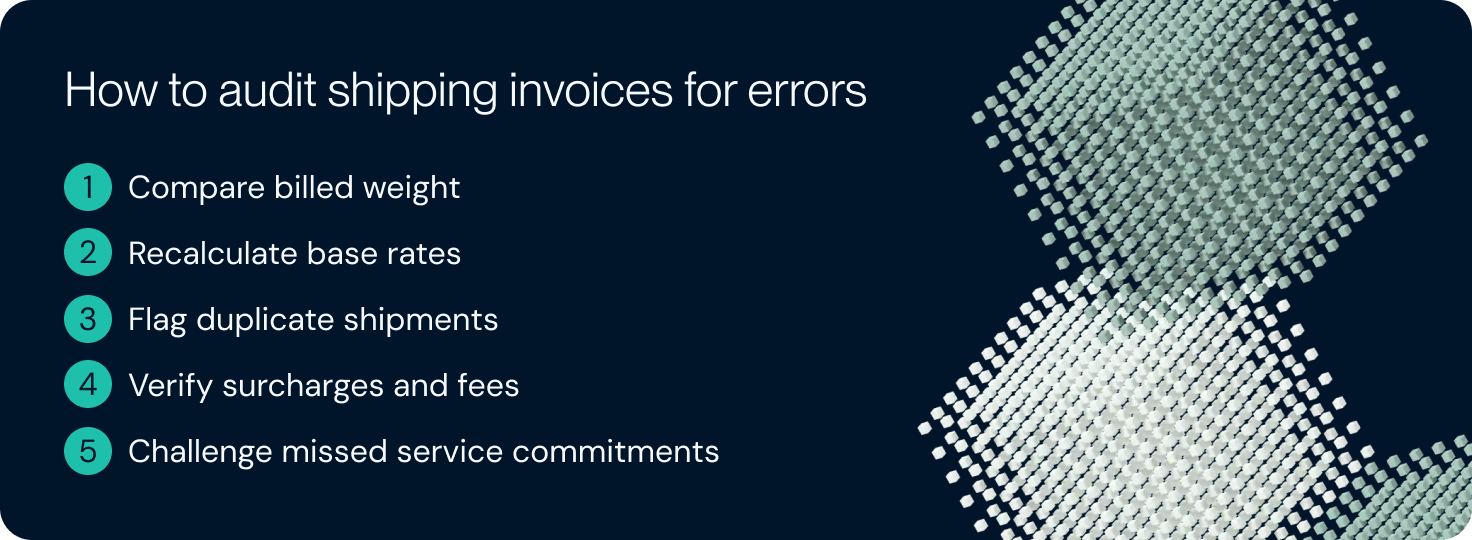
Here’s a breakdown of automated checkpoints to identify invoicing errors:
1. Matching billed weight to declared dimensions
Carriers bill on dimensional weight, and a fraction of an inch can push a package into a higher rate bracket. Matching the dimensions captured at pack time against every billed weight catches a rounded-up measurement before it becomes a pattern.
2. Recalculating base rates against contracted terms
A missed discount or a wrong zone still produces a base charge that looks legitimate at a glance, which is exactly why it survives a quick read-through. Recalculating each billed rate against the discount tier, zone, and minimum-charge terms in your parcel contract negotiation exposes whatever wasn’t actually applied.
3. Flagging duplicate and rebilled shipments
A shipment billed twice, or a canceled order invoiced anyway, is the cleanest error to recover, provided someone actually catches it. Sorting every billing period by tracking number surfaces any that appear more than once, along with anything marked canceled that still carries a charge.
4. Verifying surcharges and fees against shipment data
Address-correction fees, residential surcharges, fuel and delivery-area surcharges, and handling charges each run on their own published schedule, and each is a common source of misapplied charges. Checking each surcharge and fee against the shipment’s actual classification and ship date catches charges that were applied but never earned.
5. Challenging missed service commitments inside the filing window
Comparing delivery scans against the committed service level for every shipment, then filing the claim the moment a commitment slips, keeps a refund from expiring before anyone notices it was owed.
What limits manual parcel invoice auditing at scale?
Manual parcel invoice auditing falls behind because a person reviewing invoices in a spreadsheet samples only a fraction of the lines, and the refund windows close before anyone reaches the rest. A monthly review might catch the obvious duplicate or the surcharge that looks too high, but it never touches the thousands of shipments that carry a small, defensible-looking error.
Manual invoice auditing has a structural limit: discounts and accessorial terms shift at every rate change, and the carriers change them often. The rules a reviewer is checking against move faster than the reviewer can re-learn them.
| Invoice check approach | When errors surface | Charge types covered | Time to a credit |
|---|---|---|---|
| Manual parcel bill auditing | Weeks after the invoice arrives, on a sampled subset | Duplicates and obvious overcharges; accessorial creep usually missed | Often past the carrier’s filing window, so the credit is lost |
| Automated parcel invoice audit | In real time, as each invoice line lands | Base rate, accessorials, surcharges, service failures, and duplicates on every shipment | Inside the filing window, with disputes pre-filed automatically |
Run continuous parcel invoice auditing with Shipium
Shipium treats parcel invoice auditing as continuous validation, not a post-invoice review, and we call that model Always-On Audit.
You have financial control by creating and applying customer-specific sell rates, attributing every invoice to the right customer account, and resolving discrepancies in the same system that made the original shipping decision.
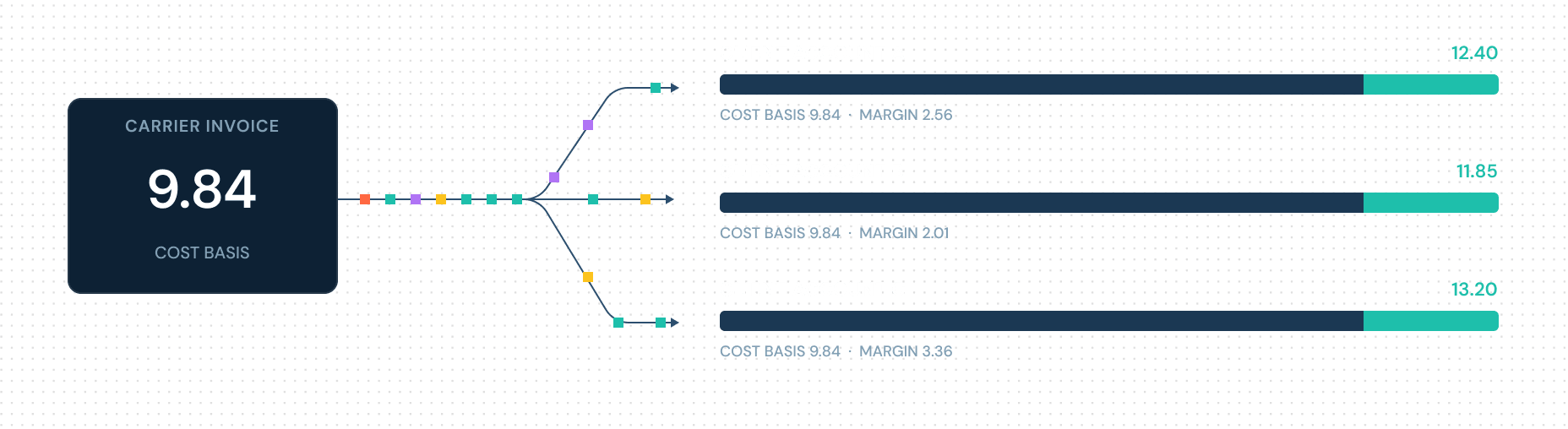
Here is what continuous parcel invoice auditing looks like in practice with Shipium:
- Invoices arrive, and our platform standardizes them into a single feed, validating each line against your pre-shipment data. Tracking-number-level visibility is what automated billing management runs on: every overcharge traces to one specific shipment.
- A single shipment ID joins rate, label, scan, and invoice records, so every charge traces back to one verified source, routed through a pre-integrated network built to cover the carriers your shipments actually move through.
- For 3PLs, client billing ties to the executed shipment: every billable event maps to an actual shipment and an actual contract, closing the gap where untracked surcharges usually erode margin.
Under Shipium’s model, 99%+ of invoice lines auto-approve without human review, and the disputes that remain feed the rating engine and contract model so the same error does not happen twice.

Book a demo to see how our Always-On Audit solution validates every charge before parcel invoices reach your payment run.
Frequently asked questions
How often should parcel invoices be audited?
Parcel invoices should be audited continuously, as each invoice line arrives. Carrier refund deadlines are tight, and delays can cause some disputes to expire before they are reviewed. Continuous validation catches errors while the credit is still recoverable and keeps your cost-per-package figure current between rate changes.
How much do shippers recover from a parcel invoice audit?
Recovery varies by carrier mix, invoice complexity, and how much of each invoice gets reviewed. What matters more than a single percentage is how much of the invoice gets checked and how fast a dispute moves: under Always-On Audit, 99%+ of invoice lines auto-approve without human review, and the exceptions that remain are resolved in days, inside the carrier’s filing window.
How is continuous auditing different from traditional audit and payment services?
Traditional audit and payment services review invoices after they arrive, working from the same invoice data the carrier already billed. Findings land after the payment cycle has moved on.
Continuous auditing of parcel invoices checks the shipment data as it’s created, so a verified figure already exists by the time the invoice arrives. A mismatch surfaces immediately, before payment comes due. That difference in timing is why continuous validation recovers more of what’s owed and reaches a credit far faster.
Can parcel invoice auditing be automated?
Yes, parcel invoice auditing can be automated, because the core checks (weight, base rate, surcharges, service commitments, duplicates) are rules-based and apply the same way to every shipment.
What doesn’t automate cleanly is the exception queue: an ambiguous accessorial, a contract clause open to interpretation, or a dispute a carrier pushes back on. Shipium’s Always-On Audit is built on that distinction: the rules-based majority auto-approves on its own, and only the disputed minority reaches a person.
-
 Read more
How Invoice Automation for Logistics Solves Billing Delays
A customer bill cannot be finalized until the actual shipment cost is confirmed, and…
-
Read more
9 Steps for Parcel Contract Negotiation in 2026
Every year, your carriers announce a rate increase, and your parcel spend climbs while…
-
 Read more
3PL Billing Management: Best Practices and Guide
Billing mistakes are a common and costly problem in third-party logistics (3PL). Manual processes,…
-
Read more
7 Key Steps to Efficient Parcel Spend Management
Ecommerce parcel cost represents a large portion of the expenses that chip away at…