
Carrier invoices land days after a shipment moves, and finance teams often approve them before anyone checks the line items against the carrier’s quoted rate. Logistics billing software validates each carrier charge against the shipment record and turns approved charges into a customer invoice.
We’ve compared nine platforms that help you automate the logistics billing process. Start with this quick-reference table of standout options, then read the full breakdown divided into three main use cases.
| Billing software for logistics companies | Best use case | Key features | Review score* |
|---|---|---|---|
| Shipium | Enterprise shippers and 3PLs tying billing to execution |
|
4.9 |
| OpenEnvoy | AP-embedded freight audit |
|
4.6 |
| Rose Rocket | Modern mid-market carriers and brokers |
|
4.8 |
*This ranking reflects data as of September 2026. G2 and Gartner Peer Insights scores fluctuate with real-time user feedback.

What is logistics billing software?
Logistics billing software is a solution that validates carrier invoices against shipment records, applies sell pricing, and generates customer bills. It differs from a general accounting platform because it reads accessorials, zone- and weight-based rate sheets, and provider-specific fee logic tied to a specific order.
A modern billing platform for logistics connects to the tools that executed the delivery, so a fee mismatch or a duplicate surcharge surfaces before the invoice reaches a customer.
This guide compares nine platforms divided into three buyer contexts:
- Enterprise shipping companies, 3PLs, and forwarders
- Freight audit and payment specialists
- Carriers and brokers running a TMS or dispatch platform
Best billing software for enterprise shipping companies, 3PLs, and forwarders
1. Shipium
Shipium Billing Management helps logistics enterprises improve accuracy, analyze their primary cost drivers, and deploy strategies to reduce them. It also helps shippers bill faster and more accurately, automating billing and invoice management by ingesting carrier invoices, analyzing costs, setting custom rates, and managing rate data in one place.
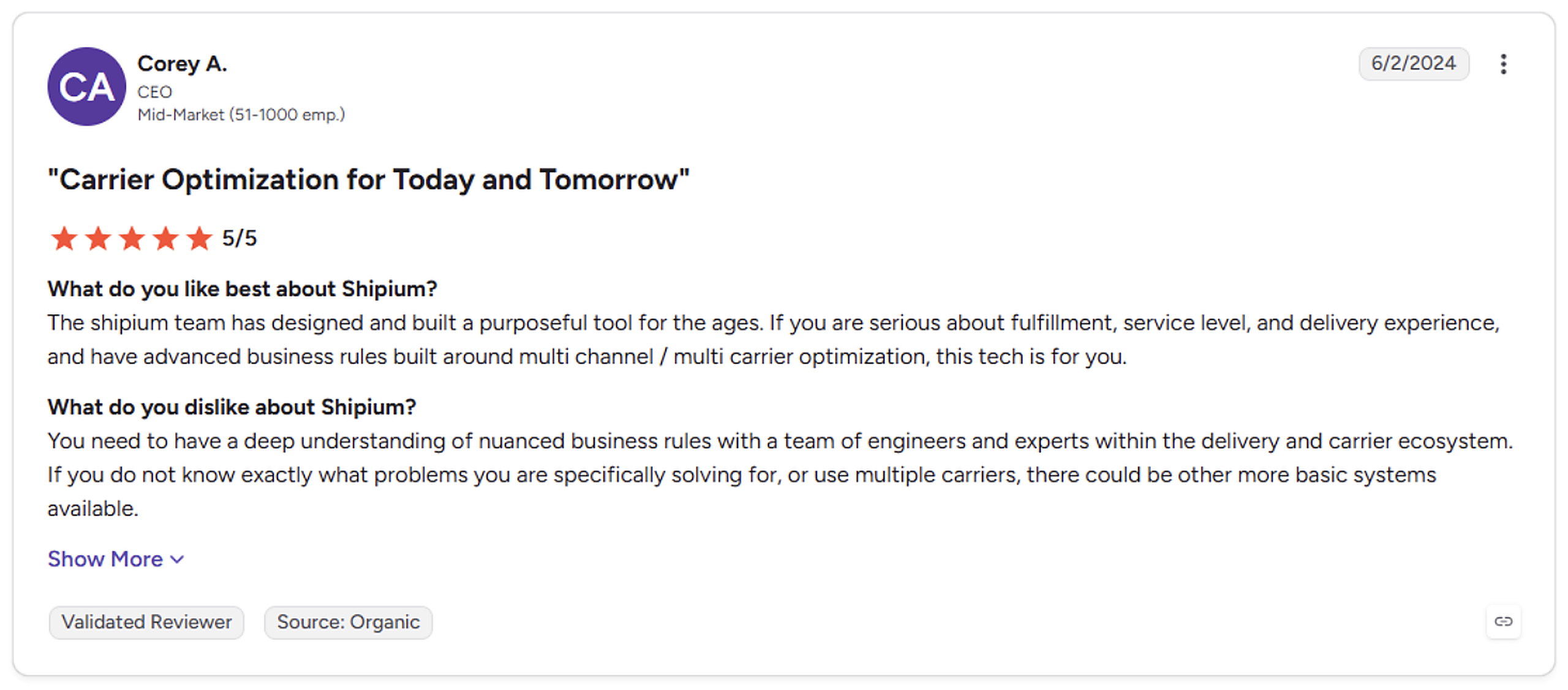
Shipium built its billing accuracy on top of the same rating and carrier-selection engine that runs its shipping network, so invoice validation draws on live carrier and transit data rather than a disconnected reconciliation layer someone adds later.
The Always-On Audit standardizes incoming carrier invoices into a single feed and validates each line against pre-shipment data, joining rating, label, scan, and invoice records under one shipment ID.
Best for: Enterprise shippers and 3PLs that want billing built directly into shipping execution.
| Shipium pros: | Cons of Shipium: |
|---|---|
|
|
2. Enveyo
Enveyo runs a logistics optimization platform for shippers and 3PLs. It connects rate optimization, carrier selection, tracking, and audit on one data foundation. The platform pulls in carrier, TMS, and ERP data through APIs, so each invoice line is checked against contracted terms without manual data entry.
Best for: 3PLs and shippers managing margins and multi-client billing across parcel and freight.
| Enveyo pros | Cons of Enveyo: |
|---|---|
|
|
Best billing software for freight audit and payment specialists
3. Trax Technologies
Trax Technologies is a freight billing software that coordinates freight audit, rate management, and carrier payment for transportation. The platform centralizes rate data, so audit teams work from current, complete tables and flag compliance variances.
Best for: Global enterprises consolidating freight audit and payment across modes.
| Trax Technologies pros | Cons of Trax Technologies: |
|---|---|
|
|
4. Loop
Loop converts carrier contracts, PDFs, TMS data, bills of lading, emails, and ERP data into one unified data foundation.
Loop’s Exception Agent manages the resolution workflow autonomously, which distinguishes it from tools that surface a discrepancy and still require a human to route it.
Best for: Shippers running AI-driven audits across unstructured carrier documents.
| Loop pros | Cons of Loop: |
|---|---|
|
|
5. OpenEnvoy
OpenEnvoy operates as freight invoice software that embeds directly into the accounts-payable workflow, validating fuel surcharges, accessorial charges, and duplicate freight bills line by line.
The freight invoicing software connects to ERP systems, including NetSuite, SAP, Oracle, and Microsoft Dynamics 365, so finance teams don’t have to export data to a standalone audit platform and reconcile it back manually.
Best for: Finance teams auditing freight invoices inside the accounts-payable workflow.
| OpenEnvoy pros | Cons of OpenEnvoy: |
|---|---|
|
|
6. Intelligent Audit
Intelligent Audit runs automated freight and parcel audits across more than 150 audit points, flags billing anomalies with its DeepDetectAI models, and manages lost and damaged claims and carrier payments in one platform.
Intelligent Audit has processed more than 2.1 billion shipments a year and runs audits used by 20% of Fortune 50 companies, checking each invoice.
Best for: Enterprise freight shippers auditing high-volume, multi-modal transportation spend.
| Intelligent Audit pros | Cons of Intelligent Audit: |
|---|---|
|
|
7. Reveel
Reveel is a shipping intelligence platform that combines parcel audit and claims, freight audit and payment across all modes, and carrier contract monitoring. Its planning tools model adding carriers and the impact of rate changes, which supports contract negotiations with FedEx and UPS.
Reveel IQ, the platform’s AI shipping analyst, gives recommendations with dollar values attached and flags exceptions in carrier data.
Best for: Parcel-heavy shippers that want invoice audit and carrier contract negotiation together.
| Reveel pros | Cons of Reveel |
|---|---|
|
|
Best billing software for carriers and brokers running a TMS or dispatch platform
8. Rose Rocket
Rose Rocket operates order management, load tendering, invoicing, and freight audit and pay on one AI-native transportation management platform. The flat platform fee (starting at $2,080/month) covers unlimited users and AI agents with no per-seat or per-load charge.
Rose Rocket connects to 20+ integrations spanning accounting (QuickBooks), load boards (DAT, Truckstop), and telematics/ELD (Motive, Samsara, Geotab).
Best for: Mid-market carriers and brokers wanting modern billing without a long TMS rollout.
| Rose Rocket pros | Cons of Rose Rocket: |
|---|---|
|
|
9. McLeod Software
McLeod Software runs load management, dispatching, carrier and driver management, safety and compliance, accounting, and native EDI management inside one TMS for brokers, carriers, and 3PLs. LoadMaster and PowerBroker cover freight rating, billing, invoicing, and settlement in a single system of record.
Best for: Established carriers and brokers standardizing on a full-featured TMS.
| McLeod Software pros | Cons of McLeod Software: |
|---|---|
|
|
Features to look for in logistics billing software
The best logistics billing software should offer more than just invoice processing. It should validate every carrier charge against the shipment that created it, apply configurable rates and markups, and surface the reporting finance and operations teams need to control cost and protect margin.
The features that separate a modern billing platform from a repackaged accounting tool are:
Automated carrier-invoice ingestion
Billing software pulls carrier invoices automatically through file transfer, EDI, or a direct API feed, depending on the method each carrier supports, removing manual data entry from the intake process.
Custom sell-rate sheets and configurable markups
Logistics billing software for 3PLs lets providers build customer-facing pricing sheets and apply flat or percentage markups by base rate, region, or weight.
Configurable markup rules let 3PLs control where they add margin across freight, handling, or service charges without manually adjusting the billing process for each customer.
Accessorial and surcharge handling
Invoicing platform records dimensional reweighs, delivery-area surcharges, demand fees, and other accessorials as separate invoice line items. Line-level visibility makes it easier to identify a misapplied charge or a surcharge that changes by carrier or origin before repeated billing errors accumulate.
Multi-carrier support
Multi-carrier shipping and billing software manages the zone and ZIP code mappings needed to process rate data across UPS, FedEx, USPS, and DHL. Broad shipping support keeps billing aligned with the carrier mix as shipping volume and contracted rates change.
Shipping-specific reporting
Shipping analytics reports show metrics such as carrier cost comparison and invoice-discrepancy analysis. Finance and operations teams use that visibility to identify cost trends and margin threats without building a custom report for every question.
How to choose the billing software for logistics
Start your evaluation of logistics billing software with your operating model, because it rules options in or out fast. A direct shipper auditing carrier invoices has very different needs from a 3PL billing per-client markups on freight it doesn’t own.
Narrow your shortlist of logistics billing platforms with three decisions:
- Match the solution to your operating model: Direct shippers, forwarders, and third-party logistics companies size this tool differently. A carrier shouldn’t configure sell-rate sheets it will never use, and a 3PL shouldn’t be stuck with audit-only tooling that can’t invoice its own clients.
- Decide between connected and standalone architecture: Choose a tool built on the same data that runs the shipment, and pick a standalone import-based tool only when you’re comfortable with someone re-keying that shipment data by hand.
- Confirm margin-strategy fit and scale: Verify if the platform supports your markup logic the way custom customer rate sheets do.
This table recaps all nine platforms side by side across pricing model, built-for use case, and standout differentiator, so you can match a shortlist to your volume, carrier mix, and audit-depth needs at a glance:
| Logistics billing software | Pricing model | Built for | Standout differentiator |
|---|---|---|---|
| Shipium | Custom, enterprise quote-based | Enterprise shippers and 3PLs | Billing runs on the same rating and carrier-selection engine that executes the shipment |
| Enveyo | Custom, quote-based | Shippers and 3PLs | Audit, 3PL margin management, and carrier selection run on one data foundation |
| Trax Technologies | Custom, enterprise quote-based | Global enterprises consolidating freight audit | Centralizes rate data across parcel, LTL, ocean, and air in one audit lifecycle |
| Loop | Custom, quote-based | Shippers running AI-driven audits | AI extraction and normalization turns contracts, PDFs, and BOLs into one unified data foundation |
| OpenEnvoy | Tiered, token-based with annual minimums | Finance teams auditing freight invoices | Validation runs inside the AP workflow itself, not as a separate audit step |
| Rose Rocket | Flat platform fee starting at $2,080/month, subscription-based | Mid-market carriers and brokers | Flat, all-inclusive pricing; unlimited users and AI agents with no per-seat or per-load fees |
| McLeod Software | Custom, enterprise quote-based | Established carriers and brokers standardizing on a full TMS | Freight rating, billing, invoicing, and settlement all live in one system |
| Intelligent Audit | Custom, quote-based | Enterprise shippers | Flags anomalies across audit points, manages claims and carrier payments in one platform |
| Reveel | Custom, quote-based | Parcel-heavy shippers and 3PLs | Parcel audit combined with carrier contract modeling and an AI shipping analyst |
Automate logistics billing with Shipium
Manual reconciliation catches a rate error after the invoice already went out. Shipium Billing Management catches it before that happens. It gives finance and operations one place to manage carrier rates, markups, and cost analysis, instead of stitching the process together across a TMS, a spreadsheet, and an accounting system.
Our billing capabilities give finance and operations teams one place to control the full cycle:
- Custom sell-rate sheets and configurable markups by base rate, zone, or weight, so 3PLs run flexible margin strategies without leaving the Platform Console.
- Reporting that traces a discrepancy back to its carrier, lane, and shipment in one view, instead of exporting data to reconcile by hand.
- Pre-Integrated Carrier Network spanning UPS, FedEx, USPS, and DHL, so billing stays aligned as the carrier mix and contracted rates change.
- Dispute and reconciliation tools that let teams flag and resolve mismatched charges while keeping each invoice line tied to its shipment.
Book a demo with Shipium to see how billing tied to shipping execution catches overcharges before payment and protects margin at scale.
Frequently asked questions
What is the difference between standard accounting software and logistics billing software?
The difference between standard accounting software and logistics billing software is timing and context: accounting software records a transaction after the fact, based on whatever total is entered or imported, while billing software checks that charge against the shipment that produced it before the charge is ever recorded.
In practice, a tracking number is tied to a rate before an invoice line is approved, not after. The two systems still work together: logistics billing software validates and prices the shipment-level charge, then passes the approved total to the accounting system.
Why is system integration critical for billing software?
System integration is critical because it prevents teams from re-entering shipment data across disconnected tools, a manual handoff that produces errors, slow cash flow, and reconciliation delays.
Without system integration, a warehouse management system that marks an order shipped and a billing tool that doesn’t know the shipment happened will drift out of sync — invoices can go out late, or at the wrong rate, because the two systems never compared notes.
A connected system pulls from the WMS, transportation system, and ERP that already ran the shipment, so reports and invoices update automatically and each invoice line reconciles against the records that produced it.
How does logistics billing software work?
Logistics billing software works by moving each shipment through a set sequence of checks, so a pricing error gets caught before it reaches a customer. The workflow starts by ingesting carrier and shipment data as it arrives, then validates each invoice line against the expected rate for that specific shipment.
Once a charge passes validation, the software applies markups and sell rates and generates the customer invoice from that priced charge. Anything that fails validation never reaches that step and is flagged for manual review.
Can logistics billing software reduce parcel spend?
Logistics billing software can reduce parcel spend in two ways: by catching carrier overcharges before they’re paid, and by surfacing the cost trends that drive better carrier negotiation and routing decisions.
When a platform validates each invoice line against pre-shipment data, it flags misapplied surcharges, duplicate charges, and rate mismatches before payment. The larger savings come from seeing cost trends across carriers, not from catching individual overcharges. Shipium customers see a 12% cost reduction through Rating Engine’s carrier and service-selection optimization.
-
 Read more
How Parcel Invoice Auditing Protects Your Billing Accuracy
Every week you approve a carrier invoice that no one has checked line by…
-
Read more
How Invoice Automation for Logistics Solves Billing Delays
A customer bill cannot be finalized until the actual shipment cost is confirmed, and…
-
 Read more
3PL Billing Management: Best Practices and Guide
Billing mistakes are a common and costly problem in third-party logistics (3PL). Manual processes,…
-
Read more
The Best Multi Carrier Parcel Management Solutions in 2026
Relying on a single transportation partner can lead to higher shipping costs and delays…