


On-time, in-full (OTIF) shipping scores are under more pressure than ever. Narrower delivery windows, stricter penalties, and shifting customer expectations have made supply chain reliability a board-level concern. But improving your on-time in-full performance often feels like a trade-off — either speed up delivery and absorb the cost or reduce costs and risk missing service-level agreements.
This guide explores how to improve OTIF without overextending your logistics budget. You’ll learn what affects performance, where breakdowns typically happen, and which technologies help operators meet delivery promises while keeping costs in check.
Key highlights:
- OTIF (on-time in-full) is a supply chain metric that measures whether an order arrives by the promised date and contains the correct items in the correct quantities — with no delays, shortages, or substitutions.
- Low OTIF performance often results from forecasting errors, carrier bottlenecks, or reactive logistics strategies that inflate costs and reduce reliability.
- Companies looking to improve OTIF without increasing logistics costs should invest in predictive delivery tools, real-time visibility, and cost-aware optimization dashboards.
- Shipium helps enterprise shippers improve OTIF shipping performance by combining machine learning delivery estimates, multi-carrier routing, and analytics into one integrated platform.
Learn how to create a Prime-like delivery promise experience— from the people who built it at Amazon.
What is OTIF?
OTIF is short for “on-time in-full,” a supply chain performance metric that measures whether a customer’s order arrives on the promised date and with every product included, no shortages or substitutions. OTIF evaluates two criteria:
- On-time: Did the order arrive on the scheduled date?
- In-full: Did the customer receive the entire order without missing or substituted products?
Retailers track OTIF as a key performance indicator (KPI) that reflects the effectiveness of their end-to-end fulfillment operations, from supplier performance to final-mile delivery.
Read our complete guide to supply chain analytics.
How to calculate OTIF
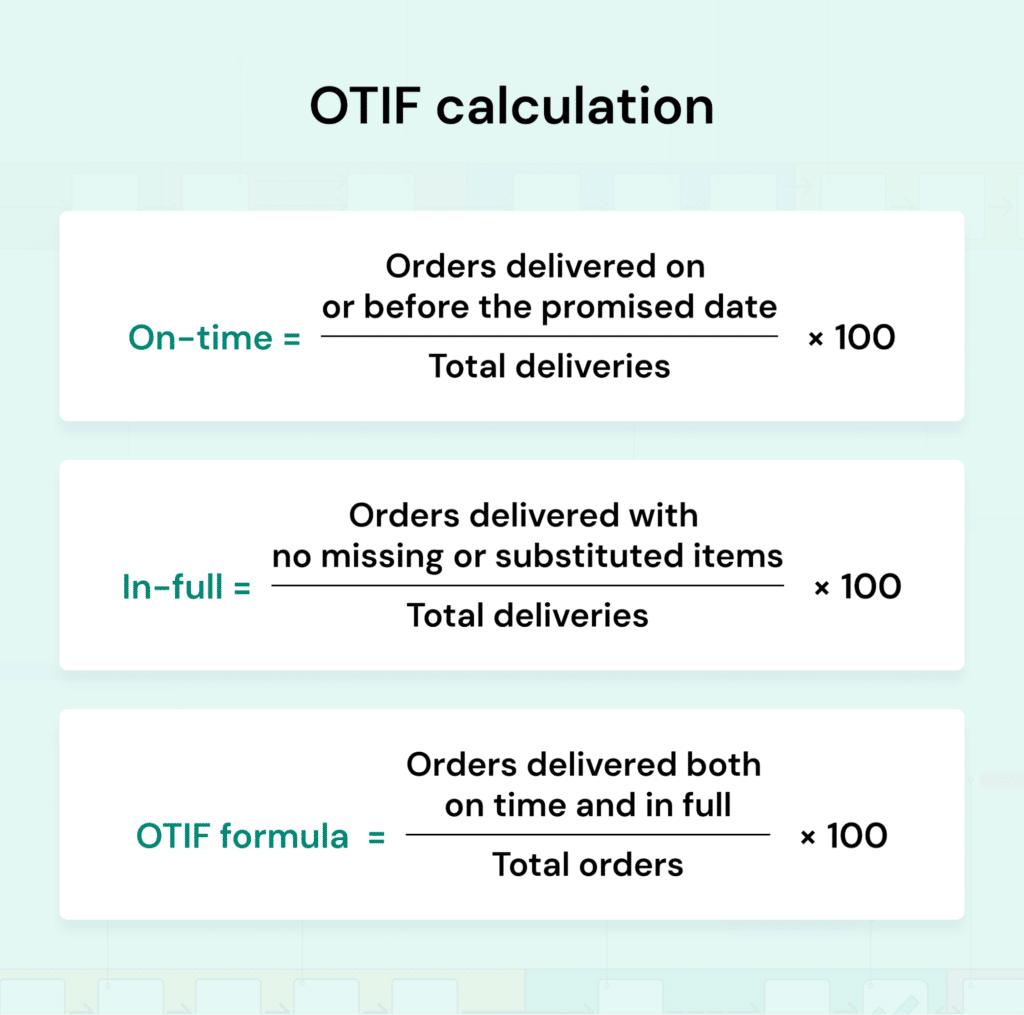
The OTIF formula combines two measures into a single KPI that reflects overall delivery performance. Each part has its own calculation:
1. On-time calculation
The on-time calculation metric measures the accuracy of delivery promises. If orders arrive late, or even early in some industries, retailers or receiving partners mark them as non-compliant because they disrupt inventory flow, shelf availability, or planned promotions.
On-time = (Orders delivered on or before the promised date ÷ Total orders) × 100
2. In-full calculation
The in-full calculation measures order completeness. An order marked “in full” includes the exact SKUs and quantities requested. Substitutions, shortages, or split shipments drive this percentage down. Note that “in full” does not measure damage-free condition — that requires additional indicators such as the damage-free rate.
In-full = (Orders delivered with no missing or substituted items ÷ Total orders) × 100
3. OTIF calculation
The full OTIF calculation is a performance metric that counts orders that meet both criteria (on-time and in-full).
OTIF = (Orders delivered both on time and in full ÷ Total orders) × 100
Let’s say a national retailer processes 5 million orders in a month:
- 4.6 million arrived on or before the promised date → On-time = 92%
- 4.4 million contained every SKU and quantity → In-full = 88%
- 4.2 million satisfied both criteria → OTIF = (4.2M ÷ 5M) × 100 = 84%
What is a good OTIF score?
There is no universal OTIF benchmark. What counts as “good” varies by industry, by customer, and even by channel. A grocery retailer running just-in-time replenishment will expect a different OTIF performance than an industrial buyer replenishing spare parts.
The right OTIF benchmark depends on three factors:
- Customer expectations: Retailers, marketplaces, and end consumers all define “on-time” differently, with varying tolerances for delays or substitutions.
- Contractual obligations: Many delivery service-level agreements (SLAs) include OTIF thresholds, with penalties for missed targets. These thresholds, not a generic industry average, define the bar you need to clear.
- Competitive standards: Your peers and direct competitors set the reference point. If your OTIF lags behind theirs, you risk losing shelf space, customer loyalty, and revenue.
How does the OTIF indicator compare to other logistics KPIs?
OTIF is one of the most comprehensive logistics KPIs because it combines timeliness and completeness into a single performance measure. But it doesn’t operate in isolation. Chief Supply Chain Officers (CSCOs) should view the OTIF indicator alongside other supply chain metrics to get a full picture of fulfillment performance.
Fill rate vs OTIF: What’s the difference?
The fill rate measures the percentage of customer demand satisfied directly from available inventory. Supply chain teams often calculate this number at the SKU or order line level. The metric focuses solely on product availability.
The OTIF KPI measures whether retailers deliver orders both on time and in full. This metric captures inventory accuracy and delivery performance.
| Delivery metric | What this metric shows | Metric strengths | Metric limitations |
|---|---|---|---|
| Fill rate | % of demand fulfilled from available inventory | Useful for monitoring stock accuracy and demand planning | This metric doesn’t consider delivery timing or accuracy |
| OTIF | % of orders delivered on time and complete | OTIF links fulfillment to customer commitments; aligns with retailer SLAs | This indicator doesn’t capture product condition or documentation accuracy |
OTD vs OTIF: What’s the difference?
On-time delivery (OTD) measures whether shipments arrive by the promised date, regardless of completeness.
OTIF goes further by requiring that the shipment be both on time and complete.
| Delivery metric | What this metric shows | Metric strengths | Metric limitations |
|---|---|---|---|
| OTD | % of orders delivered on time | Simple, clear view of carrier reliability | This metric doesn’t consider whether orders arrive complete |
| OTIF | % of orders delivered on time and in full | Holistic measure of supply chain execution | This indicator doesn’t account for damage or documentation errors |
Why OTIF performance impacts customer satisfaction and costs
OTIF performance impacts customer satisfaction and costs because it shows whether you deliver what customers expect, when they expect it, and whether you do so in a cost-efficient way.
- Customer satisfaction: Buyers lose trust when deliveries arrive late or incomplete. Consistently hitting OTIF builds confidence and strengthens loyalty.
- Costs: Missed OTIF targets drive penalties, extra shipping expenses, and labor cost inefficiencies.
What challenges prevent operators from meeting OTIF compliance?
Maintaining OTIF compliance requires precision across every link in the supply chain. A single breakdown, whether with suppliers, transportation partners, or internal workflows, can result in late or incomplete deliveries.
The most common barriers include supplier delays, carrier bottlenecks, forecasting errors, and inefficient processes. External disruptions and over-reliance on reactive problem-solving add even more risk. Let’s review these challenges in detail.
Inventory and demand forecasting errors
Poor demand forecasting causes upstream issues that prevent operators from achieving OTIF compliance. Stockouts force partial shipments, while overstock ties up working capital without improving delivery reliability. Traditional forecasting methods often rely on historical averages that fail to capture demand spikes, promotions, or regional shifts.
To protect OTIF performance, logistics leaders need forecasting tools that align with fulfillment execution through predictive analytics models. This technology adjusts real-time inventory data in response to changing demand signals, enabling logistics teams to position inventory closer to the customer, shorten delivery times, and improve service reliability.
Transportation and carrier bottlenecks
Transportation and carrier bottlenecks often prevent large-scale supply chain operations from meeting delivery commitments. Delays at handover points, limited capacity in parcel networks, and inconsistent carrier performance create gaps between what was promised and what actually arrives at the customer’s doorstep. Because SLAs are strict, every missed window exposes the business to OTIF penalties.
McKinsey highlights how these breakdowns impact profitability: 10% of packages in last-mile logistics require re-delivery, and re-deliveries alone can account for 1% to 3% of revenue loss for shippers using B2C carriers.
To address this issue, operators need both smarter routing decisions and real-time visibility into courier performance. Multi-carrier shipping software like Shipium strengthens transportation execution by dynamically modeling transit times and selecting the best service-level option for each order. This level of precision reduces failed deliveries and helps protect OTIF compliance at scale.
Internal process inefficiencies
Manual decision-making, siloed systems, and outdated technology slow down fulfillment speed and increase the risk of errors. These inefficiencies make it challenging for operators to meet stricter OTIF requirements.
Streamlining logistics processes through automation and integration enables faster, more reliable fulfillment. Operators who centralize decision-making across order routing, carrier selection, and warehouse management are better equipped to meet customer commitments.
Shipium’s integration framework eliminates fragmentation by connecting previously disconnected steps in the fulfillment workflow, giving operators more control over their OTIF outcomes.
Over-reliance on reactive logistics measures
Many organizations struggle with OTIF compliance because they lean on expensive fallback tactics. Expedited shipping often covers for late order processing, while excess safety stock masks weak forecasting and planning. These stopgaps temporarily fix problems but inflate transportation and inventory costs, eroding margins with every cycle.
One way to avoid these costs is to improve carrier decision-making. For example, a solution like Shipium’s carrier selection reduces the need for premium expedited shipping as a last-minute fix, helping operators maintain compliance while controlling costs.

How to improve OTIF performance: A 3-step guide
Improving OTIF performance requires innovation. According to McKinsey, 93% of shippers plan to increase technology investments by 2026. The message is clear: technology is the lever that drives reliable delivery performance.
1. Align OTIF targets with cost control — not just speed
Many ecommerce brands improve OTIF by paying for faster delivery, but this creates a trade-off between compliance and margin. A smarter approach is to set OTIF targets that account for both speed and cost. By aligning service levels with profitability goals, operators can protect performance without inflating expenses.
2. Gain actionable supply chain visibility with predictive delivery dates
Logistics operators often struggle to meet delivery windows because they lack real-time visibility into where inventory sits and how orders move through the network.
Predictive delivery date tools surface when an order will arrive based on live carrier performance and order routing logic. With visibility, logistics leaders can make informed trade-offs — such as re-routing shipments through a different fulfillment node or adjusting cut-off times. Shipium, for example, delivers predictive delivery promises by combining real-time data with carrier network intelligence, giving operators a clearer path to meeting strict OTIF metrics and goals.
See 12 supply chain solutionsto add to your tech stack.
3. Track and optimize OTIF with cost-focused dashboards
Retailer scorecards reveal OTIF issues only after penalties and complaints occur. Continuous monitoring identifies problems earlier and prevents failures.
Dashboards that connect OTIF performance to costs show where delays or incomplete deliveries reduce margins. With real-time data segmented by carrier, node, or product line, executives act immediately to correct problems. Shipium’s Analytics tool provides this type of visibility, enabling operators to track compliance, control spend, and improve supply chain efficiency.
Cut costs and strengthen on-time in-full outcomes with Shipium
The Shipium platform improves on-time in-full delivery by connecting intelligent delivery promises, carrier selection, and order routing in one end-to-end solution. This integration gives operators control over the decisions that determine compliance and cost.
Shipium’s results recap speaks for itself:
- Industry recognition: Shipium was named a 2025 Gartner® Cool Vendor™ and ranked Best in Support on G2 out of 209 shipping technologies.
- Proven savings: During the 2024 peak season, customers saved an average of 9% on shipments, with some weeks delivering cost reductions of over 16%.
- Performance gains: Shipium customers achieved 95.4% on-time delivery during the holiday season, even as they pursued faster delivery dates than standard carrier SLAs.
- AI-driven accuracy: Our machine learning transit models delivered 97.1% accuracy against desired delivery dates and over 90% precision on exact delivery dates — an achievement unmatched in the industry.
For logistics leaders seeking to improve OTIF without raising costs, Shipium delivers the enterprise platform that drives both compliance and efficiency in modern supply chain management. Book a demo to see for yourself.