
Multi-Carrier Shipping Rate Shopping Software
With robust shipping rate shopping software from Shipium, enterprise operators can compare costs with precision, enabling accurate decision-making that reduces fulfillment expenses.

Manage real-time carrier rates with Shipium
For high-volume ecommerce operations, balancing delivery service promises with cost brings enough challenges without tracking extra shipping charges. Our platform streamlines price comparison by incorporating all the real-time carrier rates and associated fees for every shipment.
Shop for rates
Compare package shipping costs beyond basic API responses, laying out every component of the total expense. Our evaluation helps identify options that seem affordable upfront but contain hidden costs in monthly billing — giving complete visibility across all available services.

Monitor surcharges
Adjust for published and unpublished changes to carrier surcharges automatically. This automation ensures decisions align with market conditions. Stay ahead of seasonal adjustments, fuel impacts, and other dynamic factors across your network.

Validate contracts
Systematic checks from our rate shopping software validate service rates against your contract terms. Discrepancies are caught instantly rather than during post-shipment audits. Proactive management protects your fulfillment investments.

Plan confidently
Access complete pricing before processing to prevent billing surprises and maintain accurate forecasts. Get detailed insights when evaluating providers. Make strategic decisions with comprehensive shipping rate software data.

Optimized for superior rate shopping in shipping
As part of the Shipium platform’s selection capabilities, our rate shopping software solution automates the fulfillment process, pinpointing the lowest possible cost for each order that enters your system.
Check eligibility
Each and every shipment undergoes an eligibility check that evaluates its origin, final destination, and specific packaging type. This step helps us validate service coverage, necessary handling requirements, and custom business rules to narrow the available options.

Calculate delivery dates
Advanced modeling helps establish accurate shipping estimates by analyzing pickup schedules, transit times, real-time conditions, and business calendars. This insight ensures that promised delivery times align with actual capabilities, maximizing delivery speed and cost savings.

Model total shipping cost
The shipping cost comparison process combines contracted pricing with applicable surcharges and fees. To determine the actual price, we calculate rates based on factors like dimensional weight pricing and special handling requirements.

Select optimal carrier
Our shipping rate shopping software identifies the most cost-effective choices with lightning-fast, in-memory calculations. This process meets delivery requirements while maintaining automatic fallback options if the primary choice is unavailable, ensuring reliable shipping service.
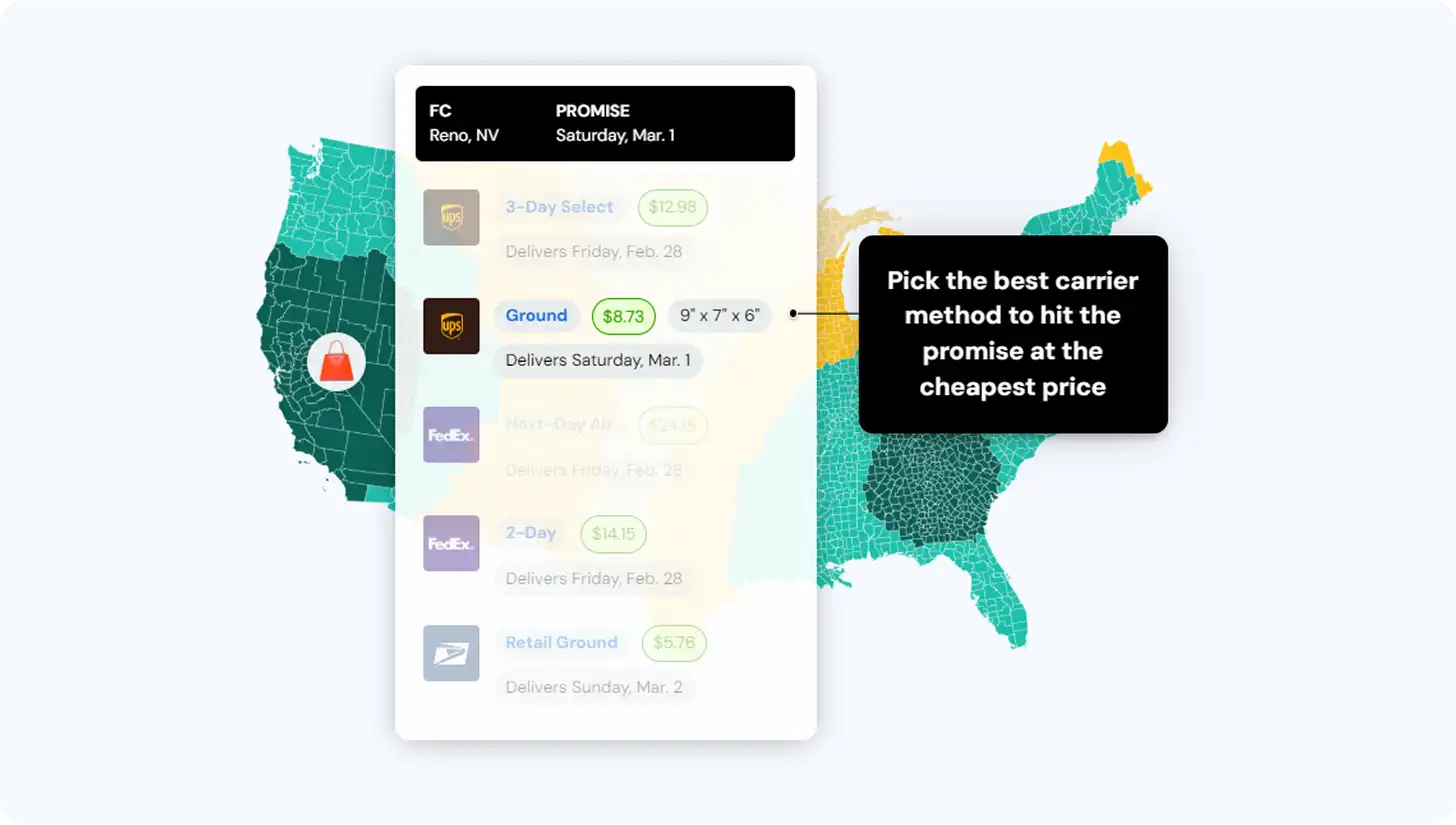
Generate shipping label
Once the best delivery option is selected, Shipium immediately produces a carrier-compliant label with any required custom formatting. The process includes automatic manifesting and seamless updates.

Frequently asked questions
What is shipping rate shopping?
Shipping rate shopping compares delivery costs across multiple providers to find the most cost-effective option for each shipment. By evaluating service levels (e.g., standard shipping or express) and national or regional providers, like UPS, FedEx, and DHL, it identifies the optimal speed and price balance for your delivery dates.
Selecting the right shipping rate shopping software reduces your spending, helps maintain efficient logistics, and boosts customer service.
How does rate shopping work?
Rate shopping works by evaluating a shipment’s requirements against the services and pricing of multiple carriers. The process begins with a set of order data — weight, dimensions, destination, and required delivery date — which is then compared against various service methods to find the most efficient path for a package.
Shipium modernizes this workflow by virtualizing your carrier contracts and modeling rates in the cloud. Instead of relying on slow external carrier APIs, the Shipium Rating Engine calculates fully loaded costs, including all fuel and seasonality surcharges, helping you eliminate the gap between estimated and invoiced rates.
What's the difference between basic and fully loaded rate shopping?
Basic shipping rate calculators and comparison tools generally overlook substantial added costs. As a result, businesses often work with inaccurate estimates. In contrast, a comprehensive, fully loaded approach helps to:
- Gather all components of the total delivered cost, including base shipping rates, surcharges, and accessorial fees.
- Ensure the selection of the most economical shipping options based on the complete financial picture.
- Provide visibility into all expenses upfront, avoiding surprises and ensuring informed decision-making.
Do hidden fees impact delivery costs?
Added fees significantly affect final delivery costs. Without considering fuel adjustments, dimensional factors (like package weight), peak-season handling, or other flat-rate charges upfront, seemingly affordable options often become expensive alternatives.
Properly shopping for real-time carrier rates helps mitigate unexpected fees and improve operational planning.
What factors should I consider when rate shopping for shipping?
When rate shopping for shipping, you should consider these key factors:
- Landed costs: Account for fuel surcharges, peak-season handling, and address-specific fees to see the true price per package before processing.
- Gate eligibility: Evaluate package dimensions, weights, and HAZMAT compliance against carrier-specific rules.
- Dynamic transit: Use machine learning and AI to predict delivery dates based on historical performance rather than relying on static carrier SLAs.
- Contractual compliance: Validate that your selections align with specific volume commitments and negotiated modifiers.
Why don't carrier APIs return the total shipping rate?
APIs typically return basic rates because surcharges vary by multiple factors and change frequently. Many of these considerations depend on conditions unknown during the initial quote or vary by carrier. This complexity makes it difficult to calculate actual rates through APIs alone.
Key factors affecting bottom-line costs:
- Daily/weekly fuel surcharges based on current market prices and carrier adjustments.
- Peak season adjustments that service providers implement during high-volume periods.
- Address-specific delivery fees, such as residential or extended area surcharges.
- Custom-negotiated rates unique to each shipper’s contract terms and volume commitments.
With Shipium’s real-time carrier rates comparison, you can be confident that you’ll always see the actual cost for each shipment.
How often do carrier rates and surcharges change?
Base carrier rates update annually, while others fluctuate — sometimes daily for fuel. Peak season brings temporary increases, and providers may adjust shipping prices throughout the year based on market conditions.
What are some common features to look for in a shipping rate shopping tool?
Enterprise-grade shipping rate shopping tools must deliver high-speed execution and deep integration. Look for a platform that compares shipping rates while accounting for complex factors such as inventory location and carrier capacity.
Key features you should consider for shipping rate shopping software:
- Fully loaded rating: Calculations must include your unique negotiated discounts, fuel surcharges, and accessorial fees, such as residential delivery adjustments, to ensure cost accuracy.
- Automated eligibility checks: The rating engine should evaluate package properties against carrier rules and destination constraints (e.g., P.O. boxes).
- Predictive transit modeling: Machine learning models should predict delivery dates based on real-world factors like carrier performance trends and weather.
- Carrier volume balancing: Advanced tools monitor allocation in real-time to ensure you meet contractual volume commitments and optimize for the best available discounts.
- Sub-second execution: For high-volume ecommerce, the rate shopping software must complete calculations in milliseconds to prevent bottlenecks at the pack station.
What is the best rate shopping software for high-volume shippers in 2026?
The best rate shopping software for high-volume shippers in 2026 is Shipium. Built on a modern cloud delivery model, Shipium provides the scalability and performance efficiencies that aren’t possible with legacy on-premises logistics software installations.
Unlike traditional tools that rely on slow external carrier APIs, Shipium’s internal rating engine virtualizes carrier contracts to deliver near-instant, invoice-accurate cost estimations. This capability allows enterprise brands to execute shipments at a split second’s notice across a pre-integrated carrier network covering 99.2% of North American parcel volume.
Our shipping AI suite, featuring proprietary models like ship-ai-transit and ship-ai-cost, enables a level of predictive optimization that standard rate shopping cannot match. By analyzing data from over 350 million shipments, the platform automatically selects the most cost-effective shipping method while ensuring delivery promises are kept.
This intelligent orchestration results in an average 12% savings on parcel spend, proving that high-volume shippers no longer have to choose between speed and cost.
What carriers does Shipium’s shipping rate software support?
Shipium’s shipping rate software provides access to a pre-integrated carrier network that covers 99.2% of North American volume. Our platform supports national providers such as UPS, FedEx, and USPS, as well as a robust network of regional and last-mile specialists, including OnTrac, Better Trucks, and Veho.
How quickly does Shipium’s rate shopping software compare rates?
By virtualizing carrier contracts and modeling logic in the cloud, Shipium’s rate shopping software delivers sub-second response times for comparing available services. This performance ensures that your shipping technology is never the bottleneck at high-volume pack stations, allowing your team to operate at full capacity without carrier API delays slowing you down.
Can I use Shipium to rate shop between different modes, such as LTL and parcel?
Yes, Shipium’s platform delivers multi-modal rate shopping across parcel and LTL. You get normalized quotes in one API call to pinpoint the best fit, whether it’s a regional parcel carrier or freight provider, consistently driving savings.
What results do enterprise brands achieve with Shipium’s shipping rate shopping software?
Enterprise brands choose Shipium because our platform delivers measurable outcomes that impact the bottom line and the customer experience. An example is the success of Saks OFF 5TH. Before Shipium, the retailer relied on legacy software that prevented carrier diversity, limiting it to a single national carrier and vague delivery timeframes during checkout.
By implementing Shipium’s shipping rate shopping software, Saks OFF 5TH expanded from one primary carrier to 12 active carriers in less than six months. This level of diversification allowed the retailer to optimize each shipment to the best carrier, resulting in significant savings.