

Selecting the right carrier for each of your shipments is a core part of outbound fulfillment. But legacy platforms for comparing service levels and rates often leave cost savings on the table. In this guide, we explore the best shipping rate shopping tools for ecommerce and how their capabilities stack up, to help you make an informed decision on a solution that modernizes your logistics operations, improving both margins and performance.
| Best automated rate shopping solutions | Key features |
|---|---|
| 1. Shipium |
|
| 2. EasyPost |
|
| 3. Proship |
|
| 4. e2open Logistyx |
|
| 5. Sendflex |
|
| 6. ShipStation |
|
| 7. ShipEngine |
|
| 8. ShipperHQ |
|
| 9. Shippo |
|
| 10. ShippingEasy |
|
| 11. Easyship |
|
| 12. ShipHero |
|
| 13. Veeqo |
|
Let’s review the 13 best automated rate shopping solutions for shipping and logistics in 2026.
Shipium
Shipium is an enterprise shipping platform built by former Amazon operations leaders to modernize high-volume fulfillment. Its internal rating engine is one of the best tools for freight rate shopping and optimization, using machine learning to help you shop across a pre-integrated carrier network that covers 99.2% of North American parcel shipments.
Unlike legacy logistics software that relies on slow external carrier APIs, Shipium virtualizes contracts in-memory, delivering instant rates and services, so you can keep printing labels at full speed, even if the carrier’s system goes offline.
Key Shipium features:
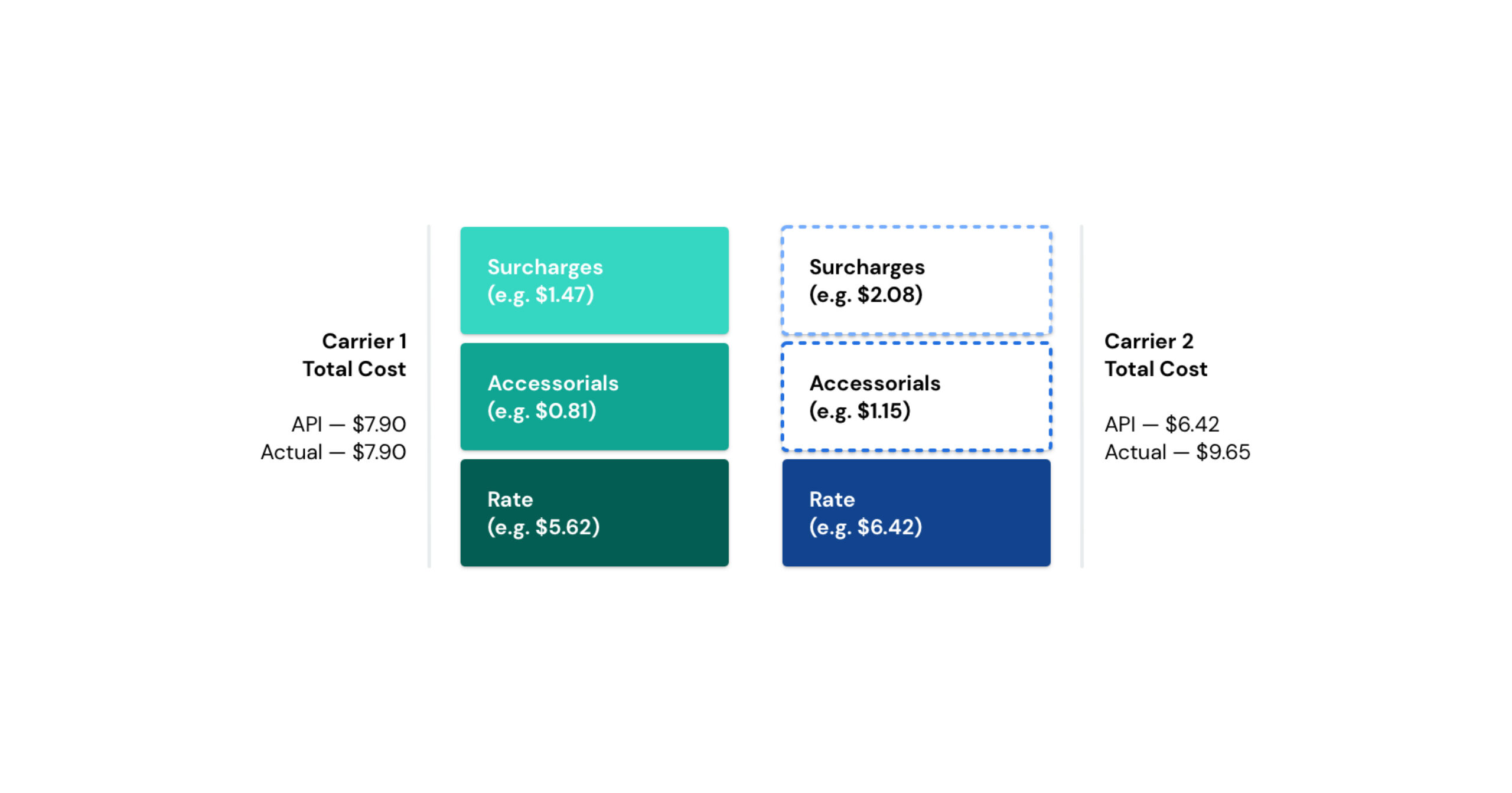
- Internal Rating Engine: Sub-50ms calculations of “fully loaded” costs, including contracted discounts and all surcharges, without reliance on carrier API availability
- Predictive date shopping: ML-powered delivery probability models for accurate arrival predictions
- Simulation module: “What-if” scenario analysis tools that allow you to test the impact of new rates or carriers before live implementation
- Delivery Promise: Accurate delivery date presentation to increase cart conversion by meeting customer expectations for speed and transparency
- Route Optimization: Strategic visibility into transit times and shipping costs for every origin point you consider in your network
EasyPost
EasyPost is a shipping technology company that provides a suite of APIs for rate shopping, labeling, and real-time tracking. While it offers a broad carrier network, its infrastructure is primarily built for small to midsize businesses seeking carrier API centralization.
EasyPost pros:
- Single API point of entry for accessing rates from over 100 carriers
- Global address cleansing before generating a shipping label
- Shipping insurance options
Cons of EasyPost:
- Reliance on external carrier APIs, leading to potential latency or inaccuracies
- Absence of native support for real-time delivery promises
- Lack of complex enterprise order routing capabilities
Proship
Proship is a provider of automated shipping software with multiple deployment options, including on-premise, cloud-hosted, and hybrid models.
ProShip pros:
- Carrier selection checks against standard service level agreements (SLAs)
- Local, on-premise manifesting in warehouses with strict security requirements
- Configuration of specific business rules for customized operations
Cons of ProShip:
- On-premise models can lead to high administrative burdens and siloed data
- Adding a new carrier can take months
- Sequential API calls can create bottlenecks compared to virtualized rating
e2open Logistyx
Logistyx (now part of e2open) offers a global multicarrier platform focused on high-volume fulfillment and trade compliance.
e2open Logistyx pros:
- Support for international shipping
- Library of carrier-compliant routing and rating tools to ensure shipments meet international standards
Cons of e2open Logistyx:
- Lack of dynamic time-in-transit modeling
- Absence of native simulation tools
- Dependency on static rate cards rather than real-time performance data
Sendflex
Sendflex is a multitenant cloud transportation management system (TMS) platform with multi-carrier selection capabilities. It provides optimization and simulation to help enterprises refine their parcel, LTL, and local carrier strategies.
Sendflex pros:
- In-memory rating optimization that processes rates without relying on carrier APIs
- “What if” planning tools for predicting the impact of network or routing logic changes
Cons of Sendflex:
- Focus restricted to North American markets
- Potential complexity in initial business rule setup
ShipStation
ShipStation is a web-based shipping solution that centralizes order management across different ecommerce platforms, including Shopify, Amazon, and eBay.
ShipStation pros:
- Integration ecosystem with access to pre-negotiated carrier discounts from USPS, UPS, and DHL
- Batch rate shopping that applies logic across thousands of orders simultaneously
Cons of ShipStation:
- Reliance on standard carrier API responses, which can be slow or fail during peak season
- No machine-learning-driven delivery date accuracy
- Limited scalability for complex enterprise-level fulfillment networks
ShipEngine
ShipEngine is a modular, developer-centric shipping platform offering shipping rate shopping tools for ecommerce, including APIs that enable diverse systems to access real-time rating and tracking functionality.
ShipEngine pros:
- Quote fetching with automatic tagging for the cheapest and fastest options
- Carrier lists and exclusion statements based on package weight or dimensions
Cons of ShipEngine:
- No standard out-of-the-box user interface
- Technical complexity
ShipperHQ
ShipperHQ is a logistics management solution that provides carrier rates and delivery options at the point of purchase.
ShipperHQ pros:
- Control over the front-end shipping experience at checkout
- Rate comparisons from parcel and LTL carriers with custom rules
- Lead and cutoff time settings that provide delivery transparency to shoppers
Cons of ShipperHQ:
- Primarily focused on the “pre-purchase” phase rather than warehouse execution
- Lack of native label generation and manifesting tools
- Limited functionality for back-end fulfillment optimization
Shippo
Shippo provides a centralized dashboard and API for managing fulfillment tasks. The system connects ecommerce businesses to a network of global and regional carriers through a single interface.
Shippo pros:
- Low entry barrier with a “pay-as-you-go” pricing model and no monthly fees
- Aggregation of carrier rates to find the lowest-cost option
- Surcharge reporting to help identify and minimize hidden fees
Cons of Shippo:
- Reliance on external carrier API responses, which can lead to system latency
- Carrier system downtime can impact rate shopping performance
- Limited advanced logic for large enterprise fulfillment rules
ShippingEasy
ShippingEasy combines shipping automation with built-in marketing and inventory tools.
ShippingEasy pros:
- Interface with built-in customer marketing capabilities
- Suggestions for the most cost-effective service hierarchy
- Proprietary “flat-rate green” logic for discounted rates on packages 2-20 lbs
Cons of ShippingEasy:
- Not ideal for high-volume enterprise operations with complex requirements
- Functional constraints regarding international shipping complexity
- Limited integration with advanced enterprise ERP systems
Easyship
Easyship is a shipping platform specializing in cross-border operations, connecting merchants to a global network of courier services.
Easyship pros:
- Large international carrier coverage
- Real-time import tax and duty calculations at checkout
Cons of Easyship:
- Domestic fulfillment workflows are less advanced than those of US-centric platforms
- Higher complexity in setting up local domestic shipping rules
ShipHero
ShipHero is an inventory and warehouse management system that integrates shipping and fulfillment into a single platform.
ShipHero pros:
- Unified data between WMS and shipping software for operational visibility
- Custom carrier groups and prioritized services through “RateShop+” profiles
Cons of ShipHero:
- Extensive warehouse features may be unnecessary for merchants without physical centers
- Steeper learning curve compared to standalone shipping tools
Veeqo
Veeqo is an Amazon-owned platform that provides sellers with the lowest commercially available rates and Amazon-specific account protection features.
Veeqo pros:
- Identification of the cheapest shipping option for bulk orders
- Cashback rewards of up to 5% back on selected shipping rates
Cons of Veeqo:
- Focus on the Amazon ecosystem, limiting multi-channel flexibility
- Support and feature development are prioritized for Amazon-specific workflows
Get the best shipping rate shopping tools for ecommerce with Shipium
To avoid overpaying for shipping, you need a platform that gives you the “fully loaded” cost of every package instantly. Shipium provides one of the best automated rate shopping solutions for shipping and logistics in 2026.
Our Rating Engine solution is the most mature rating workflow in the industry, modeling your specific courier contracts in the cloud and selecting the most cost-effective service for every order, which helps our customers reduce parcel spend by 12% on average.

By applying ML-powered logic, our platform ensures you protect your margins and consistently meet customer delivery promises. Book a demo to see how you can start saving on every shipment with Shipium.
Frequently asked questions
What is rate shopping in logistics?
Rate shopping in logistics is the process of comparing carrier options for each shipment to find the best combination of cost and reliability. High-volume shippers weigh rates from national and regional carriers while factoring in constraints such as package weight, size, and delivery speed.
Most rate shopping tools simply pass requests to carrier APIs, which can slow down or fail during peak times. Shipium takes a different approach with an internal rating engine that virtualizes carrier contracts in the cloud, enabling nearly instant rate lookups that match your invoice, including all surcharges and fees.
Learn how fully loaded rate shopping ensures maximum cost savings.
What are the benefits of carrier rate shopping?
The benefits of carrier rate shopping include enhanced delivery reliability and cost savings for enterprise shippers. By automatically selecting the most cost-effective carrier for each order, you can maintain accurate delivery promises and reduce unnecessary spend.
In practice, ecommerce businesses leveraging the best tools for freight rate shopping and optimization benefit from:
- Lower costs: Shipium customers, for example, reduce parcel spend by 12% on average by choosing the best transportation partner and service methods for each shipment.
- Improved delivery performance: Predictive machine learning models analyze historical data and real-world factors such as weather to ensure on-time delivery rates. These models provide more reliable transit times than generic carrier SLAs.
- Greater flexibility and choice: Access to an extensive, pre-integrated carrier network allows you to instantly switch to regional carriers when national carriers reach capacity or increase peak fees.
- Operational efficiency: Automated rate shopping workflows reduce administrative burden by eliminating manual data entry. Cloud-native orchestration allows you to implement network-wide rule changes without IT overhead.
See the top 3 mistakes operators make when rate shopping for shipping.
How does automated rate shopping work?
Automated rate shopping evaluates hundreds of carrier and service combinations to select the most efficient option for each of your shipments. Unlike traditional shipping platforms that rely on external API calls, Shipium uses high-performance internal modeling to ensure speed and accuracy. Here’s how our process works, step by step:
- Eligibility check: Shipium evaluates specific shipment properties to determine which carriers are qualified to handle the load. For example, the system considers your package-level details, including HAZMAT compliance, ZIP-zone delivery areas, and specific carrier requirements, such as P.O. boxes.
- Date shop: Our platform applies constraints based on your delivery promise or business days of transit (BDOT) to filter out any service methods that cannot meet the required delivery date.
- Rate shop: Once our shipping rate shopping software narrows your carrier options to eligible, on-time services, it compares fully-loaded prices — including contracted discounts, fuel surcharges, and accessorial fees — to select the most cost-effective option.
- Volume balancing: The system monitors carrier volume allocation in real-time to ensure you meet your contractual commitments and avoid overutilization.
Shipium automates this entire rate shopping workflow with a suite of AI models trained on over 350 million shipments, allowing for near-instant execution.
How do I define rate shopping business rules for my organization?
To define rate shopping business rules for your organization, align them with your unique operational goals, such as balancing costs, meeting speed requirements, or managing carrier capacity. In the Shipium Console, you can translate your high-level business logic into automated configurations that govern every order. To start:
- Configure your fulfillment contexts: Establish your “origins” (fulfillment centers) and associate them with your specific carrier contracts.
- Establish carrier selection rules: Configure delivery zone rules to specify which carriers cover certain areas and set criteria based on package properties or specific tags.
- Set capacity and cost limits: Define “shipment count limits” to manage your shipment capacity by origin and carrier, or “shipment cost limits” to control your total spend throughout the shipping process.
- Define special properties: For more complex supply chains, you can designate special handling rules for shipments containing hazardous materials, perishable goods, or those requiring specific delivery signatures.
What should I look for in the best commercial automated rate-shopping solutions for high-volume shipping in 2026?
The best commercial automated rate-shopping solutions for high-volume shipping in 2026 should offer predictive capabilities, moving beyond simple price comparisons to account for real-world delivery probabilities. That’s the case with Shipium, which simulates thousands of data points — from warehouse pull times and inventory position to weather events and carrier capacity — to ensure every rate-shop is backed by a reliable delivery promise.
-
 Read more
How fully loaded rate shopping ensures maximum cost savings
Detailed attention is required for each shipment regardless if you’re a shipper, retailer or…
-
Read more
10 Shopify Fulfillment Best Practices for Ecommerce Businesses
A successful Shopify ecommerce business not only drives sales but also delivers a seamless…
-
Read more
Ecommerce Returns Management: Best Practices for Reducing Costs and Improving Margins
Returns in ecommerce silently cut profits when businesses only treat them as a post-purchase…