

You face the same shipping challenges as other ecommerce operations teams: speeding up transit times, cutting costs, and keeping the customer happy. Yet relying on outdated logistics tools slows you down at scale. Legacy supply chain technology breaks at the moment you onboard a second carrier, open another distribution center, or hit peak-season surges.
In this guide, we compare 11 best shipping platforms for ecommerce, including options that meet modern fulfillment needs, such as intelligent carrier selection, automated rate comparison, and multi-warehouse management.
| Shipping platforms for ecommerce | G2 rankings* | Key features |
|---|---|---|
| 1. Shipium | 4.9 |
|
| 2. ClickPost | 4.8 |
|
| 3. AfterShip | 4.7 |
|
| 4. ShippyPro | 4.6 |
|
| 5. parcelLab | 4.6 |
|
| 6. ShippingEasy | 4.6 |
|
| 7. Sendcloud | 4.5 |
|
| 8. Pirate Ship | 4.6 |
|
| 9. ShipStation | 4.3 |
|
| 10. Easyship | 4.3 |
|
| 11. Shippo | 4.2 |
|
*Rankings are updated as of April 2026. Please note that G2 scores fluctuate based on real-time user feedback.
Let’s review the top shipping software for ecommerce fulfillment in 2026.
1. Shipium
Shipium is an AI-first ecommerce shipping platform built for enterprise, retail, and 3PL operations that have outgrown legacy logistics software. The system sits between your OMS, WMS, and carrier network and runs every shipping decision through proprietary machine-learning algorithms trained on over 350 million shipments.
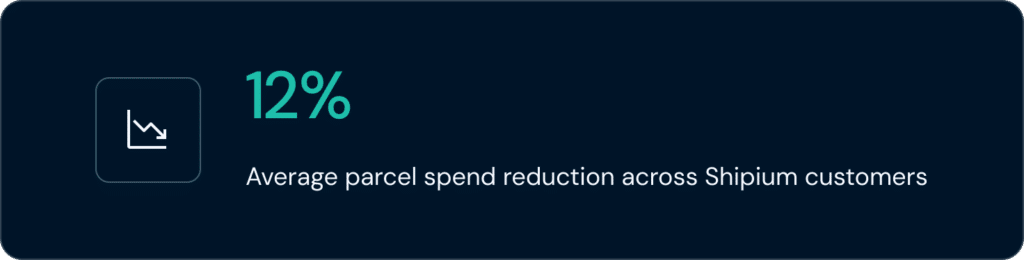
Our AI models help you make smarter carrier decisions, simulate network scenarios, and predict exact delivery times using real-time transit data. Through these optimizations, Shipium customers see an average 12% reduction in parcel spend.
Key Shipium features:
- AI-driven carrier selection through our Rating Engine, which compares fully loaded rates and service levels against delivery dates for every order
- Packaging Optimization capabilities that minimize dim weight surcharges
- ML-powered Delivery Promise that displays accurate dates at checkout to improve competitiveness and conversion
- Ship-from-store and connected origin workflows that route every order from the closest fulfillment point
- Always-on audit and billing reconciliation against carrier invoices
Shipium pros:
- Pre-integrated carrier network covering 99.6% of North American parcel shipments
- Scalability for high-volume operations with near-instant shipping rate lookups
- Automated carrier volume balancing for contract tier compliance
- Easy integration with your existing logistics tech stack
Shipium is the platform of choice for leading enterprises, including:
Explore what Shipium customers conquer with our platform.
2. ClickPost
ClickPost is a multi-carrier logistics and post-purchase platform that connects to a global courier network through a single API. The system helps you select transportation partners based on regional performance metrics.
ClickPost pros:
- AI-driven non-delivery report (NDR) management
- Branded tracking pages and SMS notifications
Cons of ClickPost:
- Operational complexity during the initial configuration of business rules
- Reporting depth lags relative to platforms with deep shipping analytics
3. AfterShip
AfterShip is a shipping platform for ecommerce that specializes in tracking and the post-purchase customer experience for global brands. The platform provides automated notifications to keep shoppers informed about status changes.
AfterShip pros:
- Branded order tracking pages for reducing WISMO requests
- Returns Center module for self-service customer exchange and refund flow
Cons of AfterShip:
- No native label generation or carrier rating features
- Add-on modules (returns, EDD) billed separately
4. ShippyPro
ShippyPro provides a multi-carrier label generation engine for businesses seeking to scale globally. You use its comparison tools to identify lower shipping costs across different service levels.
ShippyPro pros:
- Returns portal for generating labels with pre-set rules
- Multi-channel order import covering Shopify, Amazon, eBay, BigCommerce, and others
Cons of ShippyPro:
- Reliance on sequential API calls to carriers for rate shopping execution
- Lack of carrier contract management depth
5. parcelLab
parcelLab is a post-purchase platform that focuses on customer experience and returns management. Its suite of solutions provides analytics to help you understand delivery performance by region.
parcelLab pros:
- Returns and exchange flows
- Ecommerce supply chain analytics on delivery NPS, on-time performance, and post-purchase revenue
Cons of parcelLab:
- Focus on marketing and communication rather than warehouse execution
- Need for integration with separate shipping technology for packaging and route optimization
6. ShippingEasy
ShippingEasy is a platform for small-business shipping, best known for discounted USPS rates and built-in email marketing tools. The system auto-applies USPS flat-rate cubic pricing based on package dimensions.
ShippingEasy pros:
- Among the lowest USPS rates available to small operators
- Built-in customer marketing module
Cons of ShippingEasy:
- Thin courier coverage (outside USPS and UPS) when compared with multi-carrier shipping software
- Reporting tools and automation rules that lack the depth enterprise teams need
7. Sendcloud
Sendcloud is shipping software for ecommerce fulfillment, including a returns portal that supports multiple languages and carriers. The platform offers flexible checkout options to present different delivery methods to shoppers.
Sendcloud pros:
- Dynamic checkout module
- Multi-carrier label generation
Cons of Sendcloud:
- Greater carrier coverage in Europe than in North America
- No native machine learning models for predicting estimated delivery dates
8. Pirate Ship
Pirate Ship provides a free ecommerce shipping platform for startups and small businesses. You access discounts on USPS and UPS rates with zero monthly subscription fees. The simple interface allows you to import spreadsheets for batch label generation.
Pirate Ship pros:
- Zero monthly fees
- Native support for USPS Cubic pricing
Cons of Pirate Ship:
- No support for FedEx, DHL, or regional shipping options
- No native ecommerce integrations
9. ShipStation
ShipStation centralizes order management across your selling channels. With this platform, you can implement automation rules to categorize and process shipments based on weight or destination. The mobile application allows you to monitor fulfillment tasks from any location.
ShipStation pros:
- Automation rules for triggering label generation, carrier selection, and tagging without manual review
- Custom-branded labels and tracking pages
Cons of ShipStation:
- Reliance on external carrier APIs
- No advanced simulation tools
10. Easyship
Easyship is a cross-border shipping platform for ecommerce businesses, handling duty calculation, tax compliance, and international carrier coordination for brands selling outside their home markets.
Easyship pros:
- Carrier marketplace with access to discounted rates from DHL Express, FedEx, UPS, and regional providers
- Native integrations with Shopify, Magento, BigCommerce, WooCommerce, and others
Cons of Easyship:
- Sequential API latency during rate shopping
- Complex pricing structure (per-label fees plus monthly plans)
11. Shippo
Shippo provides a developer-friendly API for managing fulfillment tasks. You can use its real-time rate comparison tool to highlight the cheapest service options across carriers. The pay-as-you-go model may limit upfront investment for smaller operations.
Shippo pros:
- Carrier integrations across USPS, UPS, FedEx, DHL, Amazon, and regional providers
- Free Starter plan offering 30 monthly labels, then volume-based Pro tiers
Cons of Shippo:
- Onboarding that requires engineering resources for the API tier
- Learning curve for advanced shipping features
Automate fulfillment with Shipium: the best shipping software for ecommerce
Legacy on-premises logistics software no longer meets the speed and accuracy required for enterprise ecommerce fulfillment. For brands managing complex logistics operations, Shipium offers an AI-powered shipping orchestration solution that optimizes your entire workflow, from strategy and planning to reporting and analytics.
Through Shipium Console, you have full visibility into your end-to-end operations and can reduce costs around network maintenance and updates. Set up configurable business rules that shape how our software selects carriers or how our ML models work for your specific operational requirements.

Book a demo today and see why Shipium is the best shipping platform for ecommerce businesses with high-volume fulfillment needs.
Transform your ecommerce shipping operations with Shipium
-
 Read more
Everything You Need to Know About Third Party Logistics Companies
Whether you’re a high-volume shipper looking to better manage fulfillment in specific geographic locations…
-
 Read more
How Last Mile Delivery Impacts Your Shipping Cost
When studying ecommerce leaders like Amazon, it becomes clear that focusing on the customer…
-
Read more
How to Future-Proof Your 3PL Ecommerce Fulfillment Strategy
The role of third-party logistics (3PL) ecommerce fulfillment has changed. What was once a…