


Carrier surcharges are rising, and traditional service level agreements no longer ensure on-time delivery. Legacy systems that rely on slow external APIs lead to poor carrier selection and unnecessary costs, holding back logistics leaders from optimizing performance. This guide reviews the top AI supply chain platform choices for 2026 to help you build a more agile and cost-effective fulfillment strategy.’
| AI supply chain platforms | G2 rankings* | Key features |
|---|---|---|
| 1. Shipium | 4.9 | Internal ML rating engine (sub-50ms) Predictive date shopping Simulation module Delivery date enhancement Route optimization |
| 2. Project44 | 4.7 | Real-time multimodal visibility Predictive ETAs AI exception management |
| 3. Manhattan Active Supply Chain | 4.6 | Unified WMS/TMS AI order orchestration Agentic AI |
| 4. Samsara | 4.5 | Connected Operations Platform AI dashcams Real-time fleet and asset tracking |
| 5. FourKites | 4.5 | Intelligent Control Tower Supply chain digital twin AI agents for exception resolution |
| 6. SAP Integrated Business Planning (IBP) | 4.3 | In-memory planning AI copilot SAP ecosystem integration |
| 7. o9 Solutions | 4.2 | Real-time scenario modeling Enterprise knowledge graph AI demand sensing |
| 8. Coupa | 4.2 | AI-driven supplier performance analytics Multi-ERP integration Procurement optimization |
| 9. Blue Yonder | 4.1 | AI demand forecasting Automated replenishment Omnichannel planning |
| 10. Oracle Supply Chain Management (SCM) Cloud | 4.0 | Modular suite (procurement, planning, OMS, logistics) AI-driven demand sensing Global trade compliance |
| 11. Kinaxis Maestro | 4.0 | Concurrent planning engine Real-time scenario modeling (what-if) ML demand sensing |
*Rankings are updated as of April 2026. Please note that G2 scores fluctuate based on real-time user feedback.
Let’s review the 11 best AI/ML supply chain platforms for 2026.
Shipium
Shipium is an AI-powered supply chain software created by former Amazon operations leaders to modernize outbound shipping and fulfillment. Our API-first platform serves as an intelligence layer that optimizes carrier selection, delivery promise estimates, and network simulation in real time.
The Shipium Console gives operations teams direct control over business rules, configuring carrier eligibility, volume limits, cost thresholds, and special handling requirements without requiring IT involvement for each change.
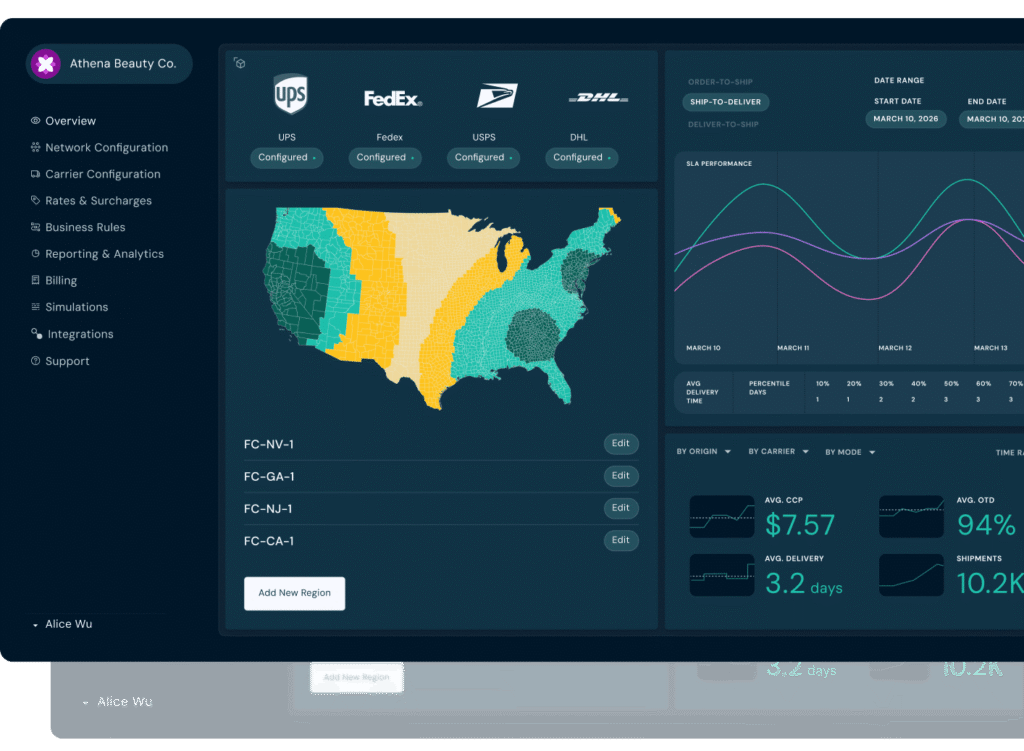
Built for high-volume, modern supply chain operations, Shipium’s AI models power every rate, routing, and delivery-date decision, trained on data from over 350 million shipments.
Key Shipium features:
- Dynamic time-in-transit modeling: ML models that combine platform-wide shipping data with your operational history to predict delivery speed, cost, and accuracy at the carrier and route level
- Orca Analytics: An AI-powered supply chain analytics engine that pairs detailed dashboards with a natural-language interface
- Multi-carrier rate shopping: Automated carrier selection tools that evaluate fully loaded rates, including fees and surcharges, across a pre-integrated network of couriers covering 99.2% of North American parcel shipments
- Route Optimization: Order routing logic that weighs your inventory location, consolidation opportunities, carrier cutoffs, and delivery commitments for optimized decisions
- Simulation module: Scenario modeling for testing carrier mixes, fulfillment center placements, or routing changes before committing your operational resources
Shipium pros:
- ML-powered accurate delivery promise estimates at the product and cart level
- 99.1% on-time delivery rates during peak season, based on Shipium customer data
- An average 12% parcel spend reduction for customers
- Operations teams configure carrier management, packaging rules, and fulfillment logic without IT overhead
- The in-memory rating architecture minimizes failure points that sequential external carrier API calls introduce
Project44
Project44 is a decision intelligence platform focused on transportation visibility and freight management. Its Movement platform delivers multimodal visibility across road, rail, ocean, and air through AI-driven tracking and predictive ETAs.
Project44 pros:
- AI agents for freight procurement, disruption response, and carrier onboarding
- Integration with TMS and ERP systems, including SAP and Oracle
Cons of Project44:
- Implementation with legacy systems is resource-intensive
- Onboarding custom carrier data sources can require manual configuration work
Manhattan Active Supply Chain
Manhattan Active, the supply chain management software from Manhattan Associates, unifies WMS, order management, and TMS in a single cloud-native architecture, applying ML to order orchestration across distribution centers, stores, and drop-ship partners.
Manhattan Active pros:
- Agentic AI tools for warehouse execution and physical site operations
- Unified supply chain visibility
Cons of Manhattan Active:
- Implementation complexity at scale
- Reporting customization requires support from Manhattan’s services team
Modernize your supply chain with Shipium and Manhattan.
Samsara
The Samsara Connected Operations Platform combines fleet management, equipment tracking, safety monitoring, and frontline workflows in one AI-powered supply chain environment. The system helps you coordinate your physical operations through fleet GPS, dashcam-based driver coaching, and predictive maintenance across vehicles and job sites.
Samsara pros:
- Open API that supports 200+ native integrations
- Real-time GPS tracking across assets and work sites
Cons of Samsara:
- AI capabilities don’t cover outbound parcel rate shopping, order routing logic, or supply planning functions
- Granular time-window analysis across selected vehicles typically requires exporting data for external manipulation
FourKites
The FourKites Intelligent Control Tower connects purchase orders, shipments, inventory, and yard operations through a digital twin of supply chain activity. The platform’s AI agents automate exception resolution tasks such as carrier contact for shipping delays, delivery rescheduling based on revised ETAs, and customer disruption notifications.
FourKites pros:
- Native yard management covers dock scheduling and trailer tracking
- Predictive estimated delivery dates surface expected arrival deviations before they reach customers
Cons of FourKites:
- Tracking accuracy depends on carrier data quality; cross-border shipments and smaller regional carriers can produce incomplete or delayed feeds
- The system requires a structured onboarding time before AI agents deliver results
SAP Integrated Business Planning (IBP)
SAP IBP is a cloud-based AI supply chain software for demand planning, inventory optimization, and S&OP. The platform’s AI copilot, Joule, gives non-technical planners conversational access to analytics insights.
SAP IBP pros:
- Direct integration with real-time data from the SAP infrastructure
- Demand planning supports statistical forecasting, collaborative forecasting, and ML models within the same environment
Cons of SAP IBP:
- Organizations not running SAP ERP can face middleware requirements
- Implementation typically requires specialized consultants
o9 Solutions
o9 Solutions provides an AI-powered business planning platform built around a graph-based enterprise model that connects demand, supply, inventory, and financial plans in a single structure. The system supports scenario modeling, demand sensing, and cross-functional collaboration, helping to align commercial, operational, and financial decisions.
o9 Solutions pros:
- Enterprise Knowledge Graph enables cross-functional planning scenarios
- Modular architecture supports staged deployment
Cons of o9 Solutions:
- Initial setup requires dedicated IT resources and customization
- o9 AI supply chain technology covers only planning, not execution
Coupa
Coupa is a business spend management (BSM) platform that incorporates AI-driven supply chain visibility, supplier collaboration, procurement automation, and inventory management. This system integrates natively with SAP, Oracle, and NetSuite, providing visibility into orders, inventory, and billing across multi-ERP environments.
Coupa pros:
- AI-powered supplier risk management
- Unified view of committed spend for finance and operations teams
Cons of Coupa:
- Long implementation timelines
- Limited value for supply chain teams managing warehousing, fulfillment, or delivery performance
Blue Yonder
Blue Yonder provides AI solutions in supply chain planning and execution. The platform suite supports demand forecasting, inventory optimization, WMS, and TMS across retail, manufacturing, and 3PL operations.
Blue Yonder pros:
- Automated replenishment reduces manual planning cycles
- Scenario analysis tools let planners test demand and supply assumptions before committing to inventory positions
Cons of Blue Yonder:
- Implementation requires specialized consulting resources
- Extended configuration timelines
Unify your supply chain processes with Shipium and Blue Yonder.
Oracle Supply Chain Management (SCM) Cloud
Oracle SCM Cloud is an AI supply chain platform that covers procurement, supply planning, order management, manufacturing, inventory, and logistics execution through a cloud-native setup. The platform integrates AI/ML for demand sensing, backlog prioritization, and supplier risk monitoring.
Oracle SCM Cloud pros:
- Modular architecture supports targeted deployments and phased rollouts
- Global trade compliance handles export controls, denied-party screening, and documentation
Cons of Oracle SCM Cloud:
- Implementations rely on heavy consulting and face extended timelines
- Web UI lags at high data volumes
Kinaxis Maestro
Kinaxis Maestro (formerly RapidResponse) is an end-to-end AI supply chain software that enables planners to run what-if scenarios and recalculate supply-demand balances in real time. This solution focuses primarily on the planning layer and does not provide native WMS or parcel execution capabilities.
Kinaxis Maestro pros:
- Concurrent planning lets multiple teams run scenario models simultaneously
- The system integrates with existing WMS, ERP, and TMS environments
Cons of Kinaxis Maestro:
- Performance can be slow under large data loads or complex simulation runs
- Supply chain teams need separate execution tools alongside Kinaxis Maestro
Leverage predictive AI solutions in the supply chain from Shipium
Most supply chain leaders have plenty of data, but they lack a system that can turn that information into an automated decision before an order leaves the warehouse. As a purpose-built AI supply chain platform for ecommerce and retail fulfillment operations, Shipium optimizes every carrier assignment, routing decision, and delivery promise in real time.
Shipium’s ship-ai-cost model compares rates across your carrier network in under 50 milliseconds, evaluating contracted discounts, fuel surcharges, and accessorial fees for every order before a label prints. Unlike platforms that pass requests to external APIs and inherit their latency and failure rates, we virtualize your courier contracts in the cloud, so the rating engine runs independently of the courier system’s availability.

Shipium helps you shift from descriptive analytics (what happened) to predictive analytics (what should happen), so you improve fulfillment speed, reduce per-parcel costs, and enhance customer satisfaction.
Book a demo to see how you can optimize your shipping strategy with Shipium.
-
 Read more
Everything You Need to Know About Third Party Logistics Companies
Whether you’re a high-volume shipper looking to better manage fulfillment in specific geographic locations…
-
 Read more
How Last Mile Delivery Impacts Your Shipping Cost
When studying ecommerce leaders like Amazon, it becomes clear that focusing on the customer…
-
Read more
How to Future-Proof Your 3PL Ecommerce Fulfillment Strategy
The role of third-party logistics (3PL) ecommerce fulfillment has changed. What was once a…