
Supply chains face volatile parcel costs and higher service expectations at the same time. For large retailers, that pressure lands directly on the outbound P&L, where small routing and promise errors add up fast. With artificial intelligence (AI), you can automate carrier choice, balance cost and speed, test network changes before rollout, and more. The result is a more controlled shipping operation that supports both margin and growth.
In this guide, we look at AI in supply chain management and the use cases that matter most for shipping, fulfillment, analytics, and accurate delivery promises.
Key highlights:
- Artificial intelligence in supply chain management refers to the application of machine learning algorithms to supply chain data to automate complex logistics decisions.
- The top use cases of AI in supply chain management include predictive transit modeling, fully loaded rate shopping, carrier load management, network simulation, and AI-powered analytics.
- Successful AI deployment requires centralizing and cleansing your supply chain data, establishing performance baselines through historical backtesting, and implementing a closed-loop feedback stream to refine model accuracy.
- Shipium is an AI-driven enterprise shipping platform that automates logistics decision-making across transit, cost, and volume, helping organizations reduce parcel spend and increase delivery speed.
What is artificial intelligence in supply chain management?
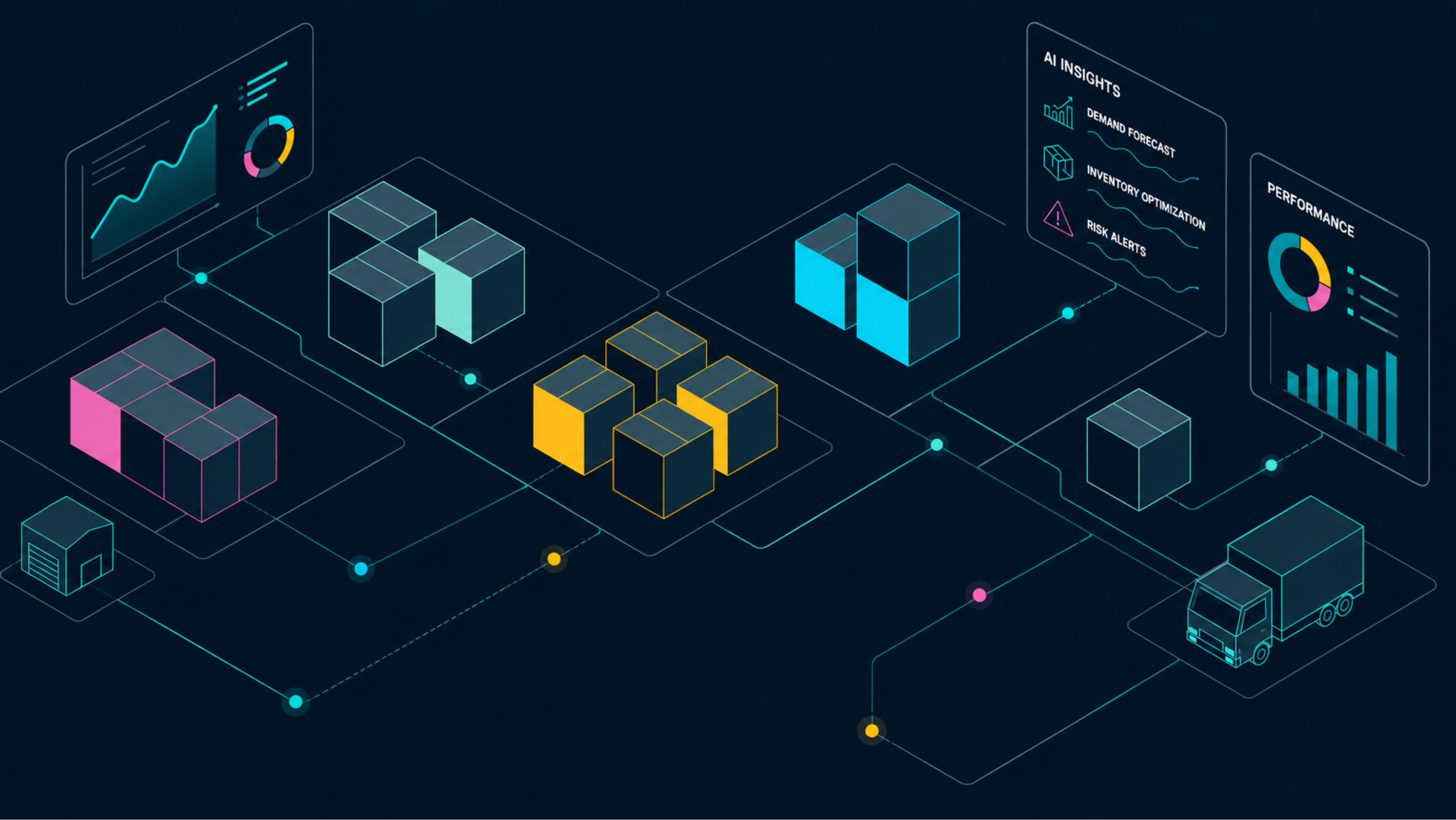
Artificial intelligence in supply chain management is the application of machine learning algorithms to optimize end-to-end operations, from demand forecasting and inventory control to logistics routing and risk mitigation.
In practice, AI helps enterprise leaders and operators streamline work across sourcing, planning, manufacturing, warehousing, and logistics. The technology uncovers complex patterns in your datasets, processing signals in real time to automate adjustments, flag disruptions, and recommend the most efficient path forward.
The AI impact on supply chain management
Applying artificial intelligence to supply chain processes improves your speed of execution and time-to-insights when managing complex networks. Instead of waiting for a missed promise, a delayed carrier pickup, or a spike in demand to show up in a report, logistics teams can use AI to surface risk earlier and make a better decision before a problem spreads.
When you can predict transit times more accurately, compare courier options faster, and spot opportunities for cost savings in real time, your business gets lower friction, stronger service, and less reliance on manual intervention. According to McKinsey, generative AI is poised to boost performance and generate trillions of dollars in operational value across industries, with roughly $190 billion in travel and logistics and $18 billion in supply chain operations.
Top use cases of artificial intelligence for supply chain management
You can use AI for different use cases in supply chain management, such as predictive time-in-transit modeling and carrier selection. When choosing your technology applications, consider those with the highest impact on service improvement or logistics cost reduction.
| Top use cases of artificial intelligence for supply chain management | How this AI use case enhances your logistics operations |
|---|---|
| 1. Demand forecasting | Pattern recognition models identify surges in customer demand to help planners align labor and inventory across the network. |
| 2. Inventory management | Automated systems use AI algorithms to ensure replenishment aligns with actual stock levels and lead times. |
| 3. Predictive transit modeling | Machine learning models use real-time data and historical performance to calculate exact business days to delivery instead of relying on static carrier service-level agreements (SLAs). |
| 4. Fully loaded rate shopping | Automated engines manage the repetitive tasks of comparing carrier base rates and dynamic surcharges to identify the most cost-effective method for every parcel. |
| 5. Carrier load management | AI tools automate volume monitoring and daily projections to minimize manual data entry and scale allocation strategies to ensure the network meets its contractual commitments. |
| 6. Network simulation | ML models allow logistics teams to backtest new rates or origin points against historical data to enhance supply chain agility without risking live operations. |
| 7. Live ops AI assistant | Operational co-pilots use natural language to give logistics managers instant, conversational access to performance metrics and bottleneck alerts. |
| 8. AI-powered supply chain analytics | A centralized intelligence layer that analyzes data to identify cost leakage and performance discrepancies that are usually hidden in siloed reports. |
| 9. Route optimization | Dynamic logic that identifies the most efficient path for shipments to minimize transit time and carbon footprint across diverse carrier networks. |
How to prepare your operations for AI in supply chain management
Artificial intelligence in supply chain management works best when your data is clean, the rules are unambiguous, and your systems exchange information fast enough to support real decisions. These five steps can help you get your operations ready for AI:
1. Centralize and cleanse your data foundations
AI models need reliable information to generate proper outputs and contribute to supply chain management. Forrester notes that data quality is a primary factor limiting generative AI adoption across organizations.
To minimize data foundation issues in your supply chain solutions stack:
- Include all relevant variables that can influence AI outcomes, such as shipment origin, destination, package dimensions, day of the week, and time of the year.
- Remove duplicates in your data sources.
- Correct erroneous entries or any information that doesn’t represent legitimate events (e.g., mid-route injections that distort regular transit times).
- Standardize fields across your logistics management software.
Proactive data management gives AI a consistent picture of your network and makes it easier to compare carrier performance and cost leakage, for example. This process also helps logistics teams better trust the AI outputs because the model is basing its recommendations on one shared version of the truth.
2. Establish a performance baseline through historical backtesting
Before AI affects live decisions, test it against historical data. Backtesting shows how well the new logic would have handled logistics issues, such as peak-season pressure or delays. For instance, replaying last year’s holiday surge data might reveal the ML model minimizing excess inventory through more precise demand forecasting that aligns with your stocking levels. This insight can help you validate the effectiveness of AI for supply chain management.
3. Define clear supply chain optimization goals
Before deploying AI for supply chain optimization, establish what you want to achieve with the technology, whether that’s cost savings, speed, or sustainability breakthroughs. Having clear goals gives models focused targets and prevents them from chasing conflicting priorities.
In high-volume ecommerce fulfillment, you might set a goal to cut transportation spend by 15% without sacrificing on-time delivery above 95%, for example. With this level of clarity, AI can weigh in trade-offs, like choosing economy carriers for low-urgency shipments versus express options for peak demand.
Learn how to create a Prime-like delivery promise experience — from the people who built it at Amazon.
4. Prepare your team for “human-in-the-loop” oversight
Develop a process for your supply chain operators to review exceptions, oversee AI suggestions, or escalate decisions. Warehouse teams should be able to validate picking recommendations during surges, while planners can concentrate on reviewing route adjustments. This hybrid approach maximizes AI’s strengths while leveraging human expertise in complex scenarios that may require oversight.
5. Implement a closed-loop performance feedback stream
AI supply chain technology improves when it learns from its own results, creating a closed-loop system where outcomes feed back into model refinement. Capturing metrics like actual versus predicted delivery times or inventory accuracy helps you retrain models to avoid performance gaps. Over time, this learning enhances AI accuracy, helping your business respond faster when conditions change.
How to choose a solution for AI-based supply chain management
When evaluating for AI solutions to add to your tech stack, search for a platform that can handle the specific complexities of your network. If you operate in both national and international retail, for example, your shipping technology should account for that.
AI should fit into the operating environment you already have, rather than requiring a complete rebuild. The best technologies for modern supply chains act as a centralized intelligence layer that connects to your existing systems.
To select the right solutions for AI-based supply chain management, look for:
- Ease of integration: Artificial intelligence and supply chain management tools must integrate with your existing software to provide value without “rip and replace” implementations that disrupt your current operations.
- Continuous learning: The system should get smarter with every package, using executed shipment or supply chain data to continuously refine its models for better future outcomes.
- Proven operational results: Partners should demonstrate a track record of measurable impact in your industry, such as a reduction in parcel spend or increases in on-time delivery rates during peak season.
- Scalability: Platforms should be able to grow with your business, handling larger sets of data through a cloud-native architecture to future-proof your investments.
Leverage Shipium for AI-powered supply chain optimization
Shipium helps you optimize the shipping planning and execution phases of your supply chain. Our platform leverages shipping AI to automate logistics decision-making, including transit, cost, and volume models trained on data from over 350 million shipments.
Our AI model “ship-ai-transit” can predict the exact business days to delivery based on historical performance, while “ship-ai-cost” compares fully-loaded rates to identify the most efficient carrier and service methods for every package.

Our newest solution, Orca AI analytics, serves as a co-pilot, providing actionable insights into operational performance. You can just ask it to “List the customer names with the highest undelivered count” or “Surface the total shipment cost by carrier this year,” and replace hours of manual analysis with instant, intuitive answers.
Book a demo to see how you can enable AI-powered supply chain optimization with Shipium.
Frequently asked questions
Which industries benefit most from AI in supply chain management?
Industries with high-volume parcel fulfillment workflows and intense pressure on the outbound P&L benefit most from artificial intelligence and supply chain management tools.
Retail and ecommerce sectors, in particular, operate in environments where shipping costs are a primary driver of margin erosion and customer satisfaction is tied directly to delivery speed. In these industries, inefficiencies can add up to massive financial “leakage” that traditional, rules-based systems simply cannot catch.
| Industry | Key benefits of AI in supply chain management |
|---|---|
| Retail |
|
| Ecommerce |
|
| Healthcare |
|
| Distribution |
|
| Third-party logistics (3PLs) |
|
Discover how ML and AI are transforming shipping.
How do I measure the ROI of artificial intelligence for supply chain management?
To measure the ROI of artificial intelligence for supply chain management, compare pre- and post-implementation results for service, cost, and efficiency metrics, such as:
- Forecast accuracy
- Fill rate
- Stockouts
- On-time, in-full (OTIF) deliveries
- Per-parcel spend
Shipium customers, for example, see an average 12% reduction in parcel spend and a 1.7-day increase in delivery speed when using the platform.
-
 Read more
Everything You Need to Know About Third Party Logistics Companies
Whether you’re a high-volume shipper looking to better manage fulfillment in specific geographic locations…
-
 Read more
How Last Mile Delivery Impacts Your Shipping Cost
When studying ecommerce leaders like Amazon, it becomes clear that focusing on the customer…
-
Read more
How to Future-Proof Your 3PL Ecommerce Fulfillment Strategy
The role of third-party logistics (3PL) ecommerce fulfillment has changed. What was once a…