
You are under constant pressure to protect delivery promises while keeping parcel spend from creeping up, and most of the tools on your desk only tell you what went wrong after a shipment has already slipped. Predictive analytics in logistics changes the order of events: instead of reacting to a missed delivery date or a blown carrier budget, you and your team see the risk forming and plan around it.
Key highlights:
- Predictive analytics in logistics forecasts demand, delays, and disruptions from shipment history, machine learning, and live operational signals.
- The biggest returns from predictive logistics come from demand forecasting, ETA prediction, predictive maintenance, and routing optimization.
- Predictions only change outcomes when they trigger an action inside the shipping workflow.
- Shipium applies predictive models to carrier selection, delivery promises, and exception prevention on a single platform.
What is predictive analytics in logistics?
Predictive analytics in logistics is the practice of using historical shipment data, machine learning models, and real-time operational signals to forecast events across a supply chain before they occur and then act on those insights.
A model trained on years of transit times, carrier performance, and order patterns estimates the probability of a late delivery, a demand spike, or a lane disruption, so your team can make the call while the shipment can still be changed.
Here’s how predictive analytics differs from other types of shipping analytics:
- Descriptive analytics: Looks backward and reports what happened, like last quarter’s on-time rate by carrier and lane.
- Prescriptive analytics: Recommends the action to take, such as routing an order to a different carrier to protect the delivery promise.
For high-volume operators, predictive analytics sits between descriptive and prescriptive: it reads the historical record and tells you what to expect from shipments still in flight.
Explore the top shipping analytics tools.
Why do you need predictive analytics in the logistics industry?
In the logistics industry, predictive logistics forecasting reduces carrier costs and protects delivery performance by ensuring carriers can meet promised dates. Reactive operations learn about a problem only after a package stalls. Your team then pays for recovery twice: expedited reships and support tickets.
Capability
Reactive approach to logistics
Predictive approach to logistics
Carrier selection
Carriers are chosen from published transit times and rate cards, and problems surface only in after-the-fact reporting.
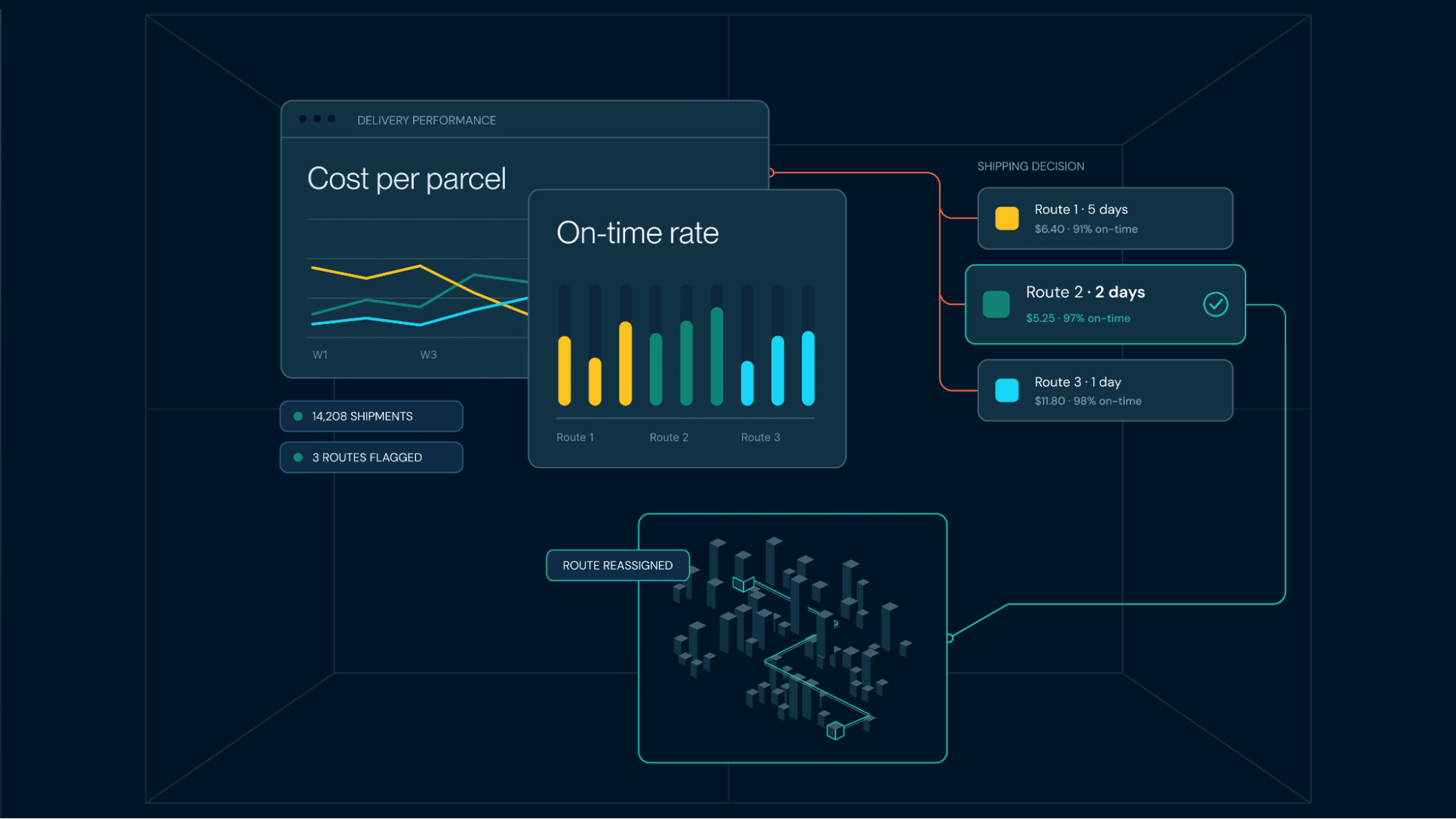
Live performance scores every carrier, so the platform reroutes at-risk orders before labels print.
Demand and inventory planning
Safety stock absorbs surprises, and you buy peak capacity only after volume has already spiked.
Forecasted demand by node positions stock and books capacity at contracted rates ahead of the surge.
Exception management
Teams learn about a problem when the customer contacts support, not when the package stalls.
Checkout scores risky addresses and underperforming carriers, so your team resolves the problem before dispatch.
Forecasting delayed deliveries and cost overruns moves your shipping decisions upstream, so you act on a probability while the package is still yours to route. The payoff shows up in:
- Lower parcel spend: Predicting transit times lets you buy the cheapest service that still meets the promised date.
- Fewer missed delivery dates: Measuring lane-level performance lets you promise a date the carrier will hold.
- Less safety stock: Forecasting demand by node lets you free up working capital tied to buffer inventory.
- Fewer fleet breakdowns: Monitoring maintenance signals lets you service assets during planned downtime.
- Faster disruption response: Anticipating weather and port delays lets you reroute before capacity tightens.
5 use cases for predictive logistics analytics
Let’s take a look at five applications of predictive logistics analytics for high-volume operators. Start wherever your process is most reactive today, because that’s where a late warning costs you most.
1. Demand forecasting and inventory planning
Demand forecast accuracy shapes every decision downstream. When inventory is positioned where demand occurs, carrier planning starts with reliable shipment volumes. An inaccurate starting number carries over to every subsequent order.
Predictive models trained on order history, seasonality, and your promotional calendar estimate demand at the SKU and node levels. You get a view of what each location will sell before the orders arrive, which is early enough to move the stock there.
Enterprise shippers are moving away from historical averages and toward models that read live signals. Gartner expects 70% of large organizations to adopt AI-based forecasting to predict future demand by 2030.
2. Route optimization and ETA prediction
Accurate transit-time predictions let you shorten lead time without buying expedited service. Customers convert at higher rates when the promised delivery date is sooner, and the retailer commits to it at checkout. In a Baymard Institute survey of shoppers who abandoned checkout, slow delivery ranked among the five most common reasons, with 21% citing it as a reason.
Last-mile carriers can make predictions difficult, as performance varies by zone, day of the week, and season — one carrier that hits its window in Dallas may run two days late in Seattle.
Shipium’s route optimization software combines inventory position with transit predictions to choose the origin for each order. Shipping from a location closer to the customer crosses fewer zones and makes ground service viable more often, so cost drops without stretching the delivery date.

3. Predictive maintenance for fleets
If you run your own fleet, telematics and maintenance history tell you which vehicles are trending toward failure. You service them on a scheduled day, at a planned cost, with the freight already covered.
Maintenance forecasting pays off more each year. American Transportation Research Institute (ATRI) found US truck repair and maintenance costs rose 8.6% per mile in 2025. The expenses then snowball: a vehicle breakdown strands every shipment along its route, leading to recovery freight, missed delivery windows, and increased support tickets.
4. Supply chain visibility and disruption alerts
Models watching weather, port congestion, and carrier network signals flag a disruption while you still have options. Decide in advance who owns the reroute and what they can change without approval. A supply chain analytics alert that lands with an analyst who needs sign-off to switch carriers expires before anyone acts on it.
5. Carrier selection and cost control
Carrier scorecards built from your own shipment history show which provider achieves the lowest cost per on-time parcel at each service level. That turns selection from a standing rule into a decision made per shipment. At 10 million shipments a year, shaving $0.05 off each parcel returns $500,000.
Per-shipment scoring also reshapes renewal negotiations. Lane-level cost per package gives you a hard number to open carrier contract management talks with.
Before deploying Shipium, Saks Fifth Avenue sent 100% of its parcels to a single carrier. With our platform, the retailer added five carriers in under three months, and Shipium now selects the best carrier for each shipment based on real-time factors.
See how our delivery promise engine turns predicted transit times into accurate customer delivery dates.
How to implement predictive analytics in logistics

Follow these five steps to get predictive logistics running inside the decisions that set your shipping costs and delivery dates.
1. Define the operational problem to solve
If you can’t attach a cost and a test to the problem, a model has nothing to aim at. “Late deliveries on ground service in the Northeast,” for example, is a valid problem, because you can price and measure it. Tie the problem to metrics you already report, such as your on-time rate against delivery service level agreements (SLAs), so you can later tell whether the model helped.
2. Audit and unify your logistics data
Predictive analytics for supply chain planning runs on shipment-level history: order date, promised date, actual delivery scan, carrier, service level, origin, and destination. You likely already have all of it, spread across an order management system (OMS), a warehouse management system (WMS), and carrier files that don’t agree on how they label anything.
Start by reconciling carrier, service-level agreements, and location identifiers across all your data sources. A model can’t tell the difference between a carrier that runs late and one whose delivery scans are recorded late.
3. Choose a predictive model or platform
MHI and Deloitte found 56% of supply chain leaders are increasing technology and innovation investment, and 52% plan to spend over $1 million. That spend goes one of two ways: a data team you staff, or a platform you configure. Legacy shipping systems make that choice harder than it looks. Static SLAs, IT-dependent configuration, and batch rate logic mean a carrier change takes a ticket and a release cycle instead of an afternoon.
Logistics management software with pre-trained carrier models removes the implementation, validation, and retraining work your data team would otherwise own.
4. Integrate predictions into shipping workflows
A prediction sitting in a dashboard changes nothing. It has to fire inside the decision itself: carrier selection when the label is created, the promised date you give at checkout, and the exception flag before dispatch. Skipping this integration step is why many AI-powered shipping pilots produce interesting charts but no savings.
5. Monitor accuracy and retrain models
Carrier performance drifts. Networks get redrawn, peak season rewrites transit times, and a model that was accurate in March quietly degrades by October. Track prediction error against what actually happened and retrain on a schedule. Retraining is part of running the system, so treat parcel shipping optimization as an ongoing practice with a named owner.
Apply predictive analytics in the shipping industry with Shipium
Shipping AI, the intelligence layer across the Shipium Platform, applies machine learning to carrier selection, routing, and delivery estimates. Trained on more than 350 million shipments and continuously tuned to each customer’s operations, the models predict probable transit speed for every carrier and method between any two ZIP codes in your network.
For high-volume operators, our shipping analytics platform offers:
- Automated carrier selection: The platform predicts the best carrier, route, and node for every shipment before the label prints and applies the same decision across your entire volume.
- Accurate delivery promises: Checkout shipping estimates model your inventory position, network transit times, and platform-wide carrier performance. Retailers that present our exact dates see a 4% increase in checkout conversion.
- Exception prevention: We predict exceptions before they happen, flagging underperforming lanes before dispatch, while the fix is still cheap.
- Shipping simulations: Before you shift your carrier mix or tighten a delivery date, we run predictive scenarios against your historical shipments so you can see the cost and transit impact first.

Book a demo to see how Shipium’s predictive analytics help set delivery promises and select carriers against your own shipment data.
Frequently asked questions
How do enterprise shippers use predictive analytics to reduce carrier costs?
Enterprise shippers use predictive analytics to forecast the cost and delivery performance of different carrier and service options for each shipment. By identifying which lower-cost services are still likely to meet the promised delivery date, they can avoid unnecessary premium shipping, improve carrier allocation, and reduce transportation spend without sacrificing customer expectations.
Shipium applies these predictions during shipment planning and carrier selection, helping shippers choose the most cost-effective option.
How can I improve delivery accuracy without building in-house AI?
You can improve delivery accuracy without in-house AI by deploying a platform with pre-trained predictive solutions. Shipium, for example, uses artificial intelligence to forecast transit time, fully loaded cost, and daily volume, then sets checkout dates and selects carriers from those predictions. Our machine learning models learn from your existing shipment and carrier records, so accuracy improves over time.
Explore the top use cases for AI in logistics.
What technology do large retailers use to predict and reduce shipping exceptions?
To reduce shipping exceptions, most large retailers run three technologies inside their shipping platform rather than a separate analytics tool:
- Address validation stops bad-address exceptions before an order is released.
- Carrier performance scoring catches lanes that have started running late.
- Machine learning models flag orders that resemble past failures.
How do I reduce shipping exceptions with predictive analytics?
You reduce shipping exceptions with predictive analytics by scoring each order for risk and acting on that score before it ships, because prevention costs a fraction of recovery. With Shipium, those checks run automatically, so the delivery exception never reaches a customer or a support queue.
How does predictive analytics for supply chain support logistics planning?
Predictive analytics for supply chain supports logistics planning by putting demand estimates on a weekly or daily refresh cycle, so capacity and labor decisions move at the speed at which the network changes, rather than on a quarterly planning cadence.
How does predictive analytics in transportation improve on-time delivery?
On-time delivery improves when predictive analytics in transportation estimates transit time from real carrier results, lane by lane, so the dates you promise reflect actual performance. The same signals flag shipments that are trending late while a reroute is still possible, protecting the original date.
Is predictive analytics the same as logistics forecasting?
No, predictive analytics and logistics forecasting are not the same, though the two overlap. Forecasting projects volumes and demand across a planning horizon, usually weekly or monthly. Prediction goes further, estimating outcomes for individual shipments, such as whether one order will miss its promised date.
-
 Read more
7 Key Steps to Efficient Parcel Spend Management
Ecommerce parcel cost represents a large portion of the expenses that chip away at…
-
Read more
10 Ecommerce Shipping Best Practices Every Company Should Follow
For enterprise ecommerce businesses, shipping doesn’t just represent a significant portion of operating expenses…
-
 Read more
17 Leading Shipping Analytics Tools and Software for 2026
Shipping is one of the most controllable costs in ecommerce, but only if the…
-
 Read more
5 Ways to Effectively Manage Ecommerce Shipping Delays
More than two-thirds of customers have experienced at least one delayed delivery in their…