


For enterprise ecommerce businesses, shipping doesn’t just represent a significant portion of operating expenses — it’s also a primary driver for their customers’ overall experience.
Key highlights:
- Best practices for shipping and fulfillment in ecommerce include offering multiple delivery options at checkout, providing customers with accurate estimates, optimizing your packaging, and more.
- Advanced shipping software like Shipium connects your OMS, WMS, and TMS to automate carrier selection, rate shopping, and delivery promise calculations at scale.
Follow these 10 must-know ecommerce shipping best practices to keep your operations efficient and cost-effective.
Offer multiple ecommerce shipping options
Some consumers prioritize expedited shipping, while others look for cheaper options. That’s why you should offer customers different shipping methods, balancing low prices and speed. Doing so expands the range of customers you cater to, reducing cart abandonment and leading to greater conversion rates. Consider these strategies:
Empower customers to balance cost and speed
If you offer buyers different ecommerce shipping options, you accommodate both groups — those who prefer to have their order arrive as fast as possible and those who are more cost-sensitive.
The video game ecommerce platform GameStop, for example, implements this strategy by offering two shipping options and a click-and-collect alternative, where customers can buy online and pick up their order in-store. By removing potential friction points in the purchase process, the company increases the likelihood of conversion.

Free shipping thresholds based on order value
By offering free shipping on orders above a certain value, businesses encourage customers to increase their cart size, boosting average order value (AOV). For example, if your AOV is $45, setting a $60 threshold can nudge customers to add another item.
This approach is beneficial because it improves profitability per order and the customer experience by offering a perceived savings opportunity, which builds loyalty and encourages repeat purchases.
Discover the economics behind free shipping programs.
Offer split shipping or consolidation options
Giving customers the option to choose whether to receive packages together or separately can improve customer satisfaction. For example:
- Some customers may opt for split shipment, preferring faster delivery of in-stock items while waiting for back-ordered products to arrive.
- Other clients might prefer to consolidate shipping across purchases to lower costs.
Explore our guide to parcel shipping optimization.
Provide accurate ecommerce delivery predictions
Consumers are more likely to purchase if they know when to expect order delivery. To make a precise delivery promise and improve your client’s ecommerce delivery experience, consider these shipping best practices:
- Use predictive analytics to refine estimates: Ensure customers receive accurate information even when real-time issues arise. Predictive analytics enables businesses to anticipate and adapt to potential disruptions, such as weather conditions or traffic accidents, enhancing customer brand trust and loyalty.
- Track macro-environmental changes: Economic fluctuations, new regulatory shifts, and many other macro-environmental changes challenge ecommerce stores to maintain their estimated delivery dates (EDD). Use flexible tracking systems to guarantee smooth transitions during major policy or technology changes.
- Manage delays with real-time carrier data: Tracking your shipment with delayed data can lead to blind spots in your logistics operation. Use systems that provide real-time data to prevent disruptions proactively and guarantee customer satisfaction.
Improve your order tracking
Providing visibility into a package’s journey not only builds trust but also reduces operational burdens like “Where Is My Order?” (WISMO) inquiries.
High-performing ecommerce companies use advanced tracking systems to deliver an exceptional post-purchase experience while automating internal operations. Here’s how.
- Give proactive status updates: Customers shouldn’t have to ask for news about their orders. Go omnichannel to reach them in the most suitable ways, such as SMS, emails, or even in-app notifications about their estimated delivery dates.
- Mobile tracking capabilities: Make sure to offer mobile-friendly product tracking pages, allowing your customers to stay informed about their deliveries on the go.
- Ensure last-mile visibility: Ensure that your carrier network, including regional and specialized last-mile providers, offers API integrations to track last-mile delivery, allowing you to offer accurate delivery updates for your customers.
Optimize your packaging
Every box counts for delivery efficiency. Ecommerce businesses can cut dimensional weight charges and reduce damage-related returns simply by minimizing packaging waste. Best practices include:
- Implementing right-sized boxes and mailers: Minimize dimensional weight charges and the use of excess filler material. This best practice helps to cut down shipping costs and create a more sustainable ecommerce delivery process.
- Selecting the best void fill and protective materials: Keep products secure during transit and minimize the likelihood of damage and returns, which could lead to customer dissatisfaction and additional costs.
- Adopting custom packaging for frequent sizes: Accelerate the packing process, improve warehouse efficiency, and reinforce brand identity through consistent packaging.
Discover how Shipium’s Packaging Optimization optimizes your cartonization strategy.
Implement real-time address validation
Failed deliveries are expensive. Validating an address before the order reaches a warehouse lets you fix any issues that may appear beforehand. Modern shipping technology provides:
- Address verification at checkout: Platforms like Shipium cross-check entered addresses against official databases, like USPS. This process ensures every detail — street name, city, ZIP code — is valid and up to date before routing orders.
- Address standardization: Address validation tools automatically format input addresses to meet postal standards — whether it’s fixing mixed-up apartment number formatting for customers in Buenos Aires or adjusting postal code conventions for buyers in Madrid. Ensure compatibility across different delivery partners and reduce the risk of rejected or delayed shipments.
Secure competitive carrier rates
Carrier shipping rates are among the most expensive parts of shipping for ecommerce. Securing competitive prices is key to maintaining profit margins in a highly competitive market.
Follow these three ecommerce shipping best practices to make the best carrier agreements:
- Negotiate volume-based discounts: Planning high-volume order shipments with a carrier can help you negotiate discounts. For instance, committing to ship 200,000 packages monthly might unlock tiered pricing in a deal that benefits both sides.
- Set favorable service level agreements (SLAs): Include performance metrics in your shipping carrier contracts, such as on-time delivery percentages, handling of exceptions, and transparency in tracking. SLAs ensure your carriers are accountable while delivering quality service.
- Implement carrier management software: After securing the best rates, using a software solution to manage your carrier contracts can ensure you fully leverage your negotiated agreements and consistently monitor them.
Learn how to negotiate carrier rates with our in-depth playbook.
Diversify your carrier network
Relying on a single carrier creates vulnerabilities in your ecommerce shipping process, such as service disruptions due to carrier delays, strikes, or capacity shortages. It can also lead to higher costs during peak seasons when demand outpaces carrier capacity.
That’s why strategic carrier selection and diversification improve your network resilience and reliability, even during unforeseen disruptions.
Get started with:
- Multi-carrier management tools: Use solutions like Shipium’s Rating Engine to manage multiple carriers and simplify carrier selection decisions.
- Cost-based routing: Automate carrier selection based on delivery cost and transit times, ensuring optimized shipping delivery.
- Proactive disruption mitigation: In cases where a carrier is overloaded or experiences delays, alternate carriers can immediately step in to maintain on-time delivery rates and preserve customer trust.
Partner with regional carriers
Partnering with regional carriers is critical to last-mile optimization and cost reduction because they can provide advantages that enterprise carriers can’t. Let’s review the benefits:
- Reduced time-in-transit: Regional, last-mile carriers often have better network coverage and delivery routes within specific geographic areas, allowing them to deliver packages faster than national carriers in dense urban zones or remote rural locations.
- Local market expertise: Local companies are familiar with the areas they serve, including traffic patterns, customer preferences, and regional shipping quirks. Their localized knowledge often translates into smoother and more efficient deliveries, reducing errors and delays.
- Specialized services: Many regional carriers offer unique services tailored to specific needs, such as same-day delivery, temperature-controlled shipping, or flexible pickup and drop-off options. These delivery options can provide competitive differentiation for your business.
See how Shipium’s pre-integrated carrier network helps you find regional delivery partners.
Streamline returns management
By offering convenient and efficient return options, you not only meet customer expectations but also differentiate your business, transforming these “not-so-good” aspects of online business into a competitive advantage.
Here are three shipping best practices for improved ecommerce return management:
- Refine your return tracking system: Use the right technology and processes to track returns on time. A robust system tracks and updates every step from start to finish of a refund or exchange. It reduces errors, cuts delays, and boosts efficiency. This automation creates a better experience for customers and internal teams.
- Offer multiple return options: Make the process more convenient by providing options like in-store returns, prepaid shipping labels, or third-party drop-off locations. This type of flexibility caters to various preferences and strengthens customer service.
- Process refunds quickly: Show customers that you value their time and satisfaction. Offering rapid returns minimizes frustration and increases the likelihood of repeat purchases.
Adopt advanced ecommerce shipping software
From real-time decision-making to seamless integration with existing systems, ecommerce shipping software helps you enhance efficiency, reduce costs, and meet growing customer expectations for their delivery experience. With a modern solution, you get:
- Real-time rate shopping capabilities: Compare shipping rates across multiple carriers in real time to select the most cost-effective option for every shipment. By leveraging fully loaded rate shopping, you go beyond basic rate comparisons to account for all associated costs, such as accessorial fees and surcharges. This comprehensive approach ensures you always choose the option that delivers true cost savings.
- Advanced inventory insights: Analyze and optimize inventory placement across your network. By strategically positioning inventory closer to demand, you reduce shipping distances, minimize delivery times, and cut costs. Advanced insights also provide real-time visibility into stock levels, enabling faster replenishment and preventing overselling, for a smoother and more efficient ecommerce delivery experience.
- Tech stack integration: A positive customer shipping experience starts with smooth internal fulfillment operations. Integrate all of your tech stack, including transportation management systems (TMS), order management systems (OMS), and warehouse management systems (WMS), to cut manual steps from your workflows and reduce fulfillment errors.
Follow shipping best practices with Shipium
Shipium helps ecommerce businesses manage the complexity of modern logistics by improving delivery speed, optimizing carrier selection, and enhancing delivery dates.
Through the Shipium Console, you can quickly respond to supply chain disruptions and reduce costs around network maintenance and updates.
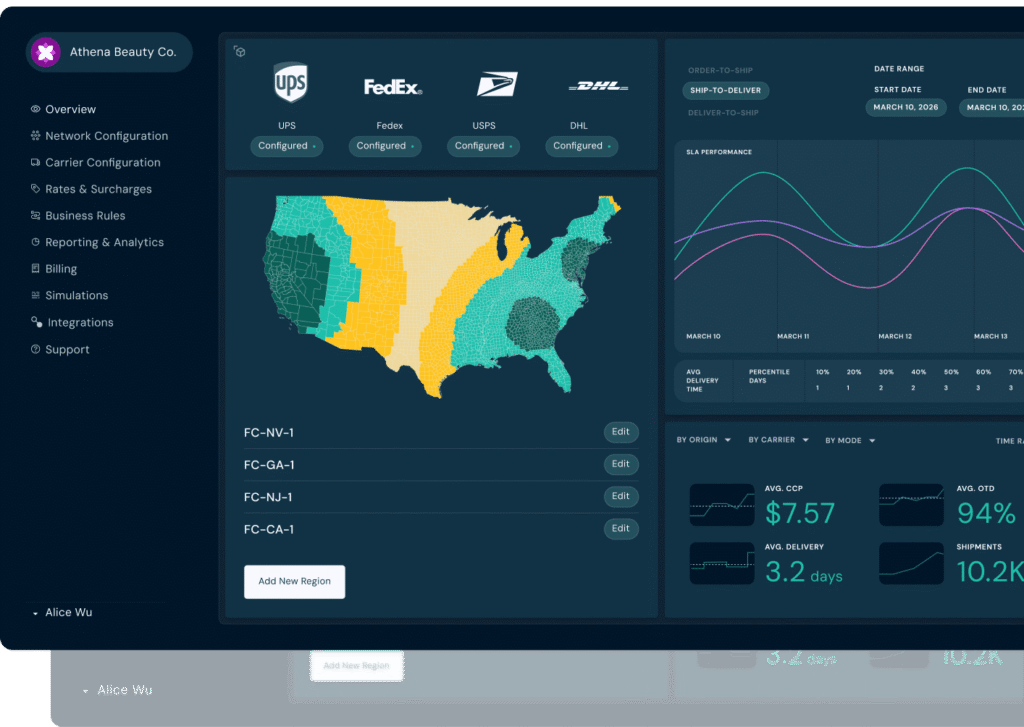
Our API-first platform integrates with your existing systems (including OMS, WMS, ERP, and TMS), enabling you to automate decisions like:
- Selecting the best carrier for each shipment
- Calculating delivery promises in real time
- Choosing the right origins to fulfill orders through Route Optimization
With our powerful AI models, you can lower per-shipment spend and increase on-time delivery rates — giving customers the consistent experience that drives repeat purchases.
Book a demo today and see how enterprise operations keep up with ecommerce shipping best practices with Shipium.
Frequently asked questions
How do I calculate the right free shipping threshold for my business?
To calculate a free shipping threshold, start with your average order value (AOV). The goal is to set a target high enough that the larger order size offsets your shipping cost, but reachable enough that customers act on it. If your AOV is $35, a $50 threshold is one example of that balance: it’s close enough to nudge customers to add an item, without asking them to double their spend.
Before setting a number, calculate your fully loaded cost per shipment — base rate, dimensional weight charges, and any accessorial fees — so you know exactly what margin you’re protecting on each order.
These factors should also inform where you set your free shipping threshold:
- Product weight and size: Heavy or bulky catalogs carry higher per-unit shipping costs, which means your threshold needs to account for a wider cost range across customer orders.
- Carrier zone distribution: If a large share of your order fulfillment goes to high-cost zones, your average shipping spend will exceed the base rate.
- Competitive benchmarks: Check what comparable retailers in your category charge for shipping, since customer expectations can be shaped by category norms.
Revisit your free shipping policies at least twice a year. Carrier rate changes, fuel surcharges, and seasonal shifts in order volume all affect whether your original threshold still protects margins.
What are the ecommerce shipping best practices for managing multiple fulfillment locations?
Running multiple fulfillment locations adds complexity to every shipping decision — for example, which node fills the order, which carrier picks it up, and whether the routing logic accounts for current inventory levels across the network. Effective ecommerce shipping best practices at this scale require a platform that connects your fulfillment nodes to a single decision layer, so carrier selection and order routing happen automatically rather than manually per shipment.
To manage multiple fulfillment locations, consider these best practices:
- Maintain real-time inventory visibility across all nodes: Track stock levels at each location so you can route orders to the right facility without risking split shipments or stockouts.
- Apply zone-based routing logic: Route orders automatically to the fulfillment center closest to the delivery address, cutting transit time and carrier cost on every shipment.
- Build supply chain disruption protocols: If one location experiences delays or capacity constraints, your system should reroute volume to the next best node without manual intervention.
Shipium’s AI applies best practices for shipping and fulfillment in ecommerce at the routing layer — evaluating inventory position, delivery promise, and fully loaded rates across your entire network to assign each order to the optimal origin.
Do ecommerce businesses need shipping insurance?
For most high-volume ecommerce businesses, shipping insurance is worth carrying, but the decision depends on what you’re shipping and who absorbs the cost of a lost or damaged order. Insurance matters most for high-value goods, fragile items, or international shipments where claims are harder to resolve, and carrier liability limits rarely cover the full product value.
What are the best shipping practices for handling delivery failures or delays?
To address delivery failures and delays before they affect customers, follow these four ecommerce shipping best practices:
- Integrate real-time carrier data: Delayed or batched tracking info leaves gaps in your logistics visibility. Enterprise shipping software that pulls in live carrier status lets your team catch exceptions before customers notice.
- Set automated customer notifications: Configure threshold triggers (e.g., a shipment that hasn’t scanned in 24 hours) to send order updates automatically without manual monitoring.
- Build carrier backup routing: When a carrier hits systemic delays, your platform should reroute new orders to an alternate carrier immediately, not after the problem compounds.
- Document failure patterns: Track failures by carrier, route, and season. That data gives your team the evidence needed to renegotiate SLAs, adjust carrier mix, or shift volume ahead of the next disruption cycle.
-
 Read more
Dangerous Goods Declaration: The Complete Guide
Dangerous goods — from lithium batteries in electronics to flammable chemicals in industrial manufacturing…
-
 Read more
FedEx One Rate vs Standard Rate: Shipping Options Explained
Every supply chain decision has downstream effects on the efficiency of your ecommerce operation.…
-
Read more
How to Reduce Freight Costs: A Guide for Enterprises
Logistics leaders are under pressure to cut costs while maintaining fast, reliable delivery. The…