

As programs like Amazon Prime reshaped consumer expectations, fast and flexible shipping has become a competitive necessity for ecommerce businesses. Customers expect a variety of shipping choices that balance speed, cost, and convenience. When faced with expensive options and long delivery estimates, many abandon their carts.
Your business needs to offer ecommerce shipping options that cater to customer needs — whether it’s urgency or affordability.
Key highlights:
- The best shipping options for ecommerce include same-day delivery, overnight shipping, 2-day shipping, economy services, flat-rate shipping, free shipping, local pickup, and more.
- To choose the right delivery methods for your shipping strategy, you need to balance speed, cost, and customer demand.
- By offering a mix of options, you can match each order (depending on package size, delivery urgency, and destination) with its ideal shipping method.
- With Shipium’s AI-driven fulfillment optimization platform, you can compare ecommerce shipping methods and automatically select the best one for your strategy.
16 best shipping options for ecommerce businesses
There is no right formula for building a successful shipping strategy. According to the Green Mountain Benchmark Report, most retail customers now expect their purchases to arrive within three to five days.
But from an operational point of view, ensuring orders arrive within two business days might require a well-distributed warehouse network and an effective carrier management system. And there might also be cases where the customers themselves are willing to wait in exchange for reduced shipping costs.

Let’s look at the 16 best shipping options that ecommerce businesses can use to strategize and maintain accurate delivery promises to customers:
1. Same-day delivery
Same-day delivery requires your company to establish partnerships with fulfillment services or own warehouses strategically placed close to major buyer hubs to ensure rapid order processing and dispatch. This shipping option is particularly effective in large urban centers because of high population density and shorter delivery distances.
By leveraging machine learning (ML), you can better understand where your customers live — optimizing your inventory placement strategy. For example, the Shipium platform applies ML models to your shipping data to help you make more intelligent logistics decisions that streamline same-day deliveries.
2. Overnight shipping
Expedited overnight shipping is commonly used for high-priority shipments, such as perishable goods or pharmaceuticals, which often require guaranteed next-day delivery. However, this method creates operational challenges, requiring you to negotiate carrier contracts and charge customers higher rates.
One strategy for lowering your shipping expenses and improving the efficiency of your deliveries is working with regional last-mile carriers that specialize in shorter, localized routes, helping you avoid premium overnight fees from national carriers and increasing logistics flexibility.
3. 2-day shipping
While major carriers like FedEx, UPS, and USPS provide 2-day shipping options for ecommerce, relying solely on them can leave you with little to no room to adapt on the fly. If these carriers experience delays, for example, your business is directly impacted. Expanding your carrier network to include regional and specialized partners offers flexibility and cost control, particularly when navigating price fluctuations or busy seasons.
Learn how to add a 2-day shipping program to your ecommerce business.
4. Economy options
Economy shipping options for ecommerce can boost conversions by providing customers with cheaper delivery. This method is commonly used for non-urgent orders, lightweight items, and international shipments, where cost savings outweigh fast delivery times.
While this shipping method offers longer timeframes, if you let customers choose between these and other options, you can accommodate groups with different needs — those who prefer to have their order arrive as quickly as possible and those who are more cost-conscious.
Read also: Shopify fulfillment best practices for ecommerce businesses
5. Standard ground shipping
Standard ground delivers orders in three to five business days through established carrier networks like FedEx Ground and UPS Ground. When building a tiered rate strategy, this ecommerce shipping option works well as a baseline delivery service alongside faster options. Use this method for consistent tracking, predictable transit windows, and service-level accountability.
6. Flat-rate shipping
Offering a flat-rate shipping option, like FedEx One Rate, allows you to ship items for a fixed cost, making your bottom-line expenses much more predictable. Most carriers define a size and weight limit, and as long as your items fit into the provided boxes, you’re good to go. This method is one of the best ecommerce delivery options for small items, such as books or minor electronic devices.
7. Table-rate shipping
Table-rate shipping calculates what a customer pays based on a set of rules you define — typically a combination of order weight, destination zone, cart value, or item count. This method gives ecommerce leaders more pricing control than flat-rate shipping, which charges a fixed cost regardless of order characteristics.
Common rule sets for table-rate shipping include:
- Weight-based tiers: Rates increase as package weight crosses defined thresholds
- Cart value thresholds: Higher-value orders qualify for reduced or free shipping
- Zone-based pricing: Rates adjust based on how far the order ships from your fulfillment location
Table-rate shipping is one of the more flexible shipping options for online stores with a diverse product catalog. It’s particularly useful when a single flat rate would either overcharge customers on light orders or undercharge on heavy ones.
8. Real-time rate shipping
Real-time rate shipping presents customers with accurate shipping costs at checkout based on the shipment’s actual weight, dimensions, and destination, rather than a fixed price set in advance.
The deeper value of real-time rate shipping sits behind checkout, at the courier selection layer. When your shipping platform evaluates fully loaded rates across your carrier network in real time, you can route each order to the lowest-cost option that still meets your delivery promise.
Shipium’s AI applies this logic automatically to every shipment, so ecommerce shipping options at checkout stay accurate while your team avoids the manual rate comparisons that can slow fulfillment decisions.
9. Free shipping
While building a free shipping program can drive cart conversions for your business, you need to offset the costs strategically — because offering this option to your customers isn’t as simple as absorbing the expenses.
Free ecommerce shipping methods:
- Provide a competitive advantage against marketplaces like Amazon Prime, which grew due to free shipping programs.
- Can be used strategically with thresholds (e.g., “Free Shipping on Orders Over $50”) to increase average order value (AOV).
Explore the economics behind free shipping programs.
10. Local pick-up
According to the Future Shopper Report, 61% of customers prefer retailers that offer both online and physical stores, indicating that today’s shoppers want flexibility in how they make and receive their purchases. This rising demand for omnichannel shopping experiences requires businesses to integrate their digital and physical operations — a strategy that can offer logistical challenges such as inventory management.
Unlike traditional delivery, local pick-up allows people to retrieve their orders from a physical store, warehouse, or third-party depot close to their location.
11. Locker delivery and pickup points
Locker delivery routes orders to a secure, unstaffed pickup location, such as UPS Access Points, Amazon Lockers, or InPost terminals. This method can be a practical last-mile delivery option in high-density urban markets where home delivery attempts frequently fail or require redelivery. Locker networks also extend your delivery coverage without requiring additional fulfillment infrastructure.
12. Carbon-neutral and eco-friendly shipping
Couriers like UPS, FedEx, and DHL now offer certified carbon-neutral shipping options for businesses responding to customer demand or internal sustainability commitments. Enterprise ecommerce teams can use these lower-emission carrier programs, route consolidation, and sustainable packaging choices to make sustainable shipping cost-competitive with standard options.
13. Subscription shipping
Subscription shipping programs allow customers to set up recurring deliveries of products they regularly purchase, offering both convenience and often discounted rates. This option provides predictable, recurring revenue for businesses and helps build customer loyalty through regular engagement.
This specific shipping method requires precise demand forecasting and reliable inventory management. This is especially true if subscription items are also available as one-off purchases both online and in stores, which can lead to stockouts.
Read also: 10 ecommerce shipping best practices every company should follow
14. Freight shipping options
Freight shipping is essential for businesses running high-volume operations or handling large, bulk orders — such as wholesalers, manufacturers, and furniture retailers. Freight services offered by nationwide carriers such as FedEx or UPS provide cost-effective solutions for transporting oversized or heavy goods that exceed standard carrier limits.
15. International shipping
International shipping can expand your reach to new customer bases and emerging markets, increasing your revenue potential. However, cross-border logistics also introduce new challenges for your operation, from managing carrier networks and compliance norms to tariffs, taxes, and complex customs requirements.
To avoid longer-than-expected delivery times, choose reliable global carriers, such as DHL, FedEx, and UPS, which offer extensive international shipping networks and customs support.
16. Hybrid shipping
Hybrid shipping moves a single order through more than one transportation partner — typically a national carrier for the long-haul leg and a regional or final-mile carrier for the last stretch of delivery. This model is one of the best shipping options for ecommerce businesses managing orders across geographically dispersed customer bases, because it pairs competitive long-distance rates with the speed and cost efficiency of regional partners near the destination.
But managing hybrid routing manually adds operational complexity. A distributed order management system that connects fulfillment locations, carrier selection logic, and real-time rate data is what makes this strategy executable at scale.
How to manage ecommerce shipping methods for your enterprise business
To effectively manage and select the best ecommerce shipping methods, consider implementing a software solution that takes into account these four factors:
1. Total parcel spend
There is increased pressure on ecommerce businesses to find cost-efficient solutions to lower total parcel spend. Strategies to minimize shipping costs without compromising quality of service include:
- Optimizing inventory placement to cut down on costs and enable competitive shipping methods for online stores, such as same-day delivery.
- Improving your cartonization decision-making upstream, ensuring you select the right-sized packaging for your shipments.
Learn how retailers can win back leverage in the great carrier war.
2. Consolidation opportunities
According to data from Flock Freight, 43% of freight truckloads moved partially empty in 2023. Strategic load consolidation, which helps operators avoid split shipments, is one effective way to minimize this typical shipping inefficiency.
Load consolidation works by:
- Combining multiple small orders going to the same region into a single, optimized cargo load to reduce per-unit shipping costs.
- Using ML and AI-powered tools to forecast demand and shipping patterns. This tactic allows operators to preemptively consolidate shipments for maximum efficiency.
3. Carrier management
Relying too heavily on a single carrier can leave businesses vulnerable to rate hikes and capacity constraints due to macro-environmental changes. At the same time, using different shipping methods in ecommerce can be expensive depending on carrier volume commitments, service levels, and regional coverage.
A multi-carrier strategy, combined with data-driven carrier selection with fully loaded rates, helps ecommerce businesses maintain delivery times efficiently and keep shipping costs in check. Equally important is negotiating rates based on shipment volume to secure carrier discounts.
Learn how to negotiate carrier rates.
4. Shipping technology and integration
Choosing the right ecommerce shipping options is only part of the equation for an efficient fulfillment strategy — having the right shipping technology to support and optimize those delivery choices is what really drives your operation’s efficiency.
The success of your logistics depends on the direct integration between your order management system (OMS), warehouse management system (WMS), and TMS. When these platforms don’t communicate effectively, businesses face data silos and limited visibility into inventory and shipping operations. A disconnected tech stack leads to delays, inefficiencies, and rising costs — so centralizing data and automating decision-making is crucial for scalable, high-performance logistics.
Optimize your ecommerce delivery options for cost and speed with Shipium
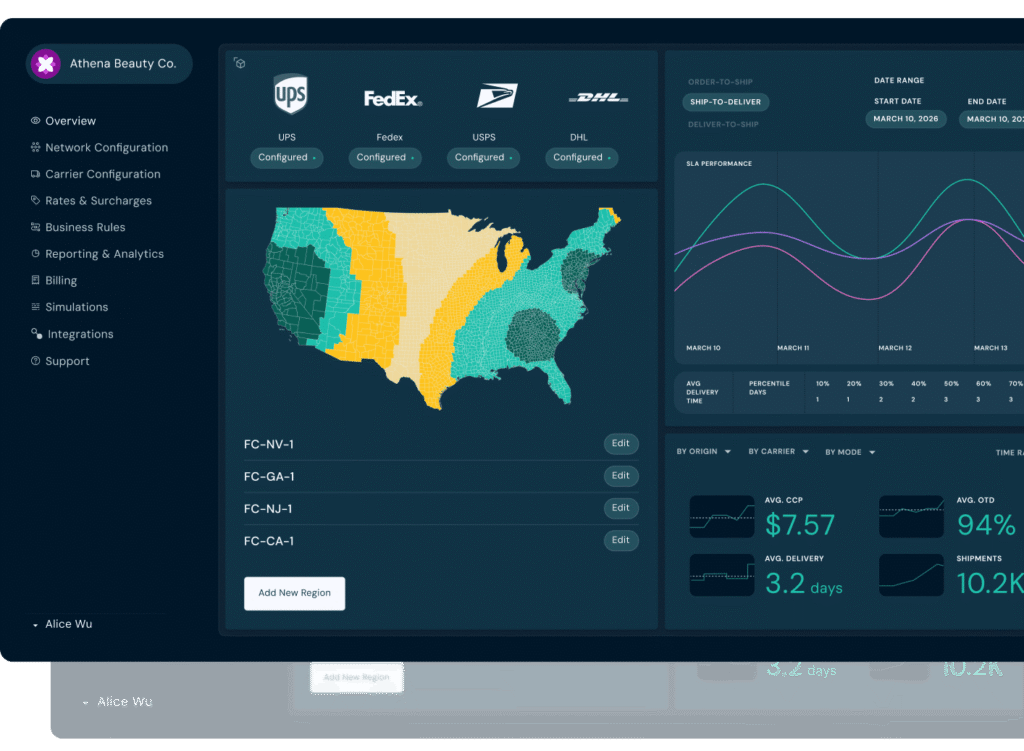
Choosing the right ecommerce delivery options requires smart decision-making at every stage of your fulfillment process to ensure orders remain cost-effective. With Shipium’s end-to-end enterprise shipping platform, you can integrate processes from your existing systems (including OMS, WMS, ERP, and TMS) to automate decisions like:
- Selecting the best carrier for each shipment with our AI-driven Rating Engine
- Calculating delivery promises in real time
- Fulfilling orders from the most strategic locations with Route Optimization
With the Shipium Console, you also respond more effectively to changes in your supply chain operations and reduce costs for network maintenance and updates.
Book a demo today and see how Shipium streamlines the management of ecommerce shipping options.
-
 Read more
How to Future-Proof Your 3PL Ecommerce Fulfillment Strategy
The role of third-party logistics (3PL) ecommerce fulfillment has changed. What was once a…
-
 Read more
Everything You Need to Know About Third Party Logistics Companies
Whether you’re a high-volume shipper looking to better manage fulfillment in specific geographic locations…
-
 Read more
How to Calculate and Improve Cart Conversion Rate
Since the first secure online purchase over 30 years ago, ecommerce has grown exponentially…