
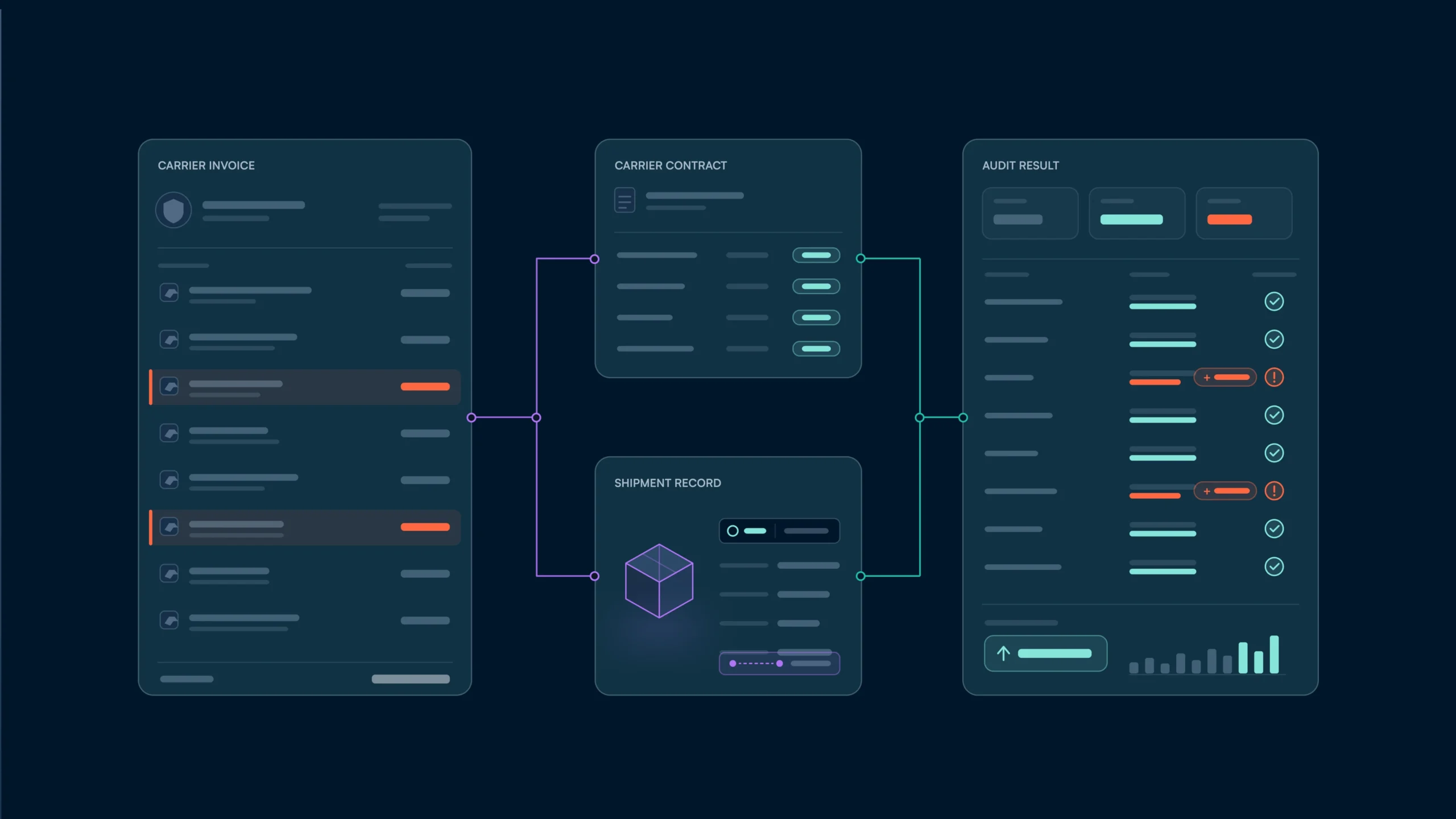

Freight audit gives you control over your carrier spend, one of the highest controllable costs in your supply chain. A structured audit compares each invoice charge against your carrier contract and shipment record, so you pay only the rates you negotiated, recover credits for billing errors, and give your finance team accurate shipping costs to plan against.
This guide covers the seven steps of the freight audit process, the benefits for finance and logistics teams, the best practices that keep audits accurate, and the technologies that automate the work.
Key highlights:
- The freight audit process matches each carrier invoice to its shipment, validates rates and surcharges, and resolves discrepancies before payment.
- Freight invoice auditing lowers transportation spend, reduces manual accounts payable work, and gives finance accurate cost data.
- Shipium runs freight audit continuously for parcel shipping, checking every charge against the rate and contract data the platform recorded at execution.
What is freight audit and payment?
Freight audit and payment is the process of checking carrier invoices against contracted pricing, shipment records, and service terms before money leaves the business.
Invoice verification catches errors such as incorrect base rates, misapplied accessorials, and duplicate charges, while settlement approves each corrected bill, assigns it to a cost center, and pays it.
You can apply freight audit to every shipping mode, and each mode bills differently:
- Parcel: Small-package carriers price by weight, zone, and service level.
- Less-than-truckload (LTL): LTL carriers price by weight, freight class, and lane, with a minimum charge per shipment.
- Full truckload (FTL): Truckload carriers usually price per lane or per mile, plus a fuel surcharge.
- Air cargo: Air carriers price by chargeable weight, which is the greater of actual weight and volumetric weight.
- Ocean cargo: Ocean carriers price per container for full loads, or by volume or weight for shared container loads.
How does the freight audit process work: 7 steps
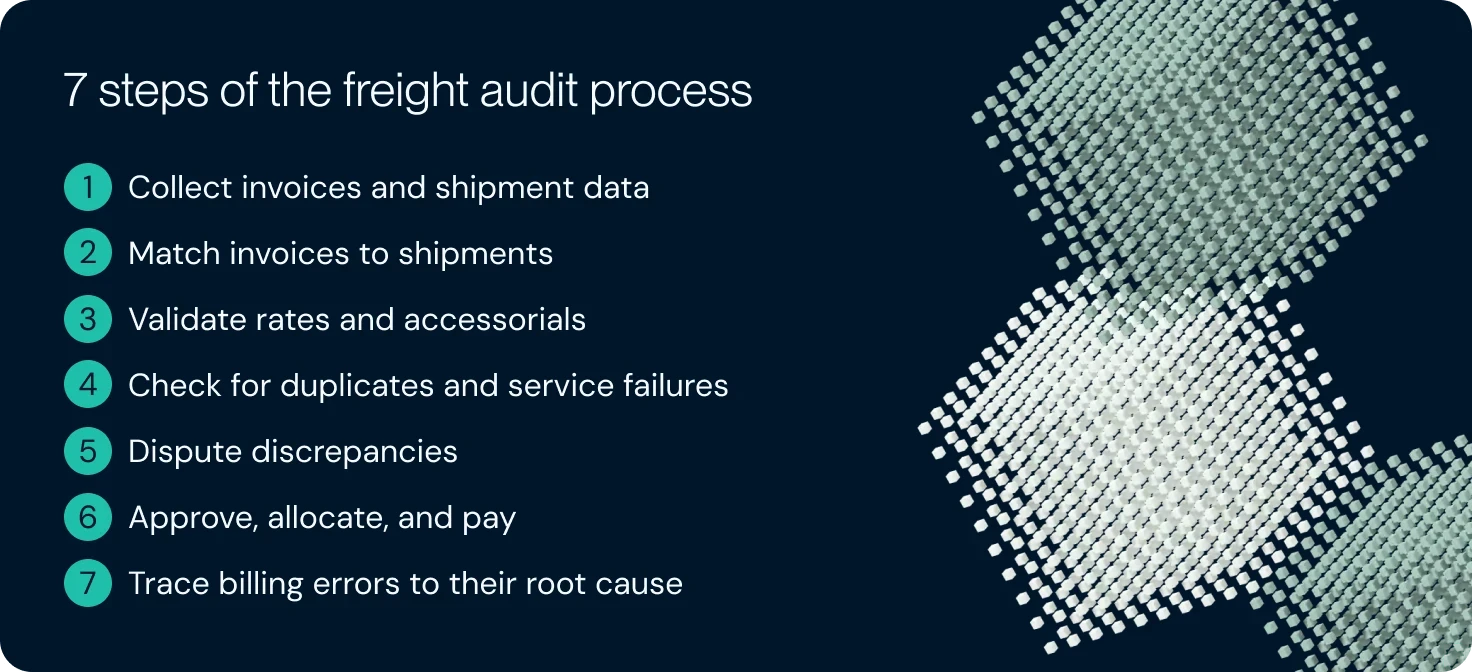
The freight audit process runs from invoice collection to spend analysis. Each step depends on clean shipment data, since every check compares a billed amount against a known expected cost. Start by:
1. Collecting invoices and shipment data
Carrier invoices reach your accounts payable (AP) team through electronic data interchange (EDI), API feeds, carrier billing portals, email, and paper. For each invoice, gather the shipment details you need to verify it:
- Shipment identifiers: The tracking or PRO number and ship date link each invoice line to one shipment.
- Package measurements: The weight and dimensions you recorded at packing determine the billable weight.
- Origin and destination: The pickup and delivery addresses set the zone or lane the carrier should charge.
- Service level: The delivery speed you selected sets the rate and any guaranteed delivery date.
Pull these details from your shipping platform, warehouse management system (WMS), or transportation management system (TMS), since your own records are the baseline for every later check.
2. Matching invoices to shipments
Connect each charge on a carrier invoice to the specific shipment it bills for, using the parcel tracking number or LTL PRO number. Every invoice charge should match exactly one shipment in your shipping records.
An invoice charge with no matching shipment in your records can mean the carrier billed your account for another company’s package or charged for a label you voided before shipping. Send each unmatched charge to manual review before you pay the invoice.
3. Validating rates and accessorials
Recalculate each base rate from your carrier contract using your negotiated discounts, the correct zone, and billable weight. Billable weight is the greater of a package’s actual weight and its dimensional weight.
Check the fuel surcharge against the percentage the carrier published for that ship week. Then review each accessorial fee for errors, such as a residential surcharge on a business address or a liftgate fee at a facility with a loading dock.
4. Checking for duplicates and service failures
Duplicate billing happens when a carrier charges one shipment twice, on the same invoice or across separate statements, so compare tracking numbers across open and recently paid invoices.
For carrier service failures, compare delivery scans with guaranteed delivery dates. A late package can qualify for a refund when your carrier honors a money-back guarantee for that service.
5. Disputing discrepancies
File each dispute through the carrier’s billing portal, EDI, or your account representative. Attach the evidence the carrier needs to approve it:
- Your contract rate
- The recorded weight and dimensions
- The delivery scan
- The invoice and tracking numbers
Carrier service guides and contracts set deadlines for billing disputes, so file each one as soon as your audit flags the error. Log every dispute with its filing date, amount, and status, and confirm the carrier posts the credit on a later invoice before you close it.
6. Approving corrected invoices and allocating each charge
Invoices that pass every check, along with corrected amounts, move to approval. Assign each charge to a general ledger (GL) code, cost center, or customer account, then pay the undisputed lines on time.
Accurate allocation lets your finance team book shipping accruals that match actual spend and report shipping cost by facility, channel, or client.
7. Tracing recurring billing errors to their root cause
Group your audit findings by carrier, service, lane, and error type to see which billing problems keep recurring. A spike in dimensional weight adjustments from one warehouse, for example, can point to outdated item dimensions or the wrong box size at a packing station, two problems packaging optimization addresses.
Track exception frequency by carrier alongside the shipping KPIs your logistics team already reviews.
What are the benefits of freight invoice auditing?
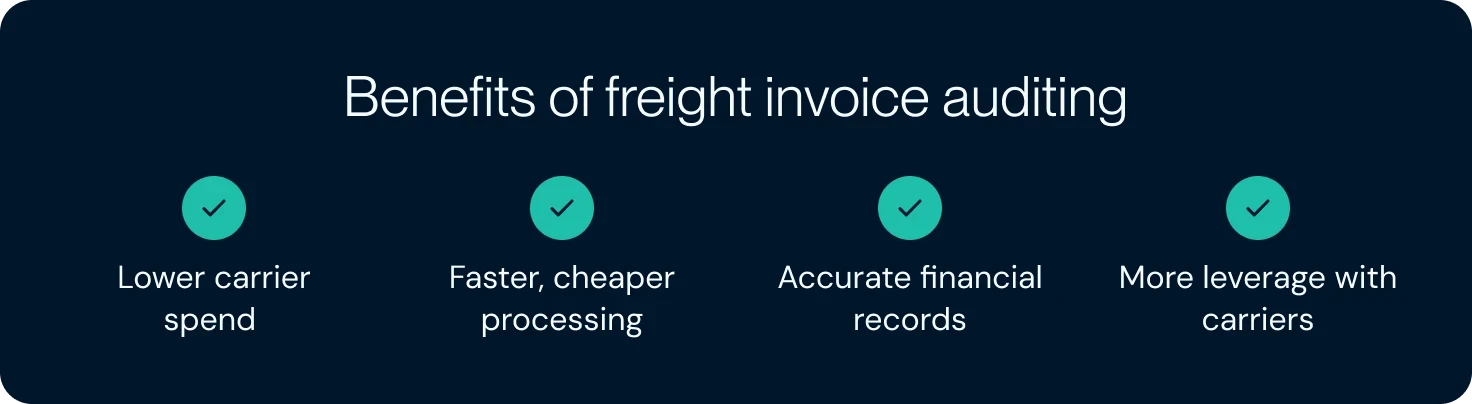
Freight invoice auditing contributes to lower transportation spend, faster and cheaper processing, accurate financial records, and more negotiating power with carriers. These benefits are a result of checking charges against known costs before payment:
- Lower carrier spend: Recovering overcharges and blocking incorrect fees helps you reduce shipping costs. The savings continue every billing cycle once the team corrects the cause.
- Faster, cheaper processing: Automated matching and approval reduce manual touches per bill. Ardent Partners’ State of ePayables 2025 research found that the top 20% of AP teams, which rely heavily on automation, process invoices at 79% lower cost than their peers.
- Accurate financial records: Each validated charge carries a GL code and a link to its shipment. Finance closes the month with accruals that reflect true shipping cost, which supports budgeting and margin reporting.
- More negotiating power with carriers: Audit data shows where providers miss agreed terms and which surcharges grow fastest. Your procurement team can bring that evidence to parcel contract negotiation and focus on the most expensive fees.
What are the best practices for freight invoice audits?
Following best practices for effective freight invoice audits, such as reviewing every line before payment and keeping rate data current, helps you catch billing errors before you pay.
Carrier pricing changes every year, so an audit that still uses last year’s tables produces false discrepancies. Case in point, per FedEx’s latest schedule, the U.S. residential delivery charge will rise from $6.95 to $7.35 per package on January 4, 2027.
| Freight audit best practice | How to implement it | Result for the audit team |
|---|---|---|
| Audit every invoice line before payment | Set the payment workflow to release funds only after each line passes rate, weight, and accessorial checks | You catch billing errors while the carrier’s dispute window is still open |
| Keep contract and rate tables current | Load each carrier’s rate increases, surcharge changes, and contract amendments before their effective dates | Your audit compares invoices against the prices in force on the ship date |
| Standardize invoice data from every carrier | Convert EDI, API, PDF, and portal invoices into one format with consistent field names | You compare carriers and lanes without rebuilding a spreadsheet for each carrier |
| Set tolerance thresholds for auto-approval | Define a small variance that approves automatically and route anything above it to review | Your team spends its time on the exceptions that cost the most |
What are the main freight auditing technologies?
The main freight auditing technologies are tools that capture carrier invoices in a standard format, calculate what each shipment should cost, detect billing errors and analyze spend trends.
Most freight audit programs combine several of these technologies, since each one handles a different stage of the audit process.
Electronic invoice ingestion and standardization
Electronic data interchange (EDI) delivers bills in a standard format, such as the X12 210 transaction set for motor carrier freight details. APIs and secure file transfer protocol (SFTP) feeds serve the same purpose. Machine-readable files remove manual keying, the first step in invoice automation in logistics.
Rules-based rating engines
A rules-based rating engine stores your negotiated rates, discounts, and accessorial terms, then calculates what each shipment should cost under your carrier contract. Your audit compares that expected cost with the amount the carrier billed and flags any difference.
A rating engine’s accuracy depends on how current its contract data is. Load each carrier’s annual rate increase, surcharge changes, and contract amendments before their effective dates, so the engine prices shipments at the rates in force on each ship date.
Learn about our Rating Engine solution.
AI anomaly detection
AI anomaly detection uses machine learning models trained on your historical invoices to flag unusual billing activity, such as a sudden jump in dimensional weight adjustments on one lane. These models find billing patterns that fixed audit rules miss, including small surcharge increases that add up across hundreds of invoices.
Parcel spend analytics
Parcel spend analytics software groups your shipping costs and audit findings by:
- Carrier: Compare spend and error rates across each carrier you use.
- Service level: See which delivery speeds drive the most cost.
- Origin: Spot facilities or warehouses with higher costs or more billing errors.
- Lane: Find origin-destination pairs where charges or adjustments spike.
- Charge type: Track how base rates, surcharges, and accessorial fees change over time.
Breaking down parcel spend by these categories shows you which charges grow fastest and which billing errors repeat. For example, a rising share of residential surcharges on one carrier tells you to check your address data or renegotiate that carrier’s surcharge terms.
Run continuous freight audit with Shipium
Shipium validates parcel charges continuously, from rate selection through invoice, and we call that model Always-On Audit. You keep financial control by creating and applying customer-specific sell rates, attributing every invoice to the right customer account, and resolving discrepancies in the same system that made the original shipping decision.
Under Shipium Always-On Audit, more than 99% of invoice lines auto-approve without human review, and the disputes that remain feed the rating engine and contract model so the same error does not happen twice.

Book a demo to see how our Always-On Audit solution validates every charge before parcel invoices reach your payment run.
Frequently asked questions
How do I audit a freight invoice before paying it?
To audit a freight invoice before payment, compare each charge with what your contract and shipment record say you should pay:
- Match each line to its shipment: Use the tracking or PRO number.
- Recalculate the expected charge: Apply your contract rate, discounts, zone, billable weight, and surcharges.
- Flag mismatches: Mark any line where the billed amount differs from your calculation.
- Check for duplicates and late deliveries: Confirm the carrier billed the shipment once and met any guaranteed date.
- Approve or dispute: Pay matching lines and dispute the rest with your contract and shipment records attached.
Manual prepayment review slows down at high volume, so large shippers often use an automated solution for this step. For parcel shipments, Shipium’s Parcel Audit Software automates this review with the rate and contract data the platform recorded when it created each label.
How do I know if my company is being overcharged by carriers?
The clearest sign of carrier overcharges is a gap between what you expected to pay and what the invoice shows, which line-level parcel invoice auditing is built to catch. Common causes of that gap include:
- Missing negotiated discounts: The carrier bills its list rate, or an outdated discount, in place of the rate in your contract.
- Incorrect dimensional weight: The carrier bills dimensions larger than the ones you recorded at packing, which raises the billable weight.
- Wrong zones: The carrier assigns a farther zone than the origin and destination ZIP codes support.
- Misapplied accessorial fees: The carrier adds fees that do not apply, such as an additional handling charge on a package within standard size limits.
- Duplicate billing: The carrier charges the same shipment twice, on one invoice or across separate statements.
Other warning signs include cost per package rising faster than the carrier’s announced rate increase and a growing share of spend going to accessorials. Correction fees are another signal, and address validation at checkout reduces them.
What is freight audit and payment and how does it work?
Freight audit and payment is the process of verifying carrier invoices against contracts and shipment data, then approving, coding, and paying the corrected amounts. Freight audit and payment works as a two-part financial control for transportation spend.
In practice, invoices flow into an audit system by EDI, API, or file upload. Software or analysts match them to shipments, flag discrepancies, and send disputes to carriers. The approved total then moves to accounts payable with GL codes attached, which keeps freight costs visible in every parcel spend management review.
How often should companies audit freight invoices?
Companies should audit freight invoices before each payment run. Major parcel carriers such as UPS and FedEx bill weekly, and LTL providers usually invoice per shipment, so a monthly or quarterly review lets errors accumulate and pushes some disputes past their deadlines.
Continuous auditing checks charges as shipments move, so you catch billing errors before the invoice reaches your payment run. Pair it with billing management software that attributes each validated charge to the right customer account and applies your customer-specific sell rates, so your client invoices reflect what each shipment actually cost.