


Dangerous goods — from lithium batteries in electronics to flammable chemicals in industrial manufacturing — require precise handling and documentation. Transporting these supplies is a high-stakes process governed by strict international and domestic regulations.
Ecommerce businesses must ensure compliance by providing detailed hazard classification, appropriate packaging, and emergency handling procedures. Without this information, your shipment could be delayed, fined, or even deemed illegal to transport.
Let’s break down everything you should know about when you need a dangerous goods declaration (DGD), how to fill it out correctly, and best practices for compliance.
Key highlights:
- A declaration of dangerous goods is an official document used to identify hazardous materials and ensure their safe, compliant transport.
- A dangerous goods declaration form must include the shipper and consignee details, UN number, hazard class, quantity, packaging type, emergency contact, and a certified signature. Missing or incorrect information can lead to shipment rejections, delays, or regulatory penalties.
- Shipium automates DG declaration management by pre-configuring dangerous goods properties, matching shipments to carrier requirements, and integrating compliance checks.
What is a dangerous goods declaration (DGD)?
A dangerous goods declaration (DGD) is an official shipping document required for hazardous materials (HAZMAT) transport. This documentation ensures proper shipment management along the supply chain and provides comprehensive information about its contents, including the potential safety concerns it poses for shippers and the general public.
It’s important to note that the terminology used to describe the required paperwork for shipping HAZMAT can vary depending on the transportation mode and governing body. While some organizations call it a “HAZMAT declaration,” others use the term “dangerous goods declaration.” Still, both serve the same fundamental purpose: ensuring the safe and compliant transport of substances that pose risks to health, property, or the environment.
Read our complete guide on HAZMAT shipping compliance.
What information is required on a dangerous goods declaration?
The information required for a complete dangerous goods declaration is:
- Shipper and consignee details: Full names and addresses of who is sending and receiving the shipment.
- Shipment identification: Air Waybill (AWB) or Bill of Lading (B/L) number connecting the declaration to the physical shipment.
- Transport details: Departure and destination airports/ports, plus carrier name.
- Proper shipping description: UN number, proper shipping name (PSN), hazard class, packing group, and subsidiary risks — listed in the correct order.
- Quantity and packaging details: The number of products you transport and the container type, for example, 2 x 5L metal cans in 1 fiberboard box.
- Additional technical information: Flash point for flammable liquids, marine pollutant declaration for sea transport, and special handling instructions.
- Emergency contact information: 24/7 emergency telephone number with a knowledgeable contact person.
- Shipper’s certification: Legal declaration statement, shipper name, authorized signature, and date.
Without a complete and accurate DG declaration, carriers may reject cargo, causing shipping delays and, depending on the scenario, heavy fines from regulatory agencies.
Shipper’s declaration of dangerous goods example
A properly completed declaration for dangerous goods ensures all stakeholders in the transportation chain understand the nature of the hazards you’re moving. Providing precise, standardized data helps to avoid shipment rejections or safety risks during transit.
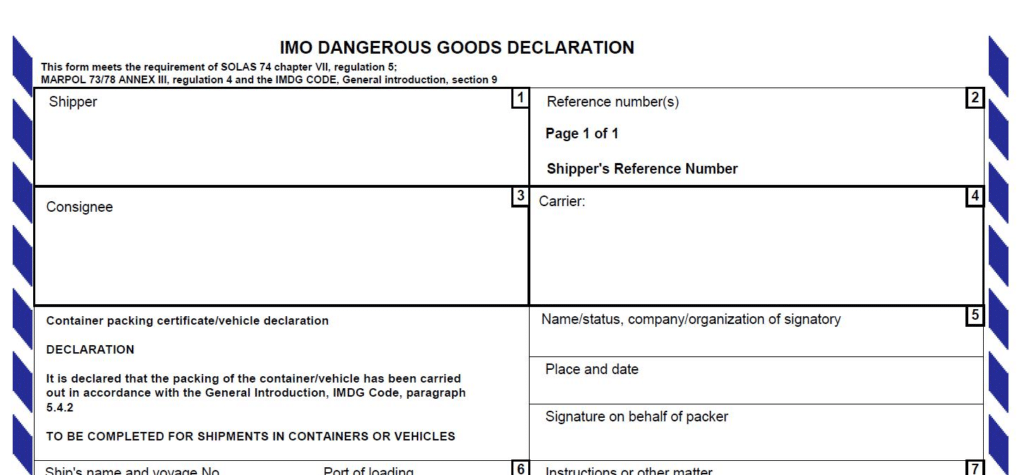
Here’s a shipper’s declaration of dangerous goods example form fill. While we used placeholder company names in this example to illustrate the layout, you should ensure your actual documentation reflects the legal entities involved in your specific supply chain.
Shipper and consignee fields
| DG declaration field | DG declaration details |
|---|---|
| Shipper | Global Chem Corp, 123 Industrial Way, New York, NY 10011 |
| Consignee | Tech Solutions Ltd, 456 Innovation Dr, Sydney, NSW 2007 |
| Transport document number | Air Waybill: 123-45678910 / Bill of Lading: ABC123456789 |
Transport details
| DG declaration field | DG declaration details |
|---|---|
| Vessel | Ocean Voyager |
| Voyage/date | 15/05/2026 |
| Port of load | Port of Los Angeles |
| Port of discharge | Port of Sydney |
Dangerous Goods shipment details
| UN No. | Proper shipping name | Class | PG | Qty/type | Packg. instr. | Total gross mass | Packg. grp/other |
|---|---|---|---|---|---|---|---|
| UN1993 | Flammable liquid, n.o.s. (Acetone solution) | 3 | II | 2 boxes (2x5L metal cans in 1 fiberboard box) | LTD QTY | 12.5 kg | F-E, S-D Flashpoint: 10°C Marine Pollutant: Yes |
Emergency and declarant
| DG declaration field | DG declaration details |
|---|---|
| Emergency contact | CHEMTREC: +1-703-527-3887 (Contract #12345) |
| Declarant name | John Doe |
| Title | Logistics Manager |
| Signature | [Authorized Signature] |
| Date | 2026-01-30 |
| Certification: “It is declared that the packing of these goods has been done in accordance with the applicable provisions. The goods are properly classified, packed, marked and labelled (and in the case of dangerous goods are in proper condition for carriage by sea).” | |
This image provides a visual example of how these data points are structured on an official International Maritime Organization (IMO) dangerous goods declaration form.
Why is a declaration of dangerous goods important?
A declaration of dangerous goods is important because it reduces health and environmental risks, prevents costly fines, and instructs workers on handling shipments safely and efficiently.
According to the US Department of Transportation (DOT), approximately 1,500 incidents involving undeclared hazardous materials occur yearly, including severe fires and chemical leaks. These situations, which disrupt the shipping process, could have been prevented with the proper documentation.
| Reasons for DG declaration | Why it’s important for shipping operations |
|---|---|
| Safety | Proper paperwork provides the necessary handling instructions for workers to prevent accidents, chemical exposure, explosions, and fires during transport. |
| Legal compliance | National and international regulations legally require a DG declaration. That’s why having the right documentation helps businesses meet compliance standards, avoiding fines and other issues such as shipment rejections. |
| Environmental protection | Declaring your dangerous goods helps your carriers and handlers follow the correct storage and transportation protocols, minimizing the likelihood of hazardous spills that cause long-term damage to ecosystems. |
| Risk management | A hazardous goods declaration specifies critical information that emergency responders use to take action in case of an incident, helping them determine the appropriate way to contain leaks or evacuate areas, for example. |
| Global standardization | Documentation provides consistent labels and classification across international shipping routes, minimizing inconsistencies and delays. |
When is a DG declaration required?
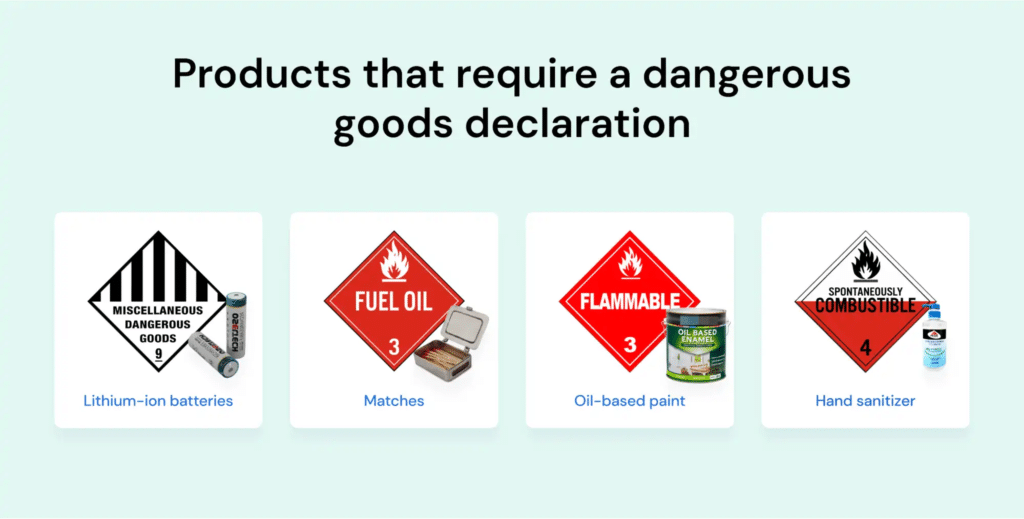
A DG declaration is required when a business needs to ship HAZMAT by any means of transportation, such as air, sea, or ground.
Many everyday products or raw industrial materials require a dangerous goods declaration. Common examples include:
- Lithium-ion batteries: Found in electric vehicles, laptops, and power banks, these batteries pose fire and explosion risksif handlers don’t manage them correctly.
- Flammable liquids: Items such as matches, adhesives, oil-based paint, and alcohol-based hand sanitizers ignite easily and require proper packaging and labeling.
- Corrosive materials: Industrial cleaning agents and acids cause serious burns and damage surfaces when they leak.
- Toxic substances: Pesticides and medical waste harm humans and the environment without careful management.
- Compressed gases: Products such as propane and refrigerants can explode or leak harmful vapors if shippers don’t secure them properly.
What are the main dangerous goods shipping declaration regulations?
The three most important regulatory frameworks governing the shipment of DG materials by air, sea, road, and rail are:
IMO dangerous goods declaration
The International Maritime Organization (IMO) established the International Maritime Dangerous Goods (IMDG) Code for transport over the seas. Since 2004, this regulation has been mandatory for all international ocean freight shipments and is recognized by governments worldwide.
Shipping by sea presents unique risks, including container fires and environmental contamination from spills. Because of these complications, non-compliance with this regulation can result in cargo seizures, heavy fines, and loss of carrier contracts.
The IMDG Code is updated every two years, so DG shippers must stay informed to remain compliant.
IATA DG regulations
The International Air Transport Association (IATA) enforces regulations for shipping dangerous goods by air. IATA paperwork is the strictest in the industry, particularly for the commonly shipped lithium batteries. Non-compliant shipments can lead to airline bans, penalties exceeding $250,000, and even criminal charges.
Regulations are updated annually, making ongoing compliance training essential.
DOT paperwork requirements
In the United States, hazardous materials transported by road or rail fall under Title 49 of the Code of Federal Regulations (49 CFR), enforced by the U.S. Department of Transportation (DOT).
While DOT enforces federal regulations, some states have additional HAZMAT transport laws that must be followed. For example, a Hazardous Materials Transportation License (HMTL) is required in California, particularly for shipments that require placarding or exceed 500 pounds.
DOT violations can result in fines of up to $179,933 for serious offenses. Carriers that fail inspections can be blacklisted from transporting hazardous goods.
How to fill out a DG declaration
A certified individual must fill out a dangerous goods declaration form following strict formatting guidelines. For example, red hatch marks should be used on the edges of the appropriate documents for air transport.
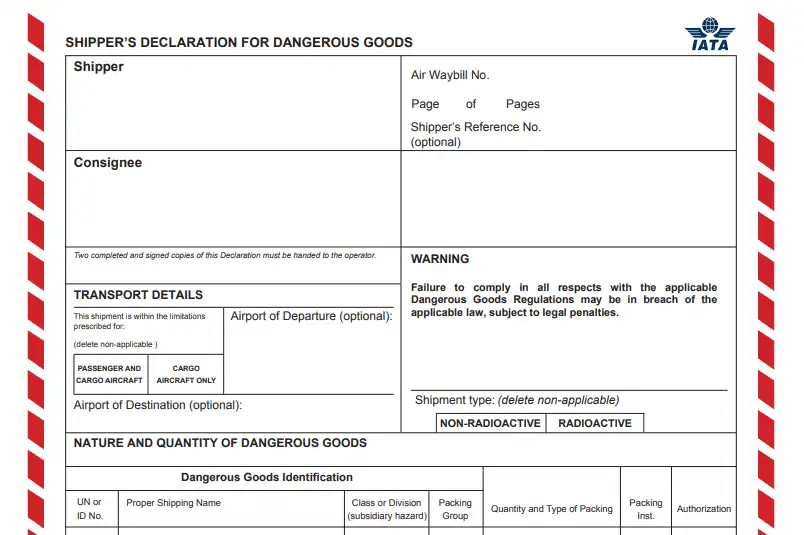
Here are the six main components and how to fill out a DG declaration:
1. Identification
This section provides key details about the hazardous material being shipped. It ensures that the cargo is properly classified and labeled so that carriers, customs authorities, and emergency responders can identify potential risks at a glance.
The identification details include:
- Shipper and consignee information: The sender and receiver’s full legal name, address, and telephone number must be listed in full.
- Proper shipping name (PSN) and UN material numbers: Every hazardous material has a UN number and official shipping name assigned by regulatory bodies (e.g., UN 3480 – lithium-ion batteries).
- Hazard class or division and packing group: This information defines the level of danger posed by each material. Packing Groups I, II, or III indicate whether the substance is high, medium, or low risk.
- Technical names and descriptions: If applicable, the full chemical name or composition must be included to ensure clarity in the case of emergencies.
- Air Waybill Number: A unique tracking number assigned by the carrier is required for air shipments.
This section’s content must all be in the proper order, with no irrelevant information thrown in between. For example, an entry can look like: UN1993, Flammable liquid, n.o.s. (Acetone solution) 3, II.
2. Quantity and type of packing
The quantity and packaging details determine if a shipment complies with regulatory weight limits and ensures safe transportation. This DG declaration section should include:
- Gross weight and volume of shipments: Regulations strictly limit the amount of a hazardous substance you can ship per package.
- Packaging materials and specifications: Approved containers, including UN-certified drums, boxes, fiberboard cartons, and metal cans, must be used. Infectious substances must be packed using triple-layer containment.
If multiple hazardous materials are shipped together, they must comply with segregation requirements to prevent dangerous chemical reactions. For example:
- Separate Class 8 corrosives like sulfuric acid from ammonium hydroxide (Class 8 alkaline), as they generate heat and gases on contact.
- Ensure that acids and bases are not packed together to prevent violent reactions that could release toxic gases.
3. Packing instruction
This section covers the specific packaging requirements for hazardous materials to ensure safe handling. Regulations vary depending on the transport mode (air, sea, or ground) and the type of dangerous goods being shipped. IATA, for instance, has a code for each packaging instruction (PI), like PI 965, which is used for standalone lithium-ion batteries that require strong outer packaging, thermal protection, and short-circuit prevention.
However, packaging compliance shouldn’t come at the expense of efficiency. Poor packing choices can lead to higher shipping costs, wasted space, and increased risks during transit. Shipium, a leading shipping platform for enterprise operators, helps businesses meet regulatory compliance by selecting the most efficient packaging configurations for hazardous materials.
Discover how Shipium’s Package Planner API can optimize your cartonization strategy.
4. Authorizations
Certain hazardous goods, such as radioactive shipments, explosives, or restricted chemicals, require additional approvals and sign-offs to be transported legally. Some international packages may require dual approvals from both exporting and importing countries.
Failure to obtain proper authorization for your dangerous goods shipping declaration can result in legal consequences or mean that you won’t meet the delivery promises initially made to customers, causing client dissatisfaction.
5. Additional handling information
Operators can include additional handling instructions and special provisions to guide transport personnel in the case of specific shipments. Examples include:
- Temperature-sensitive requirements: Certain hazardous materials, such as pharmaceuticals and perishable chemicals, require precise temperature control. These must be clearly marked with storage instructions.
- Handling precautions: If a substance requires limited movement, upright positioning, or specific ventilation requirements, these aspects must be noted on the declaration.
- Special security considerations: Some dangerous goods, such as toxic inhalation hazards (TIH) or highly flammable gases, require additional security measures and restricted access.
6. Name of signatory
The final section of a dangerous goods declaration form requires the responsible individual’s printed name and signature, confirming that the shipment complies with all applicable regulations.
The signatory must hold a valid HAZMAT certificate from an IATA, IMO, or DOT-approved training program, and the signing date must be written in an internationally recognized format, such as DD/MM/YYYY, DD.MM.YYYY, or DD/MMM/YYYY. By signing, the shipper takes full legal responsibility for ensuring that the shipment meets all regulatory requirements.
Best practices after filling out a dangerous goods declaration form
Beyond safety risks, improper DG declarations and cargo mishandling result in financial and operational disruptions. Case in point: in 2024, the Federal Aviation Administration (FAA) proposed a $146,500 penalty against an airline company that violated DOT regulations by improperly managing compressed oxygen containers.
Businesses must implement rigorous best practices in training, documentation, and compliance management to avoid these high risks. Follow these strategies to reduce errors and ensure smooth shipping operations:
Invest in training and education
All personnel responsible for hazardous materials’ classification, packaging, and documentation must be properly trained and certified. Training is critical because:
- Regulations change frequently — in some cases, more than once a year
- Mislabeling or incorrect declarations can lead to shipment rejections
- Only certified personnel can sign a DG form
When implementing regular education programs:
- Provide DG handlers complete access to IATA, DOT, or IMO-approved training and certification every two years (IATA) or three years (DOT/IMO)
- Train personnel on updated regulations annually to comply with new packaging, labeling, and documentation standards
- Incorporate scenario-based training for emergency response preparedness
Ensure regular process updates
HAZMAT regulations frequently change, making it essential to keep DG declarations, safety data sheets, and shipping procedures up to date to avoid non-compliance fines. IATA’s lithium battery shipping rules were revised in 2025, for example, introducing new packaging requirements.
To ensure your DG documentation stays current:
- Determine a compliance officer to monitor regulatory changes
- Schedule quarterly audits to verify that internal paperwork aligns with the latest regulations
- Maintain an archive of past hazardous goods declarations for at least two years for regulatory review
Optimize HAZMAT shipping with Shipium
Managing DG declarations is a complex and high-risk process, and errors in classification, documentation, or labeling can lead to many operational disruptions. Given the strict requirements, businesses need a reliable way to ensure compliance while streamlining operations.
Enter Shipium: an end-to-end shipping software that, among many benefits, simplifies the handling of hazardous materials shipping by ensuring that every shipment meets the correct packaging, labeling, and carrier-specific requirements.
The Shipium platform provides:
- Intelligent carrier selection: Different carriers have unique restrictions on shipments of dangerous goods. Shipium’s Rating Engine automates carrier selection by evaluating HAZMAT eligibility and matching shipments with reliable carriers, preventing incompatibility issues that cause delays. Our platform supports detailed HAZMAT information via API and pre-configured categories for common product types.
- Real-time visibility and optimization: Shipium integrates DG handling into your shipping process, using machine learning models to optimize carrier selection for cost, speed, and carrier requirements. Our platform provides visibility into HAZMAT shipments while supporting compliance with carrier and international shipping standards.
Request a demo today and discover how Shipium streamlines your dangerous goods declaration process and ensures compliance with national and international regulations.
Frequently asked questions
Who must sign the shipper’s declaration of dangerous goods?
Only a certified, trained individual can legally sign a shipper’s declaration for dangerous goods. This requirement ensures that someone knowledgeable about HAZMAT regulations is responsible for the shipment’s compliance.
To get certified for signing a DG declaration, workers must complete training from a recognized authority, such as the IATA Dangerous Goods Regulations (DGR) Certifications.
Do lithium-ion batteries require a dangerous goods declaration?
Yes, lithium-ion batteries — the most common globally transported batteries — are classified as hazardous and require a dangerous goods shipping declaration. This documentation is necessary due to the risks of short circuits, fires, and explosions if the batteries are damaged or improperly handled.
Key points regarding the transportation of lithium-ion batteries:
- Classification: Lithium-ion batteries fall under Class 9 of dangerous goods, which includes various substances that pose risks during transport. These items use the UN numbers UN 3480 for common lithium-ion batteries and UN 3481 for lithium-ion batteries contained in or packed with other equipment.
- Transport restrictions: There are specific restrictions on shipping lithium batteries by air, particularly regarding state of charge and packaging requirements. For instance, lithium-ion batteries shipped alone must not exceed a 30% state of charge.
What are “special provisions” in DG shipping?
Special provisions in dangerous goods (DG) shipping are additional handling, packaging, or documentation requirements for specific hazardous materials, as outlined by IATA, DOT, and IMDG regulations. These provisions modify standard DG classification rules based on the nature, quantity, or transport mode of the goods.
Examples of special provisions:
- IATA Special Provision A88: Allowing lithium batteries that exceed standard watt-hour limits to be shipped with special approvals.
- IMDG Special Provision 961: Applying to certain marine pollutants, specifying that they may not be classified as dangerous goods under specific conditions.
- DOT Special Provision 130: Providing exceptions for limited quantity shipments that meet specific packaging and labeling criteria.
What challenges do shippers usually face when managing DG declarations?
Four common challenges shippers usually face when managing DG declarations include:
- Regulatory complexity: Dangerous goods regulations differ by transport mode and country, requiring expertise across multiple frameworks.
- Documentation accuracy: A single error on a dangerous goods declaration form can trigger delays, fines, and liability exposure if an incident occurs.
- Risk management: Shippers must actively manage physical hazards — accidents, spills, and chemical exposure — through robust safety protocols.
- Evolving standards: Classification criteria, labeling requirements, and packaging standards change regularly, demanding continuous compliance updates.
What is an eDGD?
An electronic dangerous goods declaration (eDGD) is a digital data standard that replaces traditional paper forms for identifying and certifying hazardous shipments. Unlike a physical document, an eDGD allows for the seamless, electronic exchange of critical HAZMAT data—such as UN numbers and packing groups—between shippers, carriers, and regulatory bodies.
What are the benefits of using an electronic dangerous goods declaration?
The benefits of using an electronic dangerous goods declaration include:
- Faster processing times: eDGDs enable automated compliance checks and faster acceptance processes at airports and ports, helping you move shipments through the network with fewer rejections.
- Improved transparency: Electronic records provide all stakeholders with real-time visibility into a shipment’s hazardous status and allow for easier tracking and updates.
- Enhanced safety for responders: Digital documentation is quicker to share with emergency responders, providing them with critical information without requiring them to approach potentially hazardous situations to find paper documents.
- Sustainability: Transitioning to digital declarations eliminates the need for physical paper copies, saving millions of sheets of paper across large-scale logistics operations.
-
 Read more
Everything You Need to Know About Third Party Logistics Companies
Whether you’re a high-volume shipper looking to better manage fulfillment in specific geographic locations…
-
 Read more
How to Decrease Shipping Costs
What if you could transform shipping costs from a financial headache into your next…
-
 Read more
Order Fulfillment Services to Streamline Delivery
Why you need the right order fulfillment services For ecommerce businesses, any frequent or…