


When you miss delivery windows, orders arrive incomplete, or products show up damaged, the consequences ripple through your business, from chargeable penalties and contract violations to damaged customer relationships and lost market share.
This guide outlines six actionable strategies on how to improve service level agreement (SLA) performance across your logistics operation.
Key highlights:
- In the shipping industry, service level agreement (SLA) performance measures how reliably you meet delivery commitments, a key factor in customer retention and profitability.
- Monitoring SLA performance metrics enables you to identify gaps in your logistics operations and set realistic targets, such as reducing the fulfillment cycle time.
- Core strategies to improve SLA in logistics include auditing your current baseline and validating changes before full implementation.
- Shipium’s Shipping AI unifies SLA performance strategies into a single platform, enabling logistics leaders to streamline delivery speed and reduce shipping costs at scale.
What is SLA performance?
Service level agreement (SLA) performance is the metric used to measure how frequently a carrier or fulfillment partner meets the specific service targets you establish in a contract.
SLA metrics provide a roadmap for good service by establishing clear benchmarks and defining the consequences when a partner misses those standards. For example, an SLA might specify “deliver 95% of orders on-time” or “achieve 99% order accuracy,” with penalties if you miss these targets.
The most critical SLA metrics for logistics are on-time delivery, order accuracy, and product condition. Online retailers that consistently meet their commitments build customer loyalty, reduce returns, and achieve faster growth. Businesses that miss their SLAs often experience financial losses through operational costs and customer churn.
McKinsey research shows that inefficiencies at logistics handoffs can cost the industry $65-95 billion annually. These operational bottlenecks often result in missed delivery windows and incomplete orders, core SLA failures that drive customer dissatisfaction, with 85% refusing to shop with a retailer again after a poor delivery experience.
Keep learning: The complete guide to delivery service agreements
11 service level agreement key performance indicators (KPIs)
Your SLA performance metrics directly impact customer satisfaction and business goals outcomes. NRF and Happy Returns report that 16.9% of annual sales are returned, with online channels experiencing 21% return rates. Since order accuracy and product condition issues are common drivers of returns, strong SLA compliance can also reduce post-purchase attrition.
Focus on these 11 service level agreement key performance indicators (KPIs) to get started:
| # | Service level agreement key performance indicators | KPI definition | Why is this KPI important |
|---|---|---|---|
| 1 | On-time delivery (OTD) | Percentage of orders delivered by the promised date | Customer satisfaction and repeat purchases depend on accurate delivery promises |
| 2 | In-full delivery | Percentage of orders fulfilled with all items (no backorders or partial shipments) | Incomplete orders increase returns, support costs, and customer frustration |
| 3 | Order accuracy | Percentage of orders with correct items, quantities, and specifications | Errors reduce customer trust, increase returns, and raise operational costs |
| 4 | Perfect order rate | Orders that are on time, in full, accurate, and undamaged | This metric indicates your overall fulfillment excellence |
| 5 | Order fulfillment cycle time | Average time from order receipt to shipment | Speed of fulfillment signals operational efficiency and meets customer expectations |
| 6 | Damage-free rate | Percentage of orders that reach customers in good condition | Damaged products increase returns, reduce customer satisfaction, and raise costs |
| 7 | First-pass yield (FPY) | Orders completed correctly without rework or returns | High FPY indicates strong operational quality and reduces waste |
| 8 | Return rate | Percentage of orders returned by customers | High ecommerce return rates signal fulfillment or product quality problems |
| 9 | Customer satisfaction (CSAT) | Customer satisfaction score related to delivery performance and fulfillment | CSAT reflects how customers perceive your service quality and reliability |
| 10 | SLA compliance rate | Percentage of SLA targets you achieve during a period | This metric shows whether you’re keeping your commitments to customers or service providers |
| 11 | Lead time variability | Consistency of order completion times around the promised date | Predictable delivery builds confidence and mitigates supply chain risk |
How to improve SLA performance: 6 strategies for logistics leaders
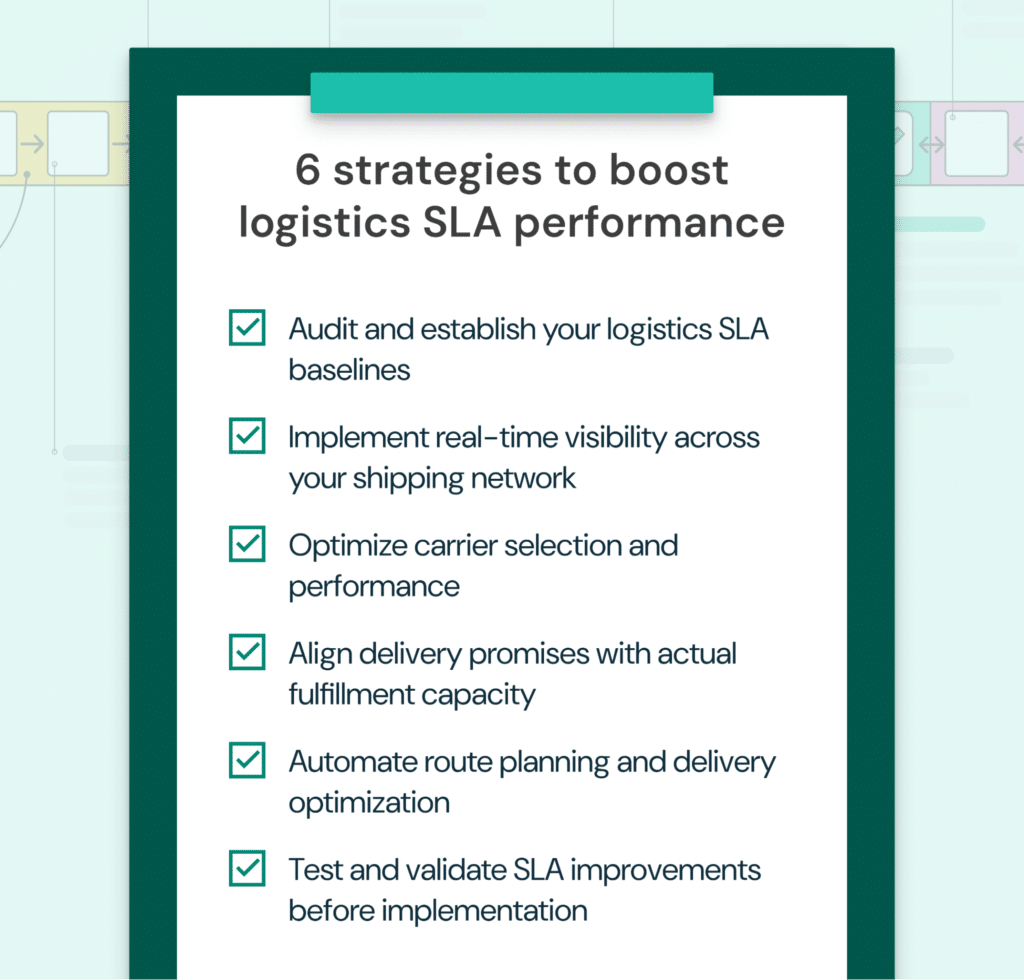
To consistently meet customer expectations while protecting your bottom line, consider these six high-impact strategies for improving SLA performance across your fulfillment network:
1. Audit and establish your logistics SLA baseline
Analyze your delivery data over the last 90 days to establish a clear measure of your performance SLA baselines. Calculate your on-time delivery rate, order accuracy rate, and damage-free rate. Identify patterns in your failures, asking questions such as:
- Which carriers miss deadlines most often?
- Which routes experience delays?
- At what times of day do we see the most issues?
With a platform like Shipium, you have all the data you need to fine-tune your SLA performance and eliminate bottlenecks before they impact the customer. Our Shipping Analytics software breaks down your results by carrier, origin, zone, and time period to identify exactly where delays occur. Our advanced algorithms analyze historical shipment data to uncover patterns and identify optimization opportunities to balance delivery speed with total shipping costs.
2. Implement real-time visibility across your shipping network
Deploying tracking systems that monitor shipments from the warehouse to customers’ doorsteps ensures complete transparency and prevents “where is my order?” calls. Set up monitoring systems that notify you when a shipment falls behind schedule, enabling a faster resolution rate by allowing you to take corrective action before missing the SLA.
With Shipium’s Shipment Tracking, for example, you have end-to-end visibility across your entire fulfillment network by consolidating tracking updates from all carriers into a single, standardized view.

3. Optimize carrier selection and performance
Analyze each carrier’s performance metrics to identify your best contributors, and use dynamic selection to route orders to the one best positioned to meet your SLA for that specific shipment.
Diversifying your carrier network reduces over-reliance on any single provider and enables you to negotiate SLAs with providers that align with your customer commitments. That’s the case with Shipium. Our Rating Engine uses machine learning to automatically select the optimal carrier for every shipment based on performance history, real-time capacity, and delivery requirements.
Learn how Atomix improved on-time delivery accuracy by using our ML-powered carrier selection.
4. Align delivery promises with actual fulfillment capacity
Use high-quality data to set achievable delivery windows that account for warehouse processing time, carrier transit time, and safety buffers. Analyze historical data to understand how long each step of your fulfillment process takes, then add conservative buffers to account for variability.
Our Delivery Date Enhancement solution uses machine learning to predict accurate delivery dates based on your specific fulfillment capabilities, carrier performance, and destination, helping you set realistic promises that customers can rely on.
5. Automate route planning and delivery optimization
Instead of relying on manual decisions or static transit tables, use AI-powered optimization that considers inventory position, transit predictions, and shipping costs. If you operate multiple fulfillment centers, machine learning algorithms can analyze historical performance data and real-world factors, such as weather events, to determine which center should ship each order and when.
With Shipium’s Route Optimization, you reduce costs by automating origin selection and shipping from closer locations, increasing delivery speed. By selecting fulfillment centers that reliably meet your delivery promises, you enhance your SLA performance.
6. Test and validate SLA improvements before implementation
Before rolling out major operational changes, whether it’s adding a new carrier, adjusting delivery promises, or optimizing volume allocation, you need to understand their impact on your costs and SLAs in logistics. Testing changes in a controlled environment prevents costly mistakes and validates enhancements to deliver the results you expect.
With Shipium Simulation, you can test operational scenarios in hours using real data from your network and machine learning trained on 350+ million shipments.
Optimize your logistics SLA performance with Shipium
Shipium analyzes your carrier performance data to identify your top performers, then automatically routes orders to them while ensuring your delivery promises align with their proven capabilities.
Unlike standalone tools that require manual coordination between separate logistics systems, our Shipping AI solution integrates all these capabilities into one central platform, enabling:
- Real-time visibility across your entire fulfillment network
- AI-powered decisions that optimize every shipping choice automatically
- Continuous improvement through machine learning that adapts to your unique carrier network
Schedule a demo to see how Shipium helps you improve your SLA performance metrics.
Frequently asked questions
What should logistics leaders include in an SLA performance report?
Logistics leaders should include in an SLA performance report:
- Compliance metrics: on-time delivery, order accuracy, damage-free rate, and perfect order rate
- Trend analysis: month-over-month performance, underperforming carriers, and underperforming routes
- Financial impact: penalties, returns costs, and revenue lost from churn
Logistics teams should also conduct regular reviews of shipping analytics reports — weekly or monthly — to identify patterns in SLA performance and make data-driven decisions.
What are the best logistics solutions to monitor service level agreement performance?
The best logistics solutions to monitor service level agreement performance combine:
- Real-time visibility: end-to-end tracking and automated alerts
- Performance analytics: breakdown by carrier/origin/zone and SLA pattern identification
- Carrier integration: coverage of your network in a single view
That’s the case with a unified platform like Shipium, which enables logistics leaders to identify issues faster and take action to improve SLA compliance.
-
 Read more
Everything You Need to Know About Third Party Logistics Companies
Whether you’re a high-volume shipper looking to better manage fulfillment in specific geographic locations…
-
 Read more
How Last Mile Delivery Impacts Your Shipping Cost
When studying ecommerce leaders like Amazon, it becomes clear that focusing on the customer…
-
Read more
How to Future-Proof Your 3PL Ecommerce Fulfillment Strategy
The role of third-party logistics (3PL) ecommerce fulfillment has changed. What was once a…