

Relying on a single transportation partner can lead to higher shipping costs and delays that hurt your bottom line. When your primary provider hits capacity or goes offline, your fulfillment operation is at risk. Shippers turning to multi carrier strategies can enhance flexibility and better support delivery promise commitments made to customers. But to leverage these benefits, you need the right technology.
In this guide, we evaluate multi carrier parcel management solutions for 2026 to help you find the best platform fit for your operations.
|
Best multi carrier parcel management solutions |
G2 rankings* |
Key features |
|---|---|---|
|
1. Shipium |
4.9 |
|
|
2. Sendcloud |
4.6 |
|
|
3. ShippyPro |
4.6 |
|
|
4. Bringg |
4.6 |
|
|
5. Shipsy |
4.5 |
|
|
6. ShipHawk |
4.3 |
|
|
7. Shippo |
4.2 |
|
|
8. I’m nShift |
4 |
|
|
9. ProShip |
3.9 |
|
|
10. Metapack |
3.8 |
|
|
11. Centiro |
3.5 |
|
|
12. Descartes Pacejet |
3.5 |
|
|
13. PitneyShip |
No reviews available |
|
*Rankings are updated as of March 2026. Please note that G2 scores fluctuate frequently based on real-time user feedback.
Let’s review the 13 best multi carrier shipping systems for 2026.
Shipium
Shipium is an enterprise shipping platform designed for high-volume fulfillment. Founded by former Amazon operations leaders, the system replaces legacy logistics software with a cloud-native internal rating engine that virtualizes carrier contracts in-memory. This architecture enables quick calculations of “fully loaded” costs, including contracted discounts and all surcharges, without reliance on partner API availability.

Shipium uses artificial intelligence (AI) models trained on over 350 million shipments to coordinate the entire parcel fulfillment workflow, from presenting delivery promises in the cart to enhancing origin selection through route optimization.
Key Shipium features:
- Rating Engine: Industry-leading machine learning (ML) modeling that qualifies and selects the right carriers for every shipment
- Simulation module: “What-if” scenario analysis that lets you test the impact of new rates, carriers, or origins before live implementation
- Delivery Promise: Accurate delivery date presentation in the ecommerce cart to increase conversion and meet customer expectations
- Route Optimization: Precision logic applied to order details to identify the most efficient fulfillment origin for your orders
Shipium pros:
- Scalability for high-volume operations with near-instant rate lookups
- Automated carrier volume balancing to ensure contract tier compliance
- Predictive transit modeling based on actual historical shipment data
- Minimal technical debt through a unified API for rating and labeling
- Simple integration with your existing logistics tech
- Pre-integrated carrier network that covers 99.2% of North American parcel shipments
See how our multi carrier shipping software helps shippers diversify their carrier networks.
Sendcloud
Sendcloud automates the fulfillment workflow for ecommerce businesses through integrated rate comparisons and label generation. The platform manages the post-purchase experience via a standardized returns portal to support multi carrier shipping operations.
Sendcloud pros:
- Global courier integrations within a single interface
- Native connectors for popular ecommerce platforms such as Shopify and Magento
Cons of Sendcloud:
- Limited support for complex enterprise-level business rule automation
- Dependency on carrier API uptime for real-time rating
ShippyPro
ShippyPro provides a cloud-based interface for generating shipping labels and monitoring orders across different parcel carriers. The platform suits mid-market retailers seeking a centralized point for label compliance and tracking notifications.
Pros of ShippyPro:
- User-friendly interface for carrier onboarding
- Integrations with 80+ sales channels
Cons of ShippyPro:
- Performance bottlenecks during peak season due to external API reliance
- Lack of advanced simulation tools for logistics network modeling
Bringg
Bringg specializes in last-mile orchestration. This multi carrier shipping system coordinates internal fleets, external logistics partners, and crowd-sourced delivery providers through a modular automation platform.
Bringg pros:
- Automated logic for internal fleet vs. third-party logistics (3PL) selection
- Transparency for end-users during the final stage of delivery via live driver tracking
Cons of Bringg:
- Long implementation cycles for large-scale delivery networks
- Setup complexity for multi-hub international operations
Shipsy
Shipsy is a multi carrier parcel shipping solution that uses AI to optimize last-mile delivery and rider allocation. The platform provides end-to-end visibility and automates billing processes for both shippers and 3PL providers.
Shipsy pros:
- Route optimization for urban delivery environments
- Dashboard for managing diverse 3PL partners
Cons of Shipsy:
- Integration latency with regional carrier systems
- High administrative requirements for initial data mapping
ShipHawk
ShipHawk focuses on ERP integration, particularly with NetSuite, to automate shipping and packing decisions. This shipping platform uses data modeling to predict package dimensions and select the optimal box size for orders.
ShipHawk pros:
- Package attribute calculation via automated dimensioning logic
- Data synchronization between ERP and warehouse execution
Cons of ShipHawk:
- Resource-intensive implementation to align with custom ERP configurations
- Slower response times compared to cloud-native virtualized engines
Shippo
Shippo provides a centralized API for multi carrier parcel management, aggregating rates from both national and regional providers. The software simplifies label creation for smaller merchants and offers built-in tools for surcharge reporting and address verification.
Shippo pros:
- Low entry barrier with no monthly fees on specific tiers
- Simple aggregation of carrier rates for comparing shipping costs
Cons of Shippo:
- System latency due to reliance on external carrier API responses
- Limited support for enterprise ecommerce fulfillment logic
nShift
nShift is a delivery management platform that provides end-to-end orchestration from checkout to returns, allowing brands to control customer touchpoints through modular cloud applications.
nShift pros:
- Cross-border shipping automation
- Native modules for sustainability reporting and emissions tracking
Cons of nShift:
- Technical setup complexity for custom carrier integrations
- No dynamic delivery date modeling
ProShip
ProShip is a logistics software provider offering on-premise and cloud-hosted manifesting solutions. It’s an option for organizations requiring high-speed local processing and strict data protection protocols in their distribution centers.
ProShip pros:
- On-premise deployment for facilities with low internet connectivity or high security
- Support for high-speed local manifesting
Cons of ProShip:
- High administrative burden to maintain local installations and siloed data
- Sequential API calls that can create potential bottlenecks for high-volume throughput
Metapack
Metapack focuses on global multi carrier parcel management and branded tracking for international retailers. The system features a library of courier services to support cross-border expansion and post-purchase engagement.
Metapack pros:
- Centralized branded portals for users to track shipments across transportation partners
- Global carrier reach for international shipping programs
Cons of Metapack:
- Dependency on static rate cards instead of real-time performance data
- Inconsistent interface across different platform modules
Centiro
Centiro is a global provider of cloud-based delivery management services that leverages machine learning to manage logistics events. The system helps you monitor carrier performance and provides real-time visibility into large-scale enterprise logs.
Centiro pros:
- Management of multi-hub global delivery networks
- A broad network of carriers for a cross-border shipping process
Cons of Centiro:
- Requirement for dedicated IT and logistics personnel during setup
- Complex dashboard interface
Descartes Pacejet
Descartes Pacejet is a multi carrier shipping system that handles both parcel and freight. It streamlines warehouse execution through scan-pack functions and automated manifesting. The platform’s native ERP integrations allow warehouse teams to retrieve order details and update financial records without moving between disparate software applications.
Descartes Pacejet pros:
- Consolidated parcel, LTL, and FTL shipment management
- Automatic order detail retrieval from leading ERP systems
Cons of Descartes Pacejet:
- Legacy architecture that may not receive updates as frequently as newer competitors
- Extended implementation timelines for complex ERP customizations
PitneyShip
PitneyShip by Pitney Bowes provides access to a unified carrier network for mailing and shipping. The software serves organizations that manage high volumes of office mail alongside standard warehouse fulfillment needs.
PitneyShip pros:
- Integrated management of both enterprise shipping and postal mailing
- Access to competitive rates through the Pitney Bowes network
Cons of PitneyShip:
- Transition challenges from legacy Pitney Bowes systems
- Limited machine-learning-driven delivery date accuracy
Get the best multi carrier parcel shipping solution with Shipium
Legacy logistics software that relies on static SLAs and external API calls can no longer meet the speed and accuracy needed for enterprise ecommerce businesses.
Shipium provides a modern alternative to traditional multi carrier parcel management solutions with its cloud-native Rating Engine. Powered by shipping AI, our platform models specific courier contracts and surcharges to ensure invoice-accurate selection. By leveraging historical data and machine learning, our customers reduce parcel spend by 12% on average while consistently meeting their delivery promises.
Through Shipium Console, you can better control your end-to-end operations, respond quickly to changes, and reduce costs around network maintenance and updates.
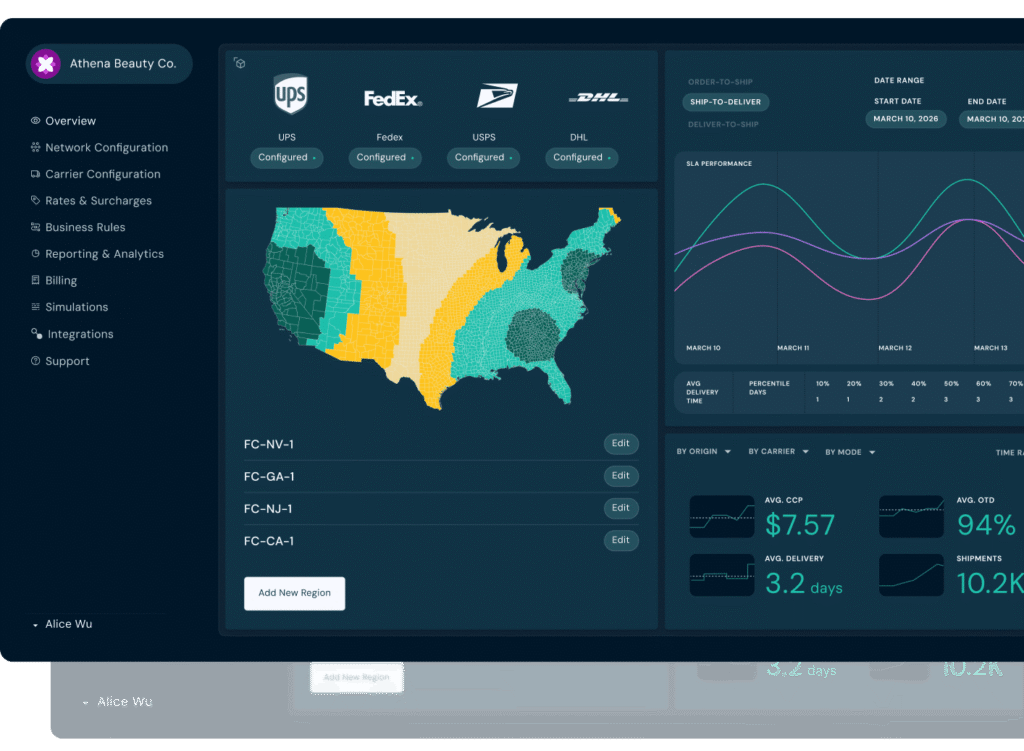
Book a demo to see how Shipium’s multi carrier parcel shipping solution can modernize your logistics operations and protect your margins.
-
 Read more
10 Ecommerce Shipping Best Practices Every Company Should Follow
For enterprise ecommerce businesses, shipping doesn’t just represent a significant portion of operating expenses…
-
Read more
10 Shopify Fulfillment Best Practices for Ecommerce Businesses
A successful Shopify ecommerce business not only drives sales but also delivers a seamless…
-
 Read more
5 Ways to Effectively Manage Ecommerce Shipping Delays
More than two-thirds of customers have experienced at least one delayed delivery in their…