
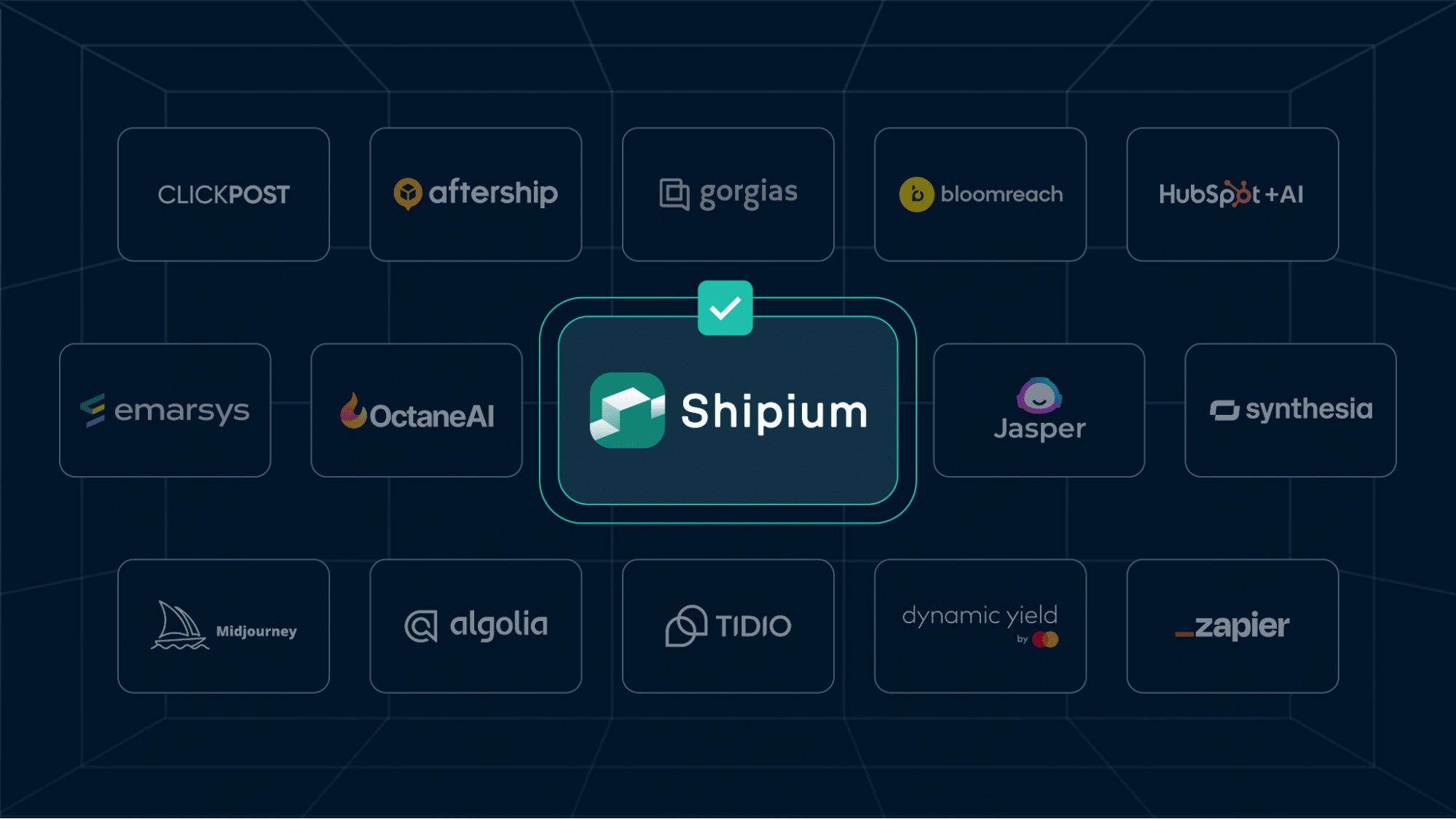

As a logistics or ecommerce operator, you spend most of the day picking which fire to put out first: a delayed shipment, a stockout, a slow checkout, or a CRM follow-up that never went out. AI tools for ecommerce now solve those problems before they reach your desk. They do it across every layer of your stack, from how you talk to customers to how you pick the carrier for tomorrow’s shipments.
| AI solutions for ecommerce | Category | G2 ranking* | Key features |
|---|---|---|---|
|
Shipium |
Logistics optimization and shipping |
4.9 |
|
|
ClickPost |
Logistics optimization and shipping |
4.8 |
|
|
Jasper |
Marketing and content creation |
4.7 |
|
|
AfterShip |
Logistics optimization and shipping |
4.7 |
|
|
Synthesia |
Marketing and content creation |
4.6 |
|
|
Gorgias |
Customer relationship management |
4.6 |
|
|
Bloomreach |
Customer relationship management |
4.6 |
|
|
Tidio |
Customer service |
4.6 |
|
|
Dynamic Yield by Mastercard |
AI for personalization and recommendations |
4.5 |
|
|
Zapier |
Workflow automation |
4.5 |
|
|
Algolia |
Site search and discovery |
4.5 |
|
|
HubSpot AI |
Customer relationship management |
4.4 |
|
|
Midjourney |
Marketing and content creation |
4.4 |
|
|
Octane AI |
AI for personalization and recommendations |
4.2 |
|
|
SAP Engagement Cloud |
Customer relationship management |
4.2 |
|
*Rankings are updated as of May 2026. Please note that G2 scores fluctuate based on real-time user feedback.*
In this guide, we break down 15 ecommerce AI tools that operators are using to modernize their stacks, and help you decide which solutions are best for your enterprise.
Shipium
Category: Logistics optimization and shipping
Shipium is a shipping platform that connects pre-purchase delivery promises to post-purchase fulfillment using AI models trained on millions of parcels. Our enterprise logistics solution integrates with an existing transportation management system (TMS), enabling retailers and third-party logistics (3PL) companies to add modern shipping logic without ripping out their legacy stack.
For retailers operating across multiple warehouses or fulfillment nodes, Shipium helps coordinate upstream shipping decisions such as order routing, carrier selection, and origin assignment to improve both speed and cost.

According to Gartner, 70% of large organizations will adopt AI-based supply chain forecasting by 2030, and operators replacing manual rate shopping today land on that curve first. Shipium supports AI adoption, enabling retailers to make faster, more accurate shipping decisions that improve delivery performance while controlling parcel spend.
Shipium pros:
- Carrier selection: You elect the cheapest eligible carrier for each label based on rate, transit, and historical performance signals.
- Delivery promise: Our platform generates pre-purchase estimated delivery dates and feeds them through to fulfillment for execution.
- Fulfillment Engine: We help plan node assignments and minimize split shipments by jointly reading inventory positions and order signals.
- AI model stack: Model training improves in accuracy over time using shipment, transit, and cost data from millions of parcels across the Shipium network.
ClickPost
Category: Logistics optimization and shipping
ClickPost is a post-purchase platform that connects ecommerce stores to 500+ carrier APIs and runs branded tracking pages, exception alerts, and notifications for direct-to-consumer brands. The platform is strongest on post-purchase visibility and tracking workflows rather than full end-to-end shipping orchestration across complex fulfillment networks.
ClickPost pros:
- Pre-built integrations cover more than 500 carriers, 30 ecommerce platforms, and warehouse management and order management workflows.
- AI exception handling flags shipments at risk of delay and triggers carrier-side or customer-side actions before shipping Service-Level Agreements (SLA) break.
Cons of ClickPost:
- Coverage centers on post-purchase tracking, so label generation, fulfillment planning, and rate shopping live elsewhere in the stack.
- Retailers with multi-warehouse networks need to pair ClickPost with an enterprise shipping platform to manage upstream decisions.
Jasper AI
Category: Marketing and content creation
Jasper AI is a generative copy platform with brand-voice training, multi-language support, and templates for product descriptions, ads, blog content, and email.
Jasper AI pros:
- Brand-voice training and templates produce on-brand copy across product detail pages, ads, and email campaigns at scale.
- Multi-language support covers more than 30 languages for stores with international SKUs.
Cons of Jasper AI:
- The content output from the tool requires human editing to avoid generic phrasing and brand drift.
- Without a strict review loop, AI-generated copy can hurt SEO performance and brand consistency over time.
AfterShip
Category: Logistics optimization and shipping
AfterShip is a post-purchase suite covering tracking, returns, and shipping notifications across carriers, with native plugins for Shopify, WooCommerce, and Magento. While the platform improves tracking and returns visibility, retailers with complex multi-node logistics operations often have to pair it with a separate shipping orchestration layer.
AfterShip pros:
- More than 1,100+ carrier integrations and a unified dashboard pull global shipping data into one view.
- Branded tracking pages and SMS and email notifications cover every shipment milestone, from label creation through delivery.
Cons of AfterShip:
- The platform does not generate pre-purchase delivery dates or run carrier orchestration at the order level.
- Retailers focused on delivery performance often layer AfterShip under a dedicated shipping platform rather than running it on its own.
Synthesia
Category: Marketing and content creation
Synthesia is a generative ecommerce AI solution that produces presenter-style videos using avatars and supports multiple languages, removing the need for filming and studio production.
Synthesia pros:
- Avatar-based videos support more than 140 languages and replace studio shoots for product explainers, training, and localized marketing.
- A library of templates and editing tools shortens production time from weeks to hours per asset.
Cons of Synthesia:
- Avatars can feel synthetic in long-form formats, which limits their use in emotional brand storytelling.
- The format is better suited for short instructional clips than narrative or talent-led campaigns.
Gorgias
Category: Customer relationship management
Gorgias is a customer service helpdesk built for ecommerce that pulls order data from Shopify, BigCommerce, and Magento into tickets and uses AI to auto-respond to common questions.
Gorgias pros:
- Native Shopify, BigCommerce, and Magento integrations bring order, refund, and tracking data into the ticket view, so agents can resolve issues without tab-switching.
- AI auto-responders close repetitive questions about orders, shipping status, and returns with zero-touch workflows.
Cons of Gorgias:
- Pricing is volume-based and rises alongside ticket counts, which becomes expensive at scale.
- Outside ecommerce use cases, Gorgias offers less depth than enterprise CRMs such as Salesforce or HubSpot.
Bloomreach
Category: Customer relationship management
Bloomreach is a customer engagement suite that pairs a real-time data platform with marketing automation, AI search, and content tools, powered by its Loomi engine.
Bloomreach pros:
- One platform handles customer data, email, SMS, web personalization, and search, reducing the number of disconnected tools in the stack.
- The Loomi AI engine drives segmentation, send-time optimization, and product recommendations from a unified data layer.
Cons of Bloomreach:
- The platform comes with enterprise pricing and longer implementation timelines than other AI ecommerce tools.
- Smaller teams without dedicated CRM support often underuse the platform’s feature set.
Tidio
Category: Customer service
Lyro by Tidio is an AI chatbot that resolves common customer questions in natural language, training on a brand’s help center, returns policy, and product catalog out of the box.
Pros of Tidio:
- The bot trains on the help center, returns management policy, and product catalog without requiring manual intent mapping.
- The chatbot absorbs delivery and tracking questions that typically overwhelm ecommerce support teams during peak seasons.
Cons of Tidio:
- The platform lacks the deep ecommerce data hooks found in purpose-built helpdesk platforms.
- Brands with order modification, subscription deliveries, or partial-return workflows often need additional tooling for full coverage.
Dynamic Yield by Mastercard
Category: AI for personalization and recommendations
Dynamic Yield by Mastercard is an enterprise personalization platform for web, mobile, app, and email, with an AI recommendation engine branded Element.
Dynamic Yield pros:
- Personalization runs across web, mobile, app, and email experiences from one platform, helping maintain consistency across touchpoints.
- The AI recommendation engine combines A/B testing with segment-level experiences and triggered messaging.
Cons of Dynamic Yield:
- The platform targets enterprise buyers, with pricing and implementation timelines to match.
- Brands without dedicated Conversion Rate Optimization (CRO) or experimentation teams may struggle to operationalize the toolset.
Zapier
Category: Workflow automation
Zapier AI is a workflow automation platform connecting 7,000+ apps with AI agents and AI Actions, used to glue together best-of-breed ecommerce tools.
Zapier pros:
- App connectors automate cross-platform workflows like enriching leads, summarizing reviews, and routing exception orders.
- AI agents and AI Actions add reasoning and natural-language workflows inside Zaps without requiring custom code.
Cons of Zapier:
- Long Zaps with multiple AI steps can add latency and runtime costs.
- Retailers making real-time operational decisions often need purpose-built ecommerce shipping software instead of a no-code automation layer.
Algolia
Category: Site search and discovery
Algolia is an AI search and discovery API that powers product search, recommendations, and merchandising for retailers like Lacoste and Decathlon.
Algolia pros:
- Neural search and dynamic re-ranking surface relevant products on the first query, improving on-site conversion rates.
- Merchandising rules combine with AI scoring to control which products appear and where they are displayed.
Cons of Algolia:
- The platform’s configuration depth often requires engineering support to maximize value from synonyms, rules, and personalization.
- Pricing scales with search volume, which can increase costs as traffic grows.
HubSpot AI
Category: Customer relationship management
HubSpot AI is the AI layer across HubSpot’s marketing, sales, and service hubs, branded as Breeze and including AI assistants, content drafting, and forecasting.
HubSpot AI pros:
- One CRM record connects paid acquisition, lifecycle email, and post-purchase service workflows in a single system.
- Breeze adds AI summaries, content drafting, and forecasting capabilities on top of existing workflows without requiring a separate tool.
Cons of HubSpot AI:
- Functionality such as returns, order edits, and real-time inventory management falls behind more specialized ecommerce AI tools.
- For retailers that think in terms of order fulfillment services, HubSpot primarily supports marketing workflows rather than logistics execution.
Midjourney
Category: Marketing and content creation
Midjourney is a generative image model that produces hero, lifestyle, and concept imagery from text prompts via Discord and a web interface.
Midjourney pros:
- Text-prompted images generate hero, lifestyle, and concept visuals in minutes for moodboards and ad iteration.
- Style controls and image references help maintain creative consistency across campaigns without re-briefing every asset.
Cons of Midjourney:
- The model is not ideal for accurate product photography, where SKU details and color accuracy matter.
- Brand consistency and likeness rights still require prompt engineering and human review before publication.
Octane AI
Category: AI for personalization and recommendations
Octane AI is a Shopify-native conversational quiz and recommendation tool that collects zero-party data from shoppers and routes the answers into lifecycle marketing flows.
Octane AI pros:
- Conversational quizzes collect zero-party data and personalize product recommendations in real time without relying on third-party cookies.
- Native integrations with Klaviyo, Postscript, and Attentive feed quiz responses into downstream email and SMS workflows.
Cons of Octane AI:
- Quiz-led discovery works best for considered-purchase categories like skincare, supplements, and pet food.
- Lower-consideration categories typically see weaker returns from the format.
SAP Engagement Cloud
Category: Customer relationship management
Engagement Cloud is an SAP-owned cross-channel marketing automation platform with predictive analytics, AI segmentation, and pre-built tactics for ecommerce verticals.
SAP Engagement Cloud pros:
- Cross-channel automation runs across email, SMS, mobile push, web, and advertising channels from a single orchestration layer.
- AI scoring on engagement, churn risk, and revenue potential triggers personalized journeys without manual segment building.
Cons of SAP Engagement Cloud:
- Setup is heavier than a standalone email platform and assumes a centralized customer data layer.
- Brands without unified customer data often struggle to realize value from the platform’s AI capabilities.
Use Shipium’s ecommerce AI solutions to optimize delivery
When shopping for AI tools for ecommerce, the layer that quietly dictates brand loyalty is the customer delivery experience, and that is where most stacks under-invest.
Shipium replaces the slowest part of your stack with AI models trained on millions of parcels. Our platform connects pre-purchase delivery promises with post-purchase carrier selection, so the date you show on the product page is the date the customer receives the product. The result is faster transit times, lower parcel spend, and a 4–6% lift in checkout conversion across our customer base.

Book a demo with Shipium to see how AI-powered carrier selection and delivery promise to tighten your shipping economics.
Optimize your operations with Shipium’s AI solutions for ecommerce
-
 Read more
Everything You Need to Know About Third Party Logistics Companies
Whether you’re a high-volume shipper looking to better manage fulfillment in specific geographic locations…
-
 Read more
How Last Mile Delivery Impacts Your Shipping Cost
When studying ecommerce leaders like Amazon, it becomes clear that focusing on the customer…
-
Read more
How to Future-Proof Your 3PL Ecommerce Fulfillment Strategy
The role of third-party logistics (3PL) ecommerce fulfillment has changed. What was once a…