
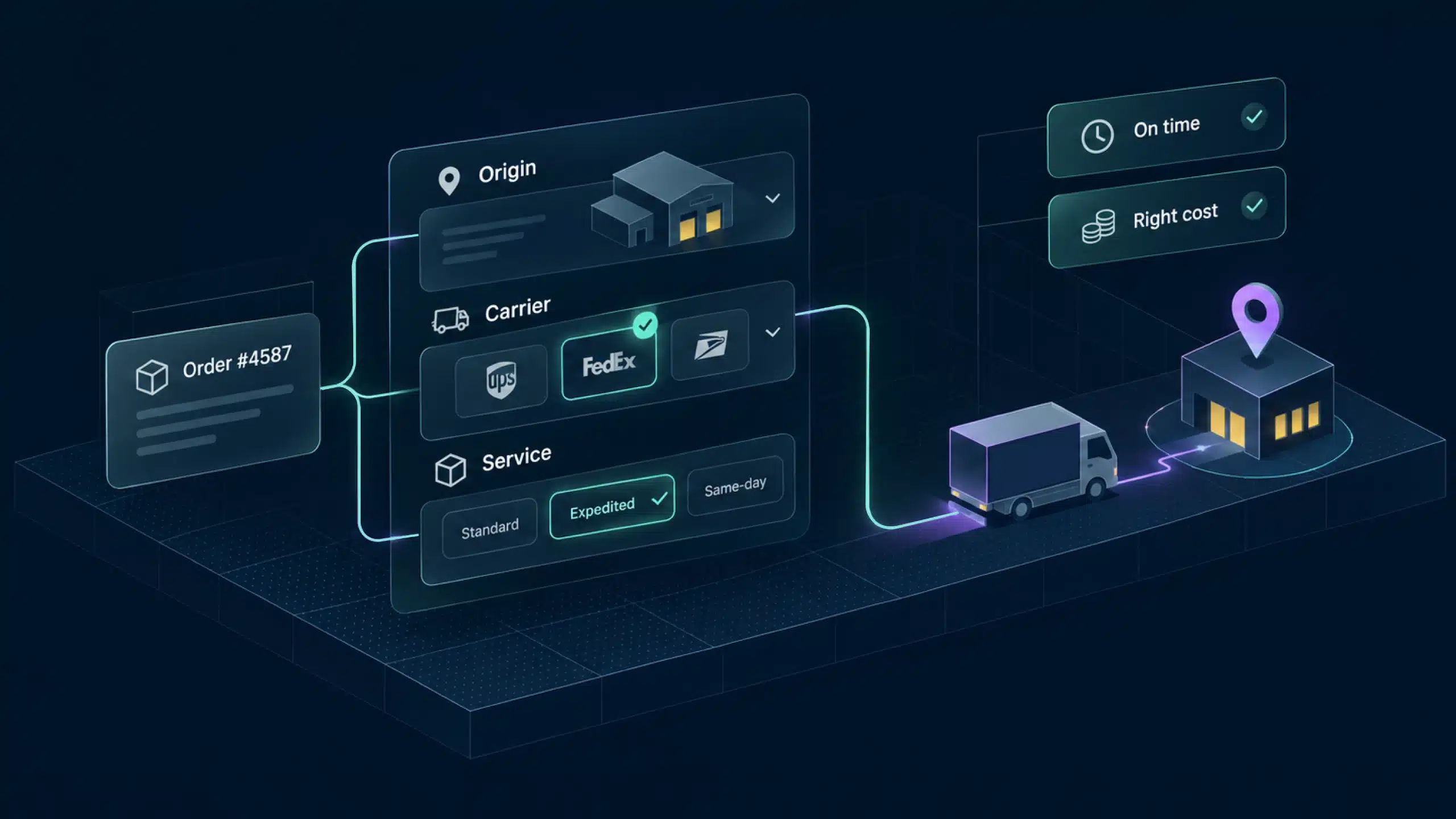

As order volume grows, every new node and carrier contract adds decisions to each shipment. Legacy shipping tools handle those decisions with static rules, and the cost shows up as missed delivery promises, unplanned surcharges, and invoices above your negotiated rates.
In this guide, we cover how shipping and logistics management works at enterprise scale, which errors cost the most, and how to grow volume without losing control of cost, speed, or accuracy.
Key highlights:
- Shipping and logistics management is the discipline of planning, executing, and auditing every parcel decision, from the moment an order releases to the day the carrier invoice closes.
- Enterprise shippers hold parcel spend and delivery dates in line when their shipping logistics management automates every carrier decision against fully loaded cost and modeled transit times.
- The most expensive shipping errors, from bad addresses to invoice overcharges, start upstream of the label, and each one needs prevention at its source.
- Shipium runs carrier selection, delivery dates, and audit together, so operators adjust rules without IT tickets.
What is shipping and logistics management?
Shipping and logistics management is the process of deciding how, when, and from where each order moves to the customer, then executing and auditing those decisions across carriers and fulfillment nodes. It involves two connected layers:
- Logistics: The broader flow of inventory through your network, including warehouse placement, transportation modes, and replenishment.
- Shipping: The parcel-level execution inside that flow, from service selection, rating, and labels to delivery date promises, tracking, and invoice reconciliation.
Enterprise parcel teams run logistics shipping management as one function because the origin picked for an order changes the eligible carriers, the transit time, and the final charge. Parcel management software checks eligibility, delivery window, and true cost for every package before a label prints.
Why is logistics and shipping management harder at enterprise volume?
At enterprise volume, the rates, transit times, rules, and invoices behind each parcel decision change faster than most legacy platforms can update. Challenges to shipping management and logistics teams include:
- Rate tables and surcharges that change with every general rate increase (GRI): Each GRI resets base rates and fees.
- More carriers, nodes, and service levels to choose from on every order: A network with five fulfillment centers and four carriers with six service levels each produces 120 possible paths for one package. A static rule, such as ground service from the nearest warehouse, applies one choice to every matching order without pricing the other 119 paths.
- Static carrier transit times that miss the customer’s promised delivery date: Carrier service guides list one transit time per zone and ignore lane-level performance, pickup cutoffs, and peak congestion. Promises tied to published times fail once actual performance drifts.
- Business rules inside legacy systems that need IT or vendor tickets to change: Adding a regional carrier, moving a cutoff time, or excluding a service for hazmat items often sits in an IT queue for weeks. Peak shipping season leaves no room for that kind of delay.
- Carrier invoices nobody checks line by line: Parcel providers bill address corrections, dimensional weight adjustments, and residential surcharges after delivery. Without parcel audit software, those charges surface weeks after payment, if anyone catches them at all.
Compare logistics management software platforms side by side.
How can enterprise shippers reduce shipping and logistics costs without slowing delivery?
Enterprise shippers reduce shipping and logistics costs without slowing delivery by choosing the lowest fully loaded cost among services that still meet the promised date, on every order. Follow these steps to reduce shipping costs:
- Ground over air when ground arrives on time: When modeled transit times show a ground service reaching the customer inside the promised window, the order moves off a default two-day air rule at a lower rate.
- Rate shopping with every surcharge included: Fully loaded rate shopping counts fuel, residential, delivery area, and additional handling fees, which a base rate comparison misses.
- Volume balancing across carriers: Spreading packages across carriers keeps you inside negotiated tier discounts.
- Right-sized packaging and zone skipping: Smaller cartons avoid dimensional weight charges, and zone skipping lowers cost for dense regions.
How do I balance shipping cost against delivery speed?
You balance shipping cost against delivery speed by setting the delivery date first, then picking the least expensive carrier service projected to meet that date at your target on-time rate.
OnTrac’s State of Speed study found that 88% of retailers still show delivery ranges such as four to six business days at checkout, and shoppers are twice as likely to abandon carts when they see vague delivery timing. A precise date at checkout supports conversion and gives your parcel team a fixed target to optimize against.
For accurate delivery promise, you need transit models trained on actual carrier scans by lane, origin, and day of week. Published service guide times miss by lane, which pushes teams toward expensive upgrades.
What are the most common shipping errors, and how do I prevent them?
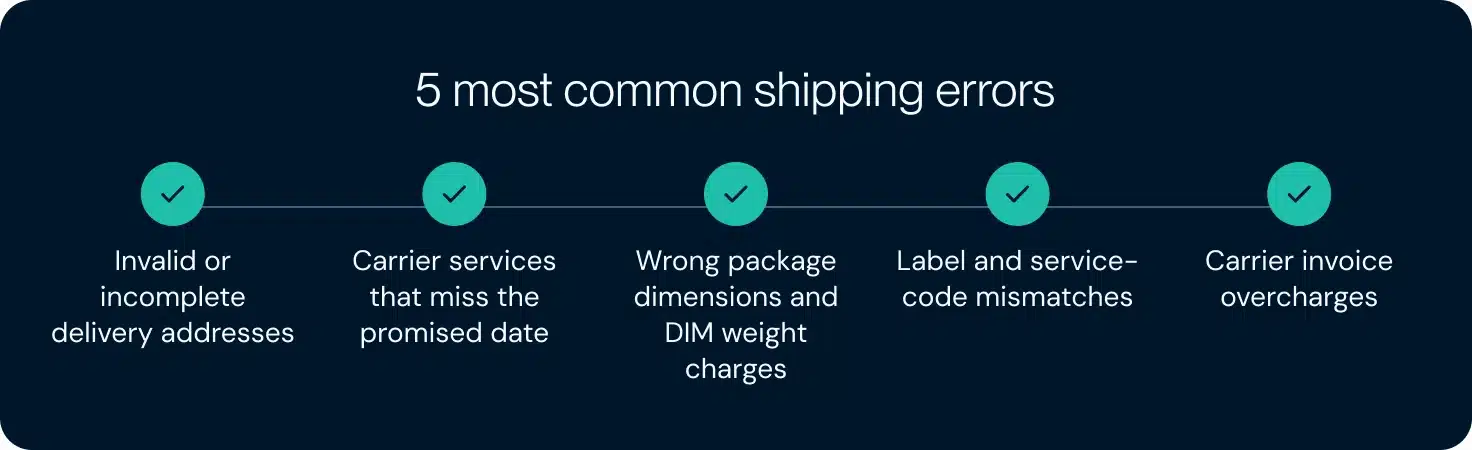
The most common shipping errors are invalid addresses, carrier services that miss the promised date, wrong package dimensions, label and service-code mismatches, and carrier invoice overcharges. You prevent each error by catching it at the point where it first enters the workflow, ahead of the label or the invoice.
| Shipping error | Where the error starts | How to prevent it |
|---|---|---|
| Invalid or incomplete delivery addresses | Customer entry at checkout, with typos, missing unit numbers, or mismatched ZIP codes | Address checks in the order management system (OMS) at order entry and in the warehouse management system (WMS) before labeling |
| A carrier service that misses the promised date | Static transit times from carrier service guides | Service selection based on modeled transit times by lane, origin, and recent carrier performance |
| Wrong package dimensions and dimensional (DIM) weight | Default box sizes or outdated product dimensions in item master data | Packaging optimization rules that right-size cartons, plus item dimension checks against warehouse scans |
| Label and service-code mismatches | Hardcoded carrier integrations that fall out of date after provider updates | Validation of each label response against the expected rate and service before the package leaves the dock |
| Carrier invoice overcharges | Misapplied accessorials, zone errors, and missed service commitments | Line-item reconciliation of each invoice against pre-shipment rating data |
Address validation at order entry returns a valid or invalid status, a suggested correction, and detailed error codes. Your OMS flags and corrects a bad entry before the order reaches the warehouse, which avoids correction fees and reshipment costs.
Invoice errors need a separate control. Automated parcel invoice auditing validates rates, labels, scans, and invoices at each stage of the shipment lifecycle, then approves matching charges and disputes the rest with root-cause detail.
How do I scale shipping operations for high order volume?
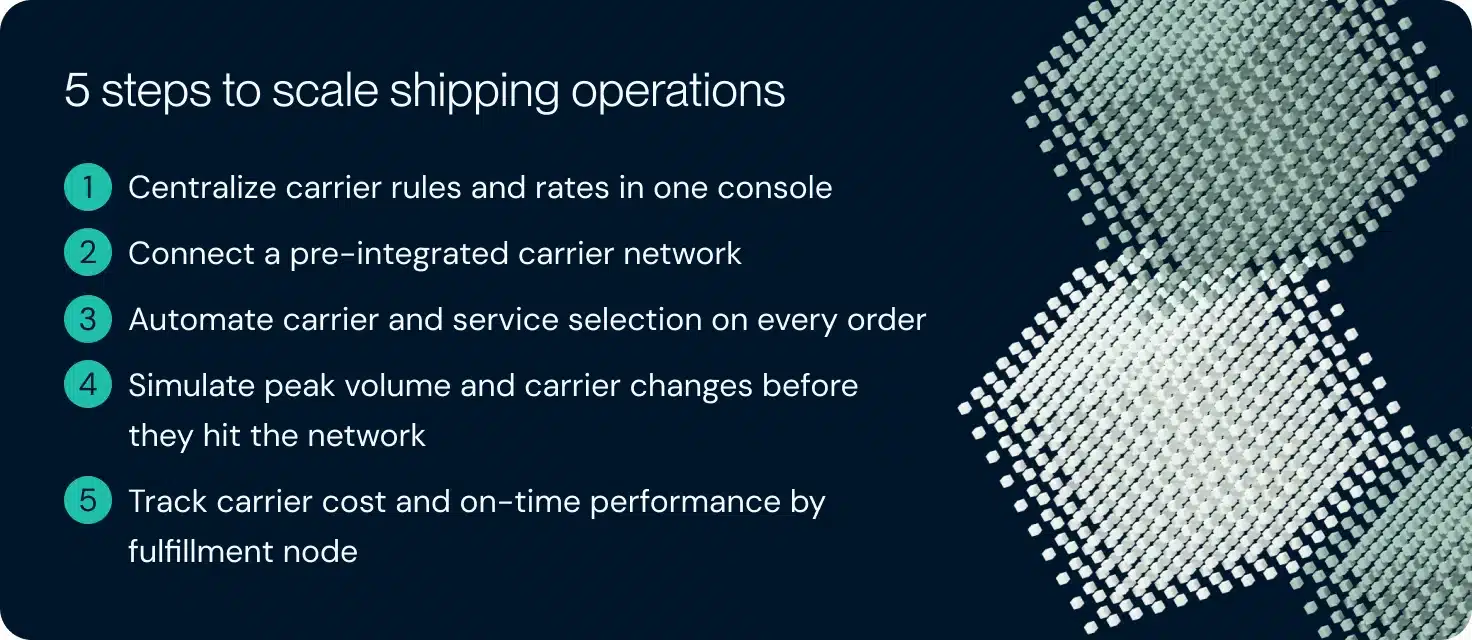
You scale shipping operations for high order volume by centralizing carrier rules, connecting carriers once, automating every selection, testing changes before peak, and measuring results by node. Each step removes a manual decision that slows parcel teams as orders grow.
According to the U.S. Census Bureau’s Quarterly Retail E-Commerce Sales report, retail ecommerce sales reached $340.2 billion in the second quarter of 2026 on a seasonally adjusted basis, up 12.2% from the second quarter of 2025, while total retail sales grew 6.7%. A parcel network sized for last year’s orders absorbs double-digit growth only when carrier decisions run automatically, order by order.
We recommend these steps:
1. Centralize carrier rules and rates in one console
A centralized shipping platform gives operators one interface for carriers, business rules, rate cards, and performance data. Teams stop logging into a separate portal for each provider, and rule changes take hours with no IT or vendor ticket.
Centralized rules apply the same logic across every origin, tenant, or brand. One warehouse no longer runs outdated carrier preferences while the rest of the network follows current contracts.
2. Connect a pre-integrated carrier network
Each custom carrier integration takes engineering time to build, to certify for labels, and to maintain through application programming interface (API) changes. A pre-integrated carrier network lets you add national, regional, and same-day providers through configuration.
More connected carriers give your selection logic more options in dense metros and during periods when a national carrier caps your volume.
3. Automate carrier and service selection on every order
Shipping automation software evaluates eligibility, delivery window, fully loaded cost, and volume commitments for each package in milliseconds. Your team sets the rules and thresholds, and the platform applies them to every order at peak throughput.
Volume balancing inside the carrier selection decision steers packages across carriers to hit each carrier’s minimum commitment.
4. Simulate peak volume and carrier changes before they hit the network
A shipping simulation reruns your historical orders through a proposed carrier mix, rate sheet, or distribution center. Operators test each change against last year’s peak and see projected parcel spend, transit speed, and on-time rate before signing a contract or updating a rule.
Run your own what-if scenarios with Shipium Simulation.
5. Track carrier cost and on-time performance by fulfillment node
Network-wide averages hide node-level problems. Split your shipping analytics by fulfillment node and carrier to see which warehouse is falling behind. A warehouse with rising cost per package or more late deliveries points to a carrier mix or pickup cutoff that needs to change. Recheck node-level cost and on-time results after every rate increase, carrier change, or peak season, then update carrier rules wherever a provider misses its target.
Run shipping and logistics management at scale with Shipium
Shipium runs shipping and logistics management on one platform, with carrier selection, delivery dates, address validation, audit, and network control sharing the same shipment data.
Our Shipping Management System evaluates each package against your carrier contracts, service commitments, true cost, and rules before a label prints, then executes the rate, label, and manifest.
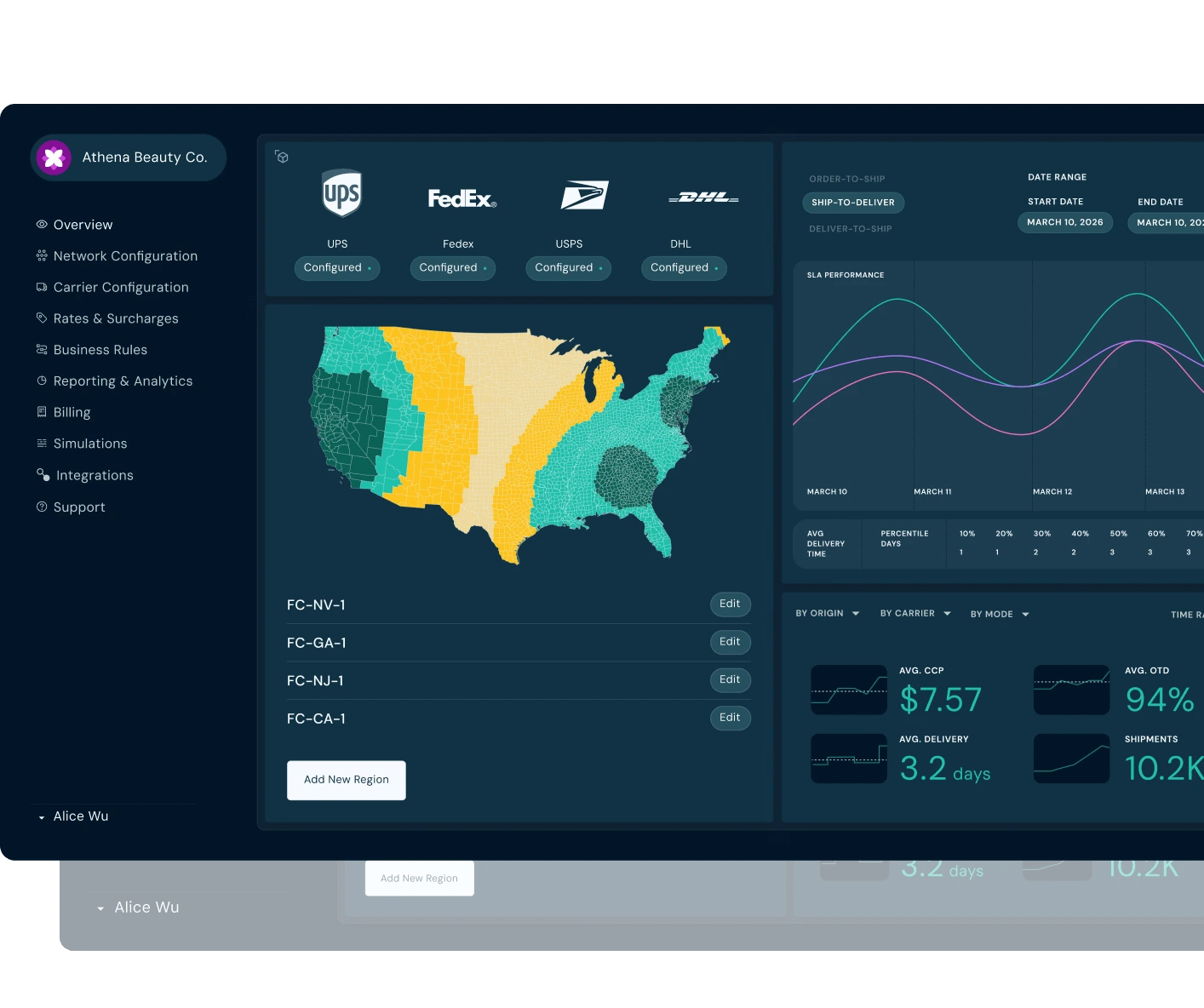
With Shipium, you get:
- Rating Engine: Automated carrier and service choices that hit delivery dates while using more ground services. Shipium customers see 12% savings on average.
- Delivery Promise: Machine learning models account for network details, carrier performance, and macro conditions to inform exact delivery dates at checkout.
- Address Validation: Your OMS or WMS calls one API to confirm deliverability before a label exists.
- Always-On Audit: Shipium flags rate, label, and invoice discrepancies as they occur, ahead of payment.
- Console: Your team manages the whole network from a single interface.
Book a demo to see how Shipium can help you manage your shipping and logistics operations.